
A practical guide to what the Unified Namespace is, how it fits into the industrial data architecture, and how to design one that can scale from a production line to a global manufacturing enterprise.
A Unified Namespace (UNS) is a shared, event-driven operational data layer that gives applications, systems, people and AI a consistent way to discover and consume the current state and meaningful events of manufacturing operations.
The Unified Namespace is best understood as a shared operational view of what is happening across manufacturing right now. It gives systems a common place to publish current state, meaningful events, production context and other operational information without creating a dedicated integration for every consumer.
In a conventional architecture, each dashboard, MES, analytics application or enterprise platform may need to connect directly to the systems that own the data it needs. As the number of producers and consumers grows, those connections multiply and the integration layer becomes increasingly difficult to change.
A UNS changes that pattern. Producers publish information once into a common, event-driven data space. Authorized consumers discover and subscribe to the information they need. The producer does not need to know who will use the data, and the consumer does not need a dedicated connection back to every PLC, SCADA system, historian or MES.
The Unified Namespace is not the entire industrial data architecture. Its primary role is to make trusted operational information continuously available through a common real-time interface.
Manufacturing data is spread across controllers, SCADA systems, DCS platforms, historians, MES applications, databases and specialist operational systems. Every one of these systems may expose different protocols, identities, data structures and naming conventions.
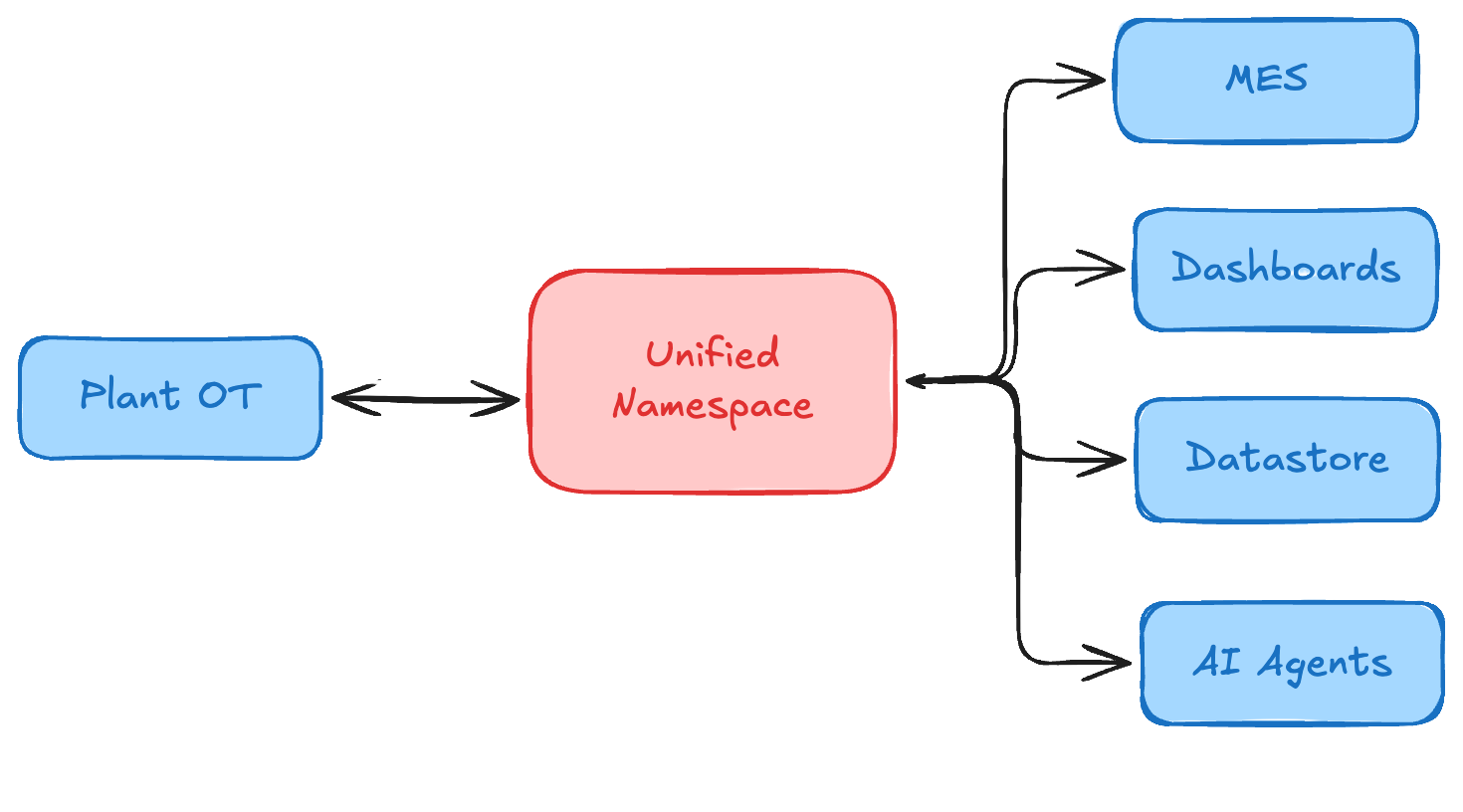
Collect, contextualize and publish once; allow many consumers to reuse the same operational information.
The architectural benefit is reuse. If an equipment identity, production event or process value has already been collected, contextualized and exposed through the shared foundation, another consumer can subscribe to it without rebuilding the same plant integration.
A typical UNS uses MQTT publish/subscribe as the transport mechanism. Equipment, edge applications and operational systems publish information beneath predictable topic paths. The MQTT broker distributes changes to authorized subscribers, while retained messages can expose selected last-known values for rapid discovery and current-state reconstruction.
What is true now: equipment state, active work order, current KPI, recipe, mode or setpoint.
What happened: BatchStarted, WorkOrderActivated, EquipmentFaulted, QualityHoldPlaced.
Observed values such as pressure, temperature, speed, energy use and quality measurements.
Stable descriptive information about equipment, metrics, capabilities and other operational entities.
The UNS therefore contains more than raw telemetry. Its value comes from providing a structured, discoverable operational representation that software can consume predictably.
One of the easiest mistakes is to make the Unified Namespace responsible for everything. A stronger architecture separates the roles of data preparation, real-time distribution, historical persistence and semantic understanding.
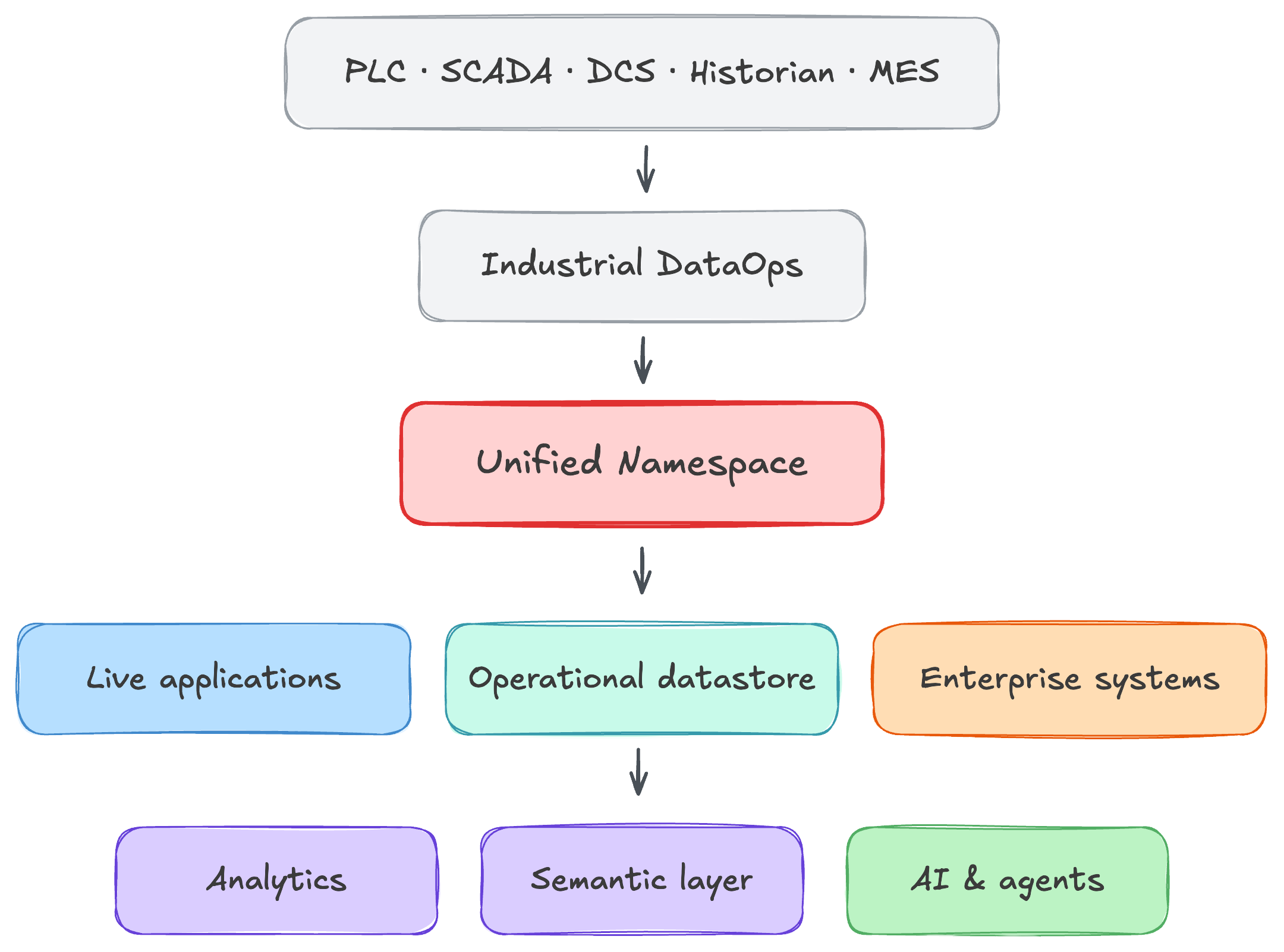
Industrial DataOps extracts, contextualizes, transforms, validates and maps source data.
The Unified Namespace distributes trusted current state and operational events through a common real-time interface.
The operational datastore preserves history for traceability, analytics, machine learning and evidence.
The semantic layer describes what entities mean, how they relate and which rules apply.
The MQTT topic hierarchy should not be treated as a decorative tree that happens to resemble the factory. Once applications depend on it, the namespace becomes a machine-consumable addressing contract. Consumers should be able to predict where a class of information will appear without knowing every topic beforehand.
{namespaceVersion}/{enterprise}/{site}/{area}/{workCenter}/{domain}/{messageCategory}/{specific}gv1.0/GlobalIndustries/Munich/ProductionArea/Line1/Production/Events/WorkOrderActivatedA consistent grammar makes useful wildcard subscriptions possible. A central application interested in production events can subscribe to a class of information rather than maintain a catalogue of every individual event topic.
gv1.0/+/+/+/+/Production/Events/#A predictable topic tells a consumer where information lives and what class it belongs to. The payload defines how that information is structured and understood. Both sides of the contract need consistency.
{
  "schemaVersion": "1.0.0",
  "eventType": "WorkOrderActivated",
  "eventId": "EVT-7c2b4",
  "timestamp": 1787722800000,
  "workOrderId": "WO-123",
  "equipmentId": "EQ-MUC-MX004",
  "workCenterId": "WC-MUC-200-L1",
  "productCode": "PRD-441",
  "source": "MES-MUC-01"
}
Start with the information your operations actually produce and the consumers actually need. A practical model may contain a small set of reusable classes such as Metric, EquipmentDefinition, EquipmentState, Status, KPI and Event. Stable identities, timestamps, provenance and schema versions give those messages enough structure to remain useful outside their original source system.
Not every technical change deserves to become an event. The strongest event models capture meaningful occurrences in the lifecycle of operational entities: a batch starts, a work order activates, an equipment fault occurs, quality places material on hold, or a production phase completes.
Would another application care that this occurrence happened without needing to understand the implementation details of the source system? If yes, it is a strong candidate for an operational event.
Current state tells you what is true now. Event history explains how the operation arrived there. Together, the two provide a much more useful foundation for workflows, traceability, analytics and AI.
A UNS is only as useful as the information published into it. Industrial DataOps absorbs the complexity of the underlying plant systems and prepares data before it becomes part of the shared operational interface.
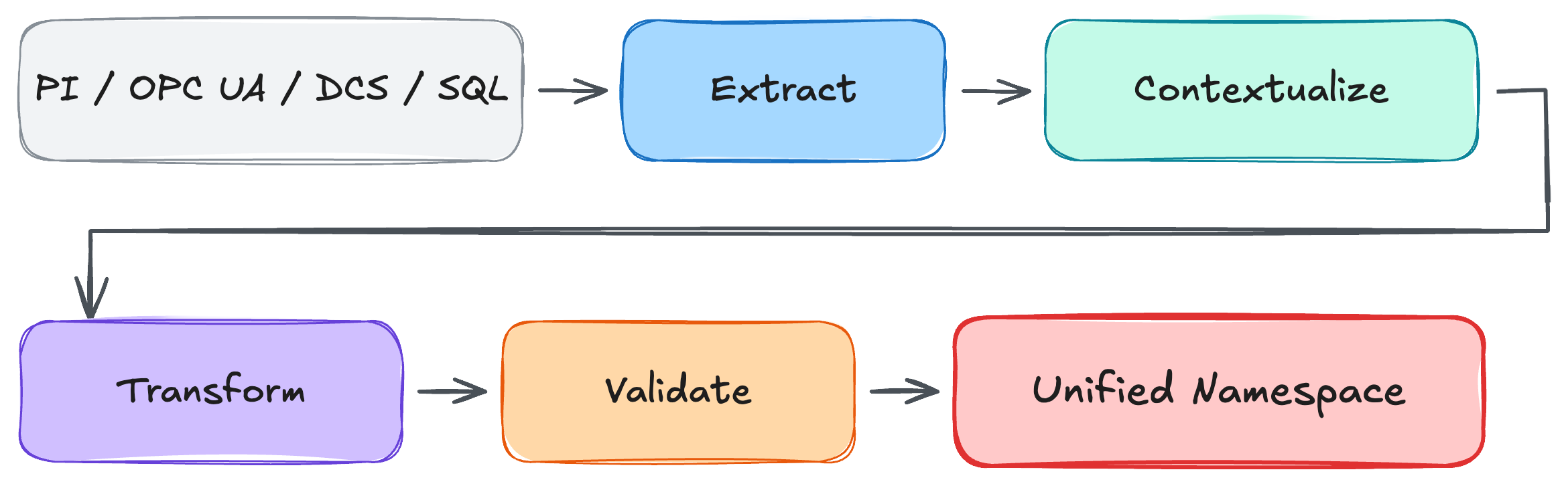
The important architectural principle is that every downstream consumer should not independently decode raw tags, proprietary data structures and local naming conventions. DataOps converts local representations into trusted enterprise information once, allowing that context to be reused across applications.
MES should be an important participant in the operational data architecture, not necessarily the gateway through which every other digital manufacturing application must access plant information.
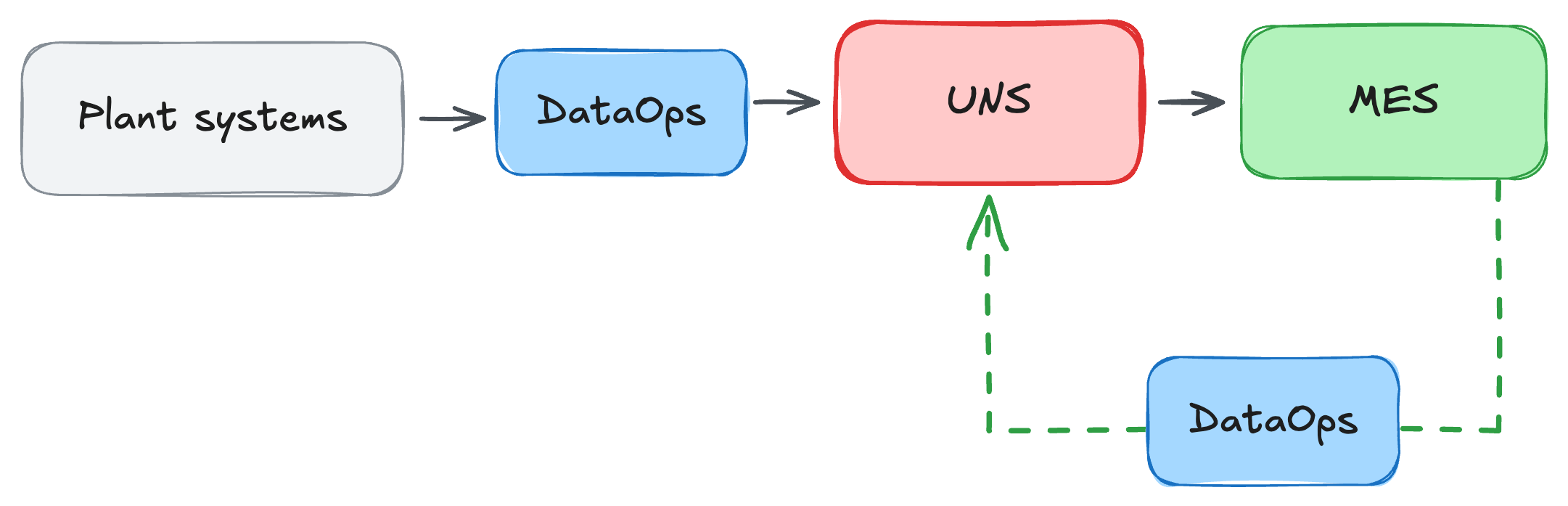
MES publishes execution context and events back into the UNS.
MES can consume contextualized equipment and process information from the shared foundation, while publishing the execution context it uniquely owns: work orders, batches, operations, quality holds and production completion events. Other applications can subscribe without creating dedicated interfaces back into MES.
The Unified Namespace is optimized around live operational distribution and event-driven interaction. Historical analytics requires a different capability: durable, queryable storage that can retain large volumes of time-series measurements, state transitions, events and contextual records.
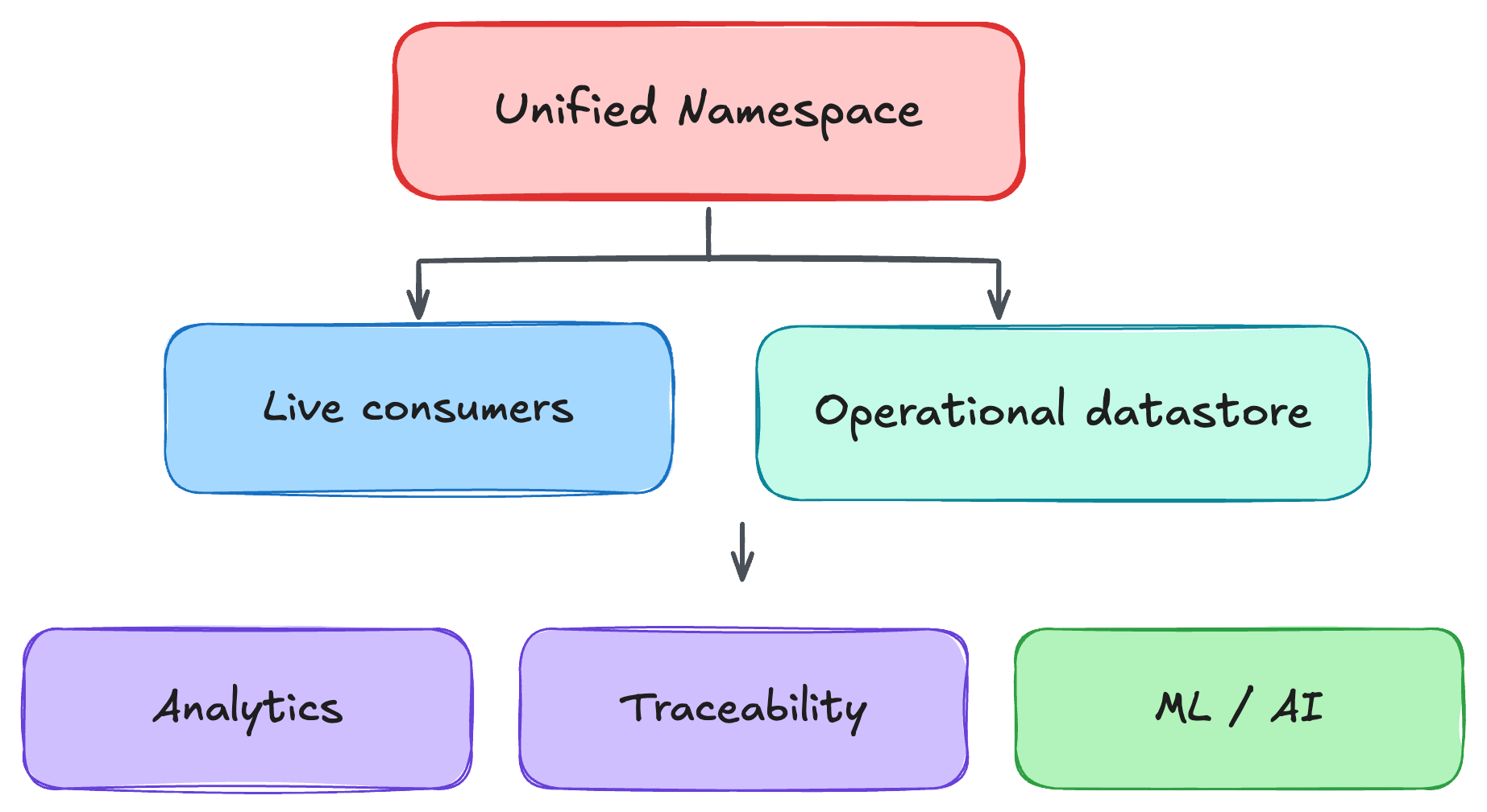
The two layers complement each other. The UNS exposes what is happening now. The datastore creates the evidence base needed to ask what happened, compare periods, reconstruct conditions, train models and support root-cause analysis.
A hierarchy is useful for addressing information, but manufacturing reality contains relationships that do not fit neatly into a single tree. A semantic layer or knowledge graph can represent equipment classes, material relationships, capabilities, process participation, locations, roles and other connections that cut across the namespace hierarchy.

Stable identifiers are therefore important beyond simple integration. They provide the bridge through which live operational information, historical records and semantic models can refer to the same real-world entities.
AI agents operating around manufacturing need more than documents and database queries. Many use cases depend on recognizing that something has just changed: a batch has started, a line has faulted, a work order has completed or a quality hold has been placed.
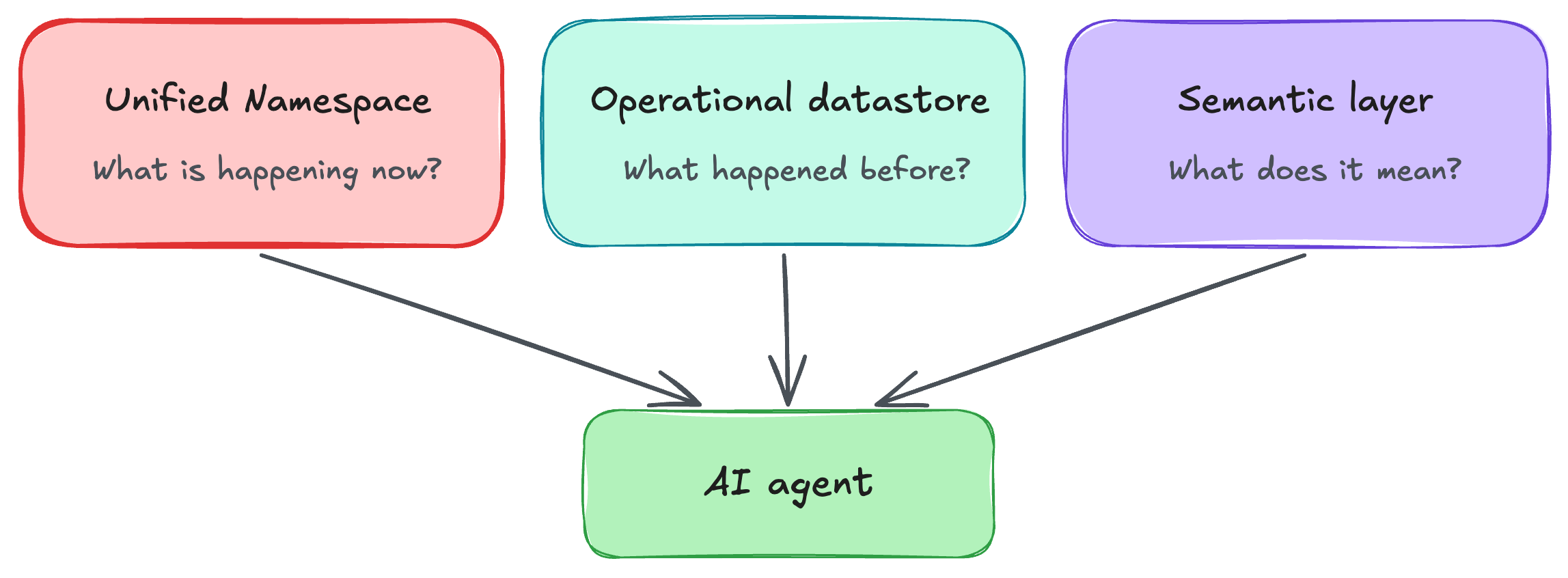
A strong agent access architecture can therefore combine real-time subscriptions to the UNS with historical queries and semantic context. The agent no longer needs to understand the proprietary interfaces of every underlying plant system before it can establish operational context.
Enterprise consistency does not require every plant to use identical controllers, historians, MES products or data structures. The better goal is to standardize the information contracts exposed at the shared data-foundation boundary while allowing sites to retain the source technologies that fit their operations.
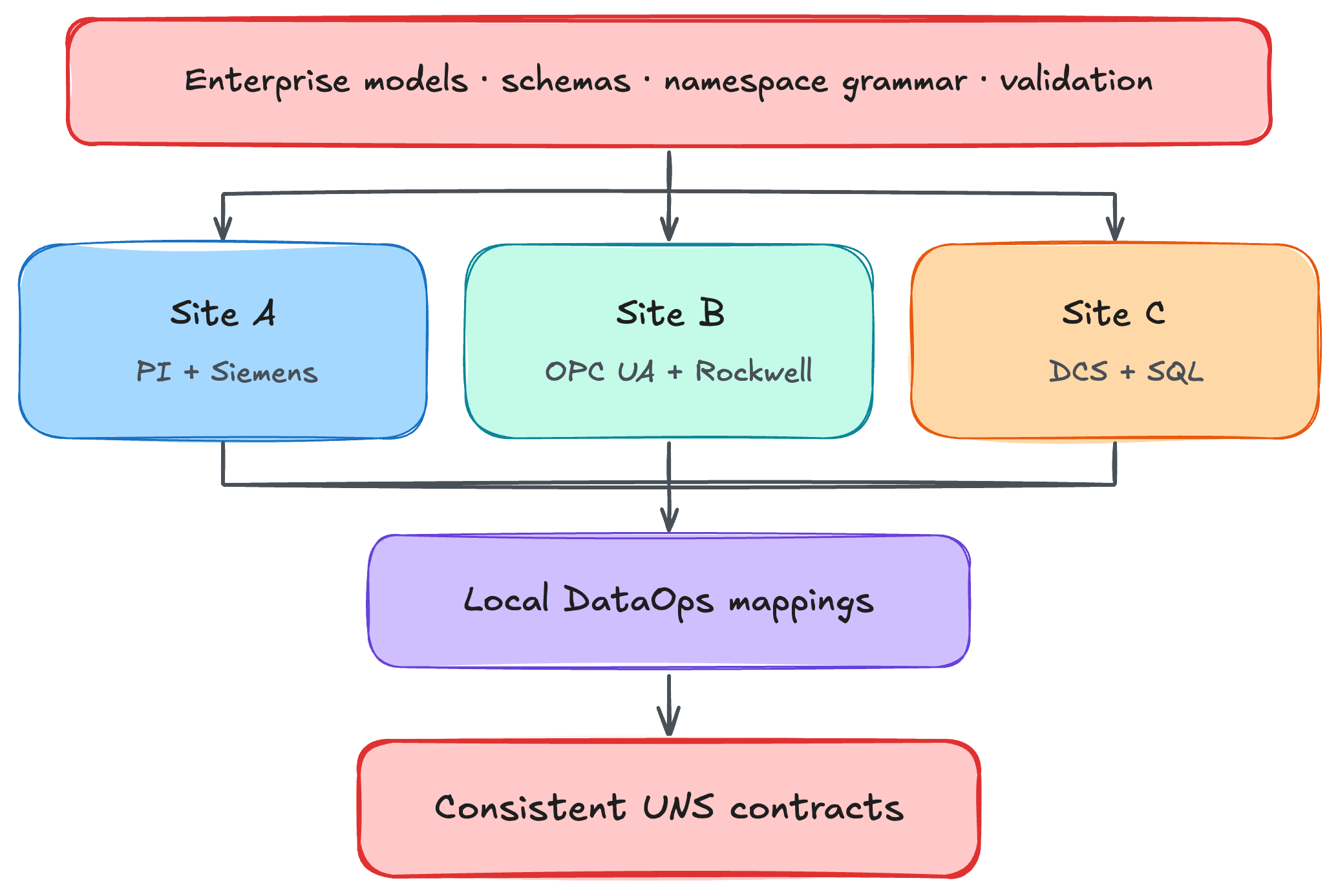
Namespace grammar, enterprise models, schemas, event semantics, validation rules, versioning and reusable pipeline patterns.
Source connectivity, tag mapping, protocol translation, plant-specific context and deployment details.
MQTT is the transport. The namespace, information models, governance and operational semantics are what make the environment usable at scale.
Moving source-system complexity into MQTT simply creates a new place for consumers to solve the same integration problem.
A scalable namespace should reflect stable operational information, not the temporary architecture of individual applications and vendors.
Live distribution and historical query are different workloads. Use the right storage layer for durable history.
Local flexibility should exist in source mapping, not in the basic addressing contract presented to enterprise consumers.
Once software depends on topics and payloads, those contracts need the same discipline applied to APIs.
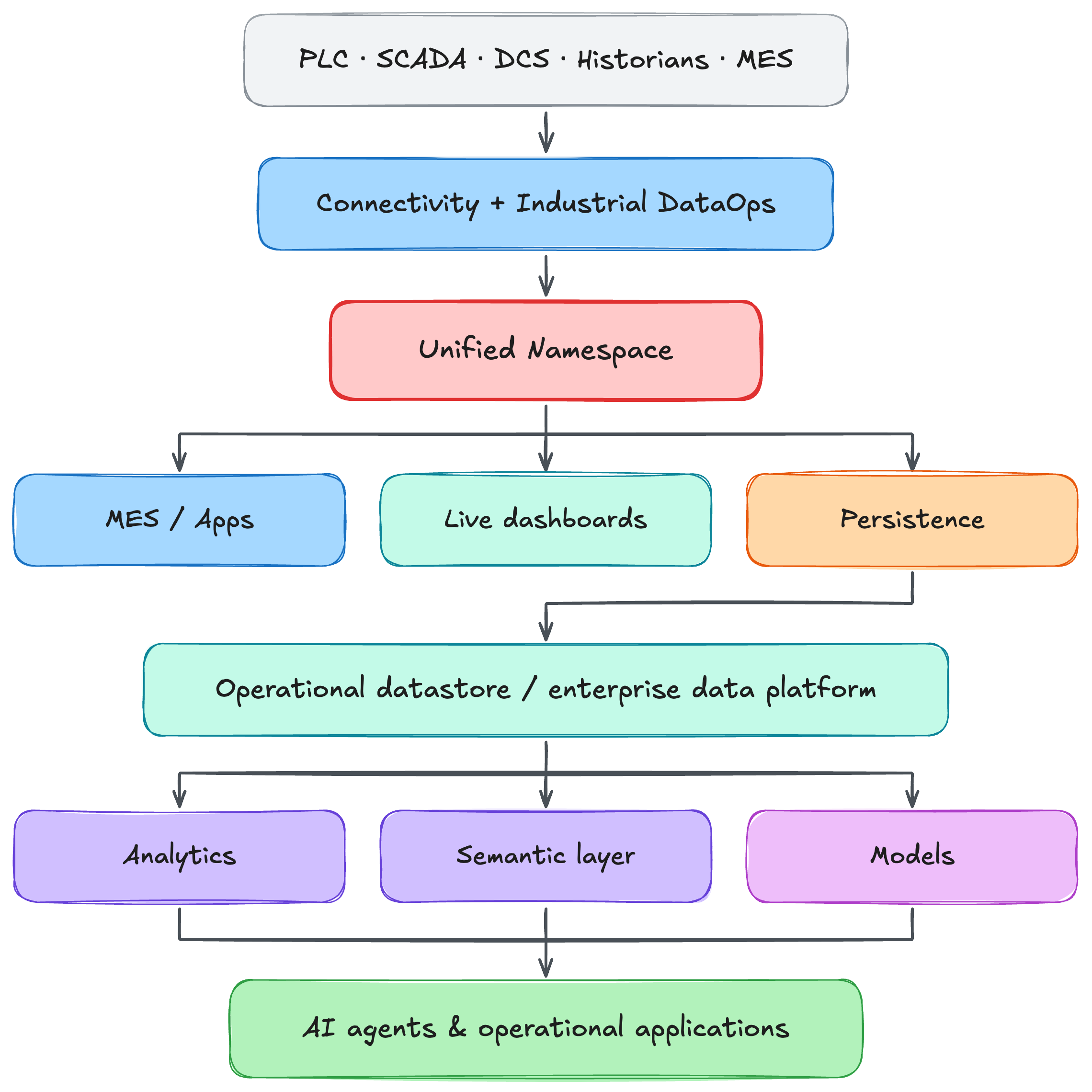
The architecture below separates the major responsibilities while allowing the same prepared operational context to be reused across real-time applications, historical systems, enterprise platforms and AI.
Do not begin by trying to model an entire enterprise. Start with one operational use case and use it to establish the first reusable contracts.
Pick a problem with clear consumers and measurable value.
Acquire only the operational information required for that use case.
Resolve equipment, work centers, sites, orders and other relevant entities.
Establish a reusable namespace grammar, information classes and schemas.
Extract, transform, contextualize and validate local source information.
Expose current state and meaningful events through predictable addresses.
Prove that the foundation can support MES, dashboards, persistence or analytics without rebuilding source integrations.
Capture what can be reused at the next line or plant before expanding scope.
Use this page as the overview. The guides below go deeper into individual design, implementation and architecture questions.

The leading IIoT & AI educational platform for digital manufacturing teams