
Building the Data Foundation for MES with DataOps and a Unified Namespace
How DataOps and a Unified Namespace create a reusable data foundation that simplifies MES integration while supporting analytics, applications, and AI.

For many manufacturers, the digital manufacturing journey begins with MES.
That is understandable. MES sits at the center of production execution. It connects planning with what is happening on the plant floor, manages work orders and production workflows, tracks material and quality information, and provides the operational structure needed to run manufacturing processes consistently.
But there is a broader architectural question that often emerges once an MES program begins to scale.
What happens when the organization also wants real-time production dashboards, custom applications, advanced analytics, AI agents, predictive maintenance, energy optimization, or enterprise-wide operational visibility?
If MES is the primary integration point for plant data, those initiatives can quickly become dependent on the MES architecture, its interfaces, its data model, and its deployment schedule.
This is where many manufacturers discover that digital manufacturing is larger than MES. What begins as an MES-centered initiative gradually expands to include custom applications, analytics, AI, and enterprise-wide data requirements, creating the need for a common data foundation that can support MES alongside these broader digital manufacturing capabilities.
Instead of building the digital manufacturing architecture around MES, the goal becomes to establish a shared operational data foundation in which MES can participate alongside other applications.
It is an important shift in thinking.
Instead of building the digital manufacturing architecture around MES, they are considering a shared operational data foundation that MES can participate in alongside other applications.
This article looks at why that architectural change matters and how Industrial DataOps and a Unified Namespace can provide the foundation.
Digital Manufacturing Is Larger Than MES
MES remains a critical part of the manufacturing architecture. The challenge begins when it is expected to serve not only as the execution system, but also as the primary integration and data layer for every other digital manufacturing initiative.
A typical architecture may start simply, but as new requirements emerge, more applications and consumers are gradually connected through the MES layer.
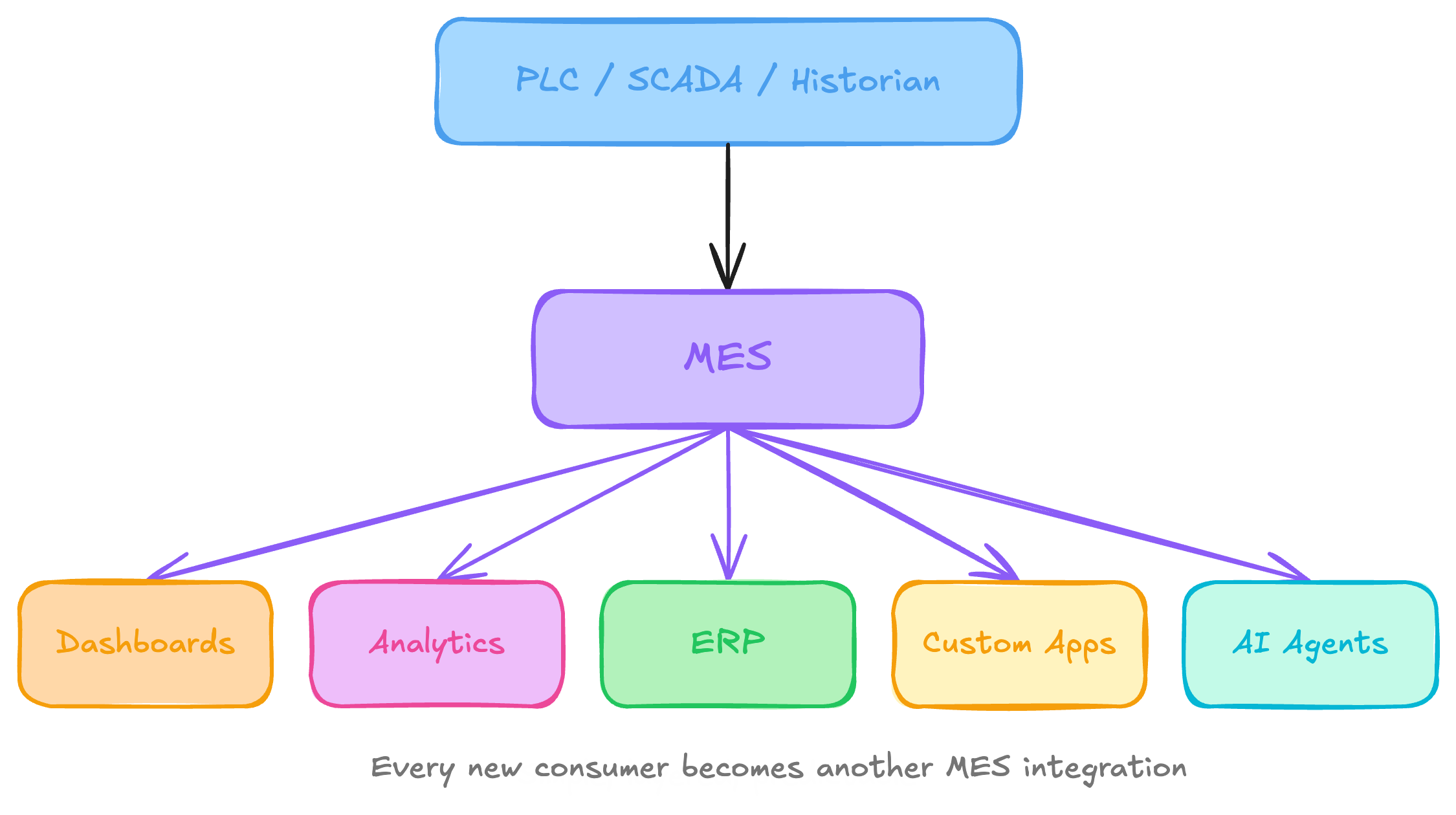
At a single plant, this may appear manageable. Across ten, twenty, or fifty manufacturing sites, the weaknesses become much more visible.
Different plants may have different MES products or versions. Some plants may not yet have MES at all. Others may use local historians, SCADA systems, databases, or specialized production applications that contain information needed by enterprise applications.
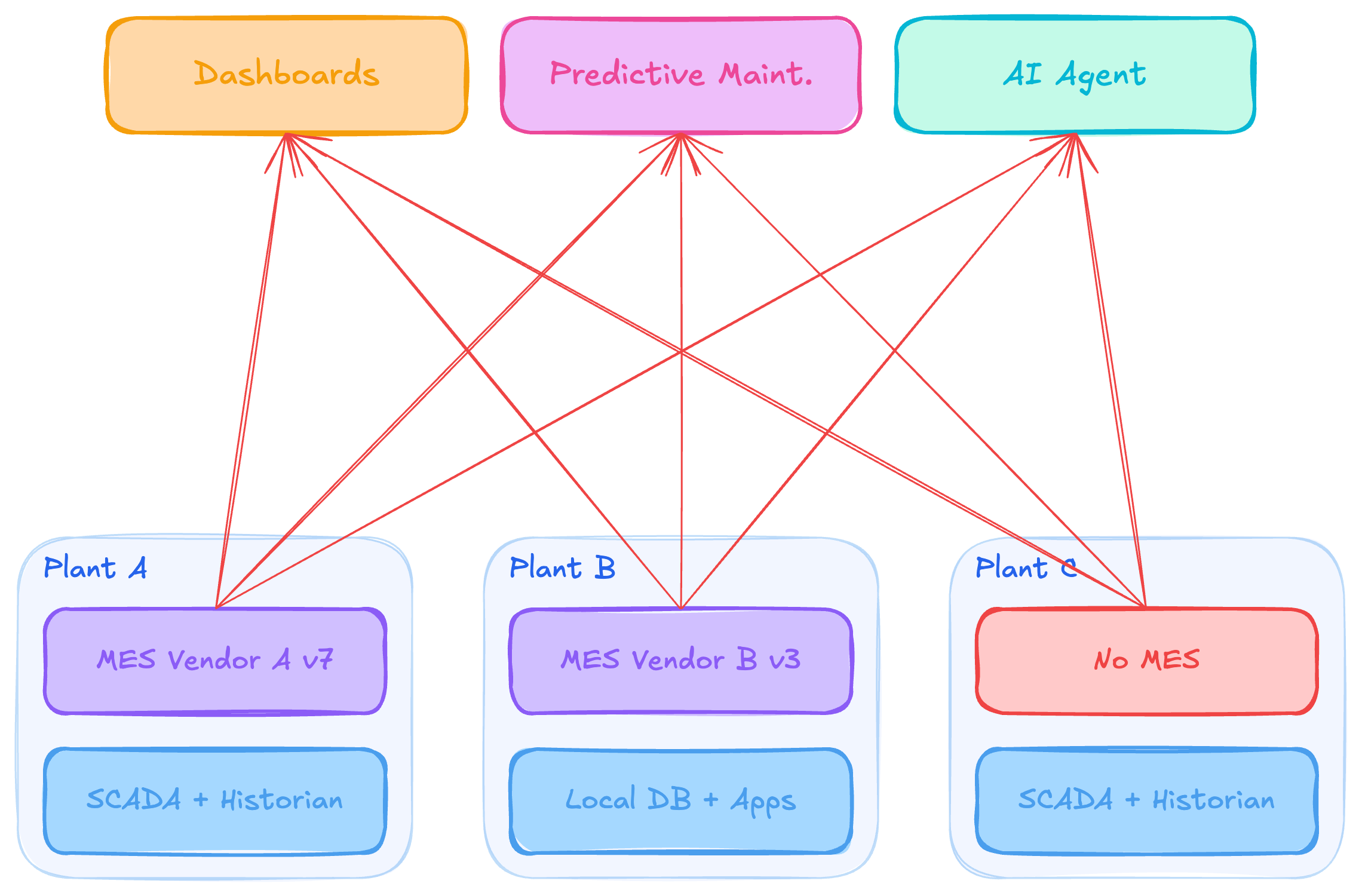
A dashboard requiring machine status should not necessarily depend on an MES implementation. Neither should a predictive maintenance application.
An AI agent looking for production conditions should not have to understand the proprietary interfaces of several MES products before it can discover what is happening in the factory.
When every digital initiative starts by asking how to retrieve operational data from MES, MES has effectively become the manufacturing data platform.
That is a responsibility it was never primarily designed to carry.
Move the Data Foundation Below the Application Layer
A more scalable architecture separates the operational data foundation from the applications that use it.
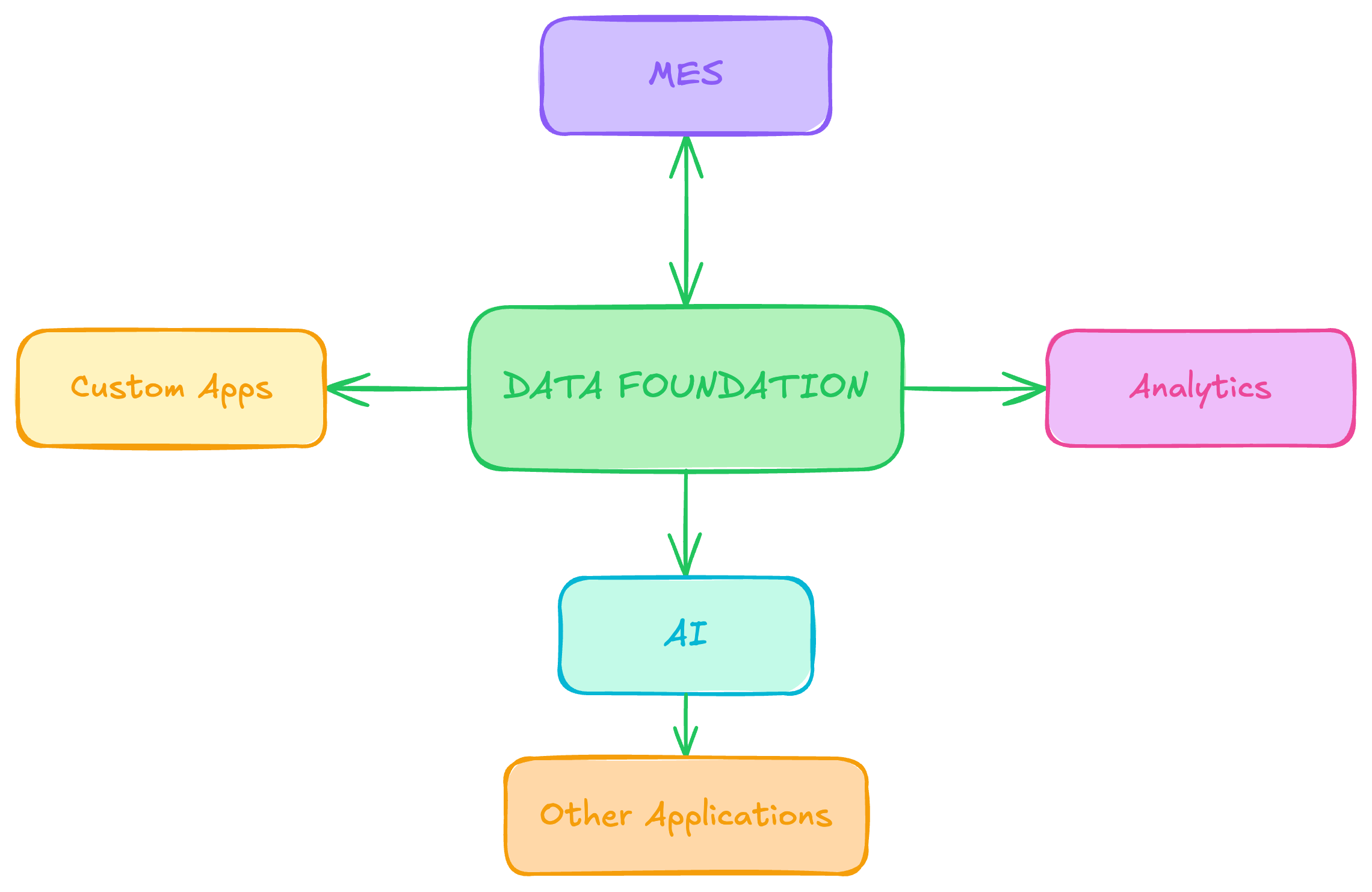
The foundation sits between the heterogeneous operational environment and the applications that need access to it.
MES becomes an important producer and consumer of operational information rather than the single gateway through which operational information must flow.
This may sound like a subtle architectural distinction, but it changes how digital manufacturing systems are designed.
If Line 1 equipment data has already been collected, contextualized, standardized, and made available through a common foundation, it can be reused across the digital manufacturing architecture.
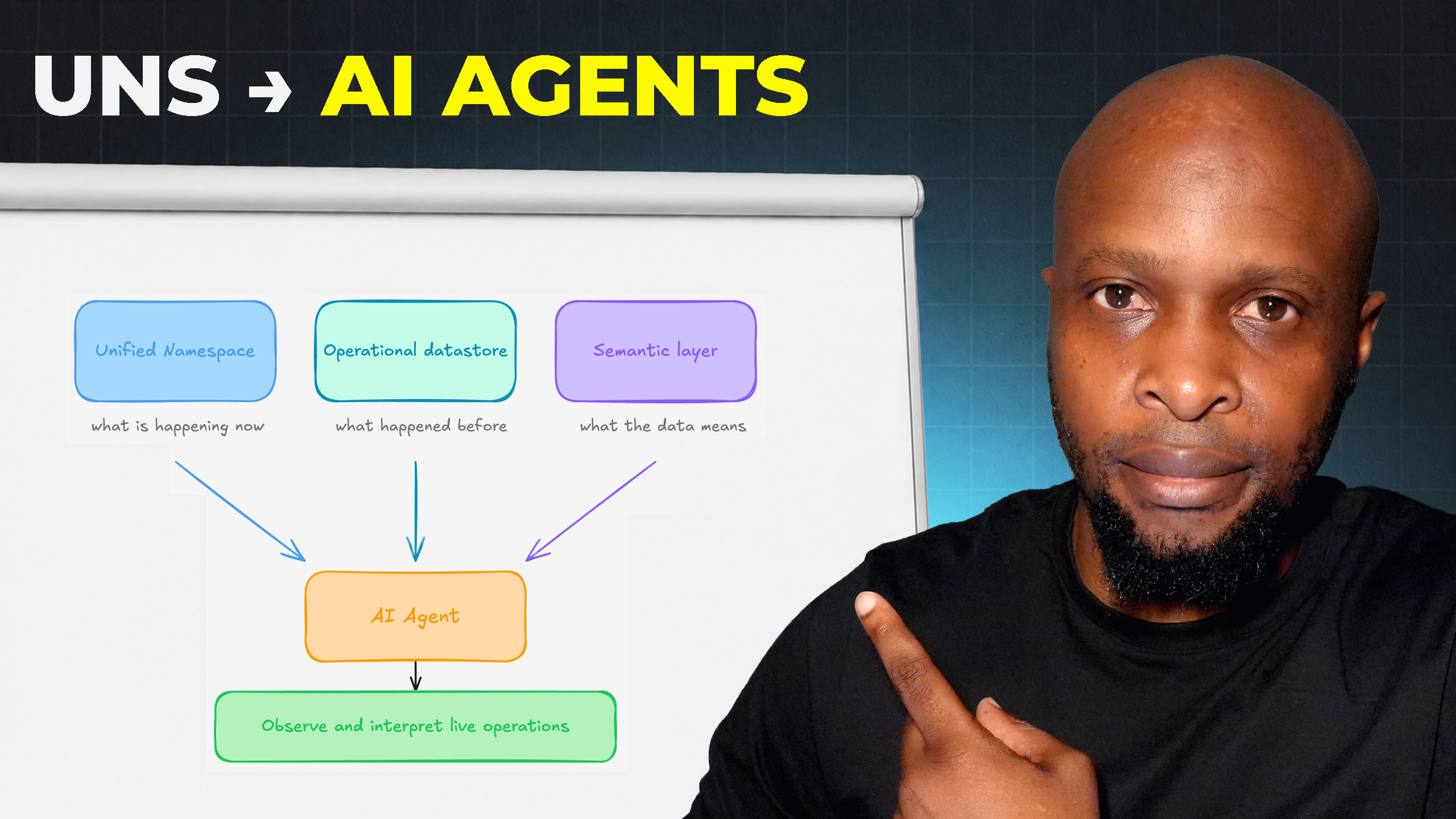
The MES can consume it for execution, a production dashboard can use it for real-time visibility, an operational datastore can persist it for historical analysis, a maintenance application can respond to relevant conditions, and an AI agent can use the same context to support reasoning and decision-making.
Instead of rebuilding the same plant integration for each application, the work is done once at the foundation layer and made available to multiple consumers.
This is the data foundation that Industrial DataOps and a Unified Namespace can provide together: one that prepares, contextualizes, and makes operational data consistently available for reuse across MES, applications, analytics, and AI.
The Role of Industrial DataOps in MES Integration
Let's make this more concrete.
Suppose an MES needs information from a DCS database, an OPC UA server, and a historian. Without a shared DataOps layer, much of the connectivity, transformation, contextualization, and mapping logic required to understand those systems may be implemented specifically for the MES.
With Industrial DataOps, that preparation happens upstream.
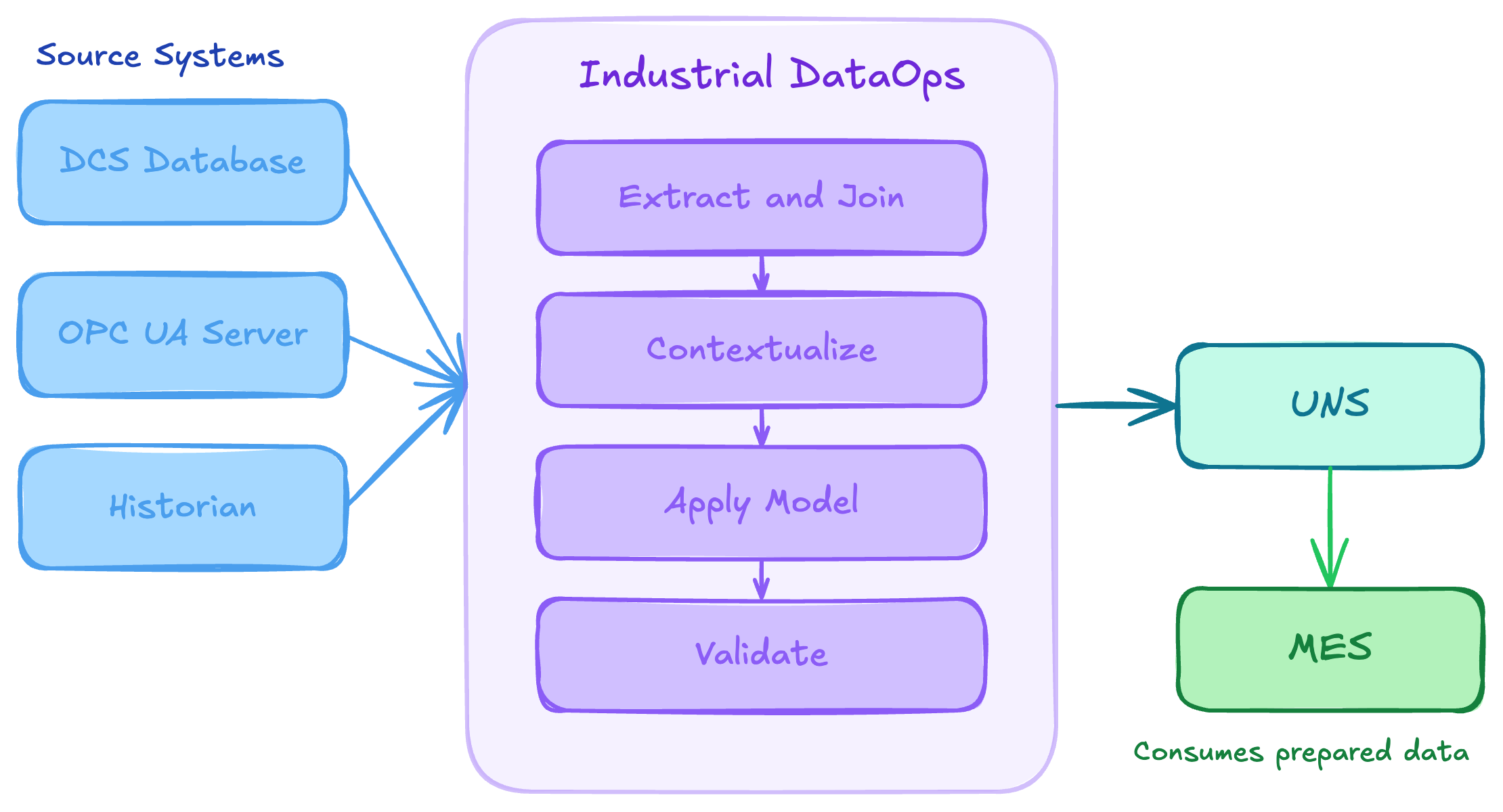
Several important activities are taking place within this layer.
1. Extract Operational Data From Heterogeneous Sources
Industrial DataOps provides the connectivity needed to acquire information from the systems where it originates. Depending on the plant, these sources might include OPC UA servers, industrial databases, DCS tables, historians, PLC interfaces, APIs, files, and other OT systems.
Much of this connectivity can be deployed close to the source at the plant edge. Rather than requiring MES to maintain separate knowledge of every underlying system and interface, the DataOps pipelines create a boundary between vendor-specific plant systems and the common enterprise data architecture.
2. Contextualize the Data Before MES Consumes It
The information coming from OT systems often needs additional manufacturing context before MES or other applications can use it effectively.
Simple example:
TT4711.PV = 82.4
could be enriched into something more meaningful:
{
  "site": "Munich",
  "area": "Mixing",
  "workCenter": "MixingLine01",
  "equipment": "Mixer03",
  "measurement": "ProductTemperature",
  "value": 82.4,
  "unit": "degC"
}
That context does not necessarily come from a single system. Process values may originate in the PLC or DCS, equipment relationships may come from an asset model, and production context may come from ERP.
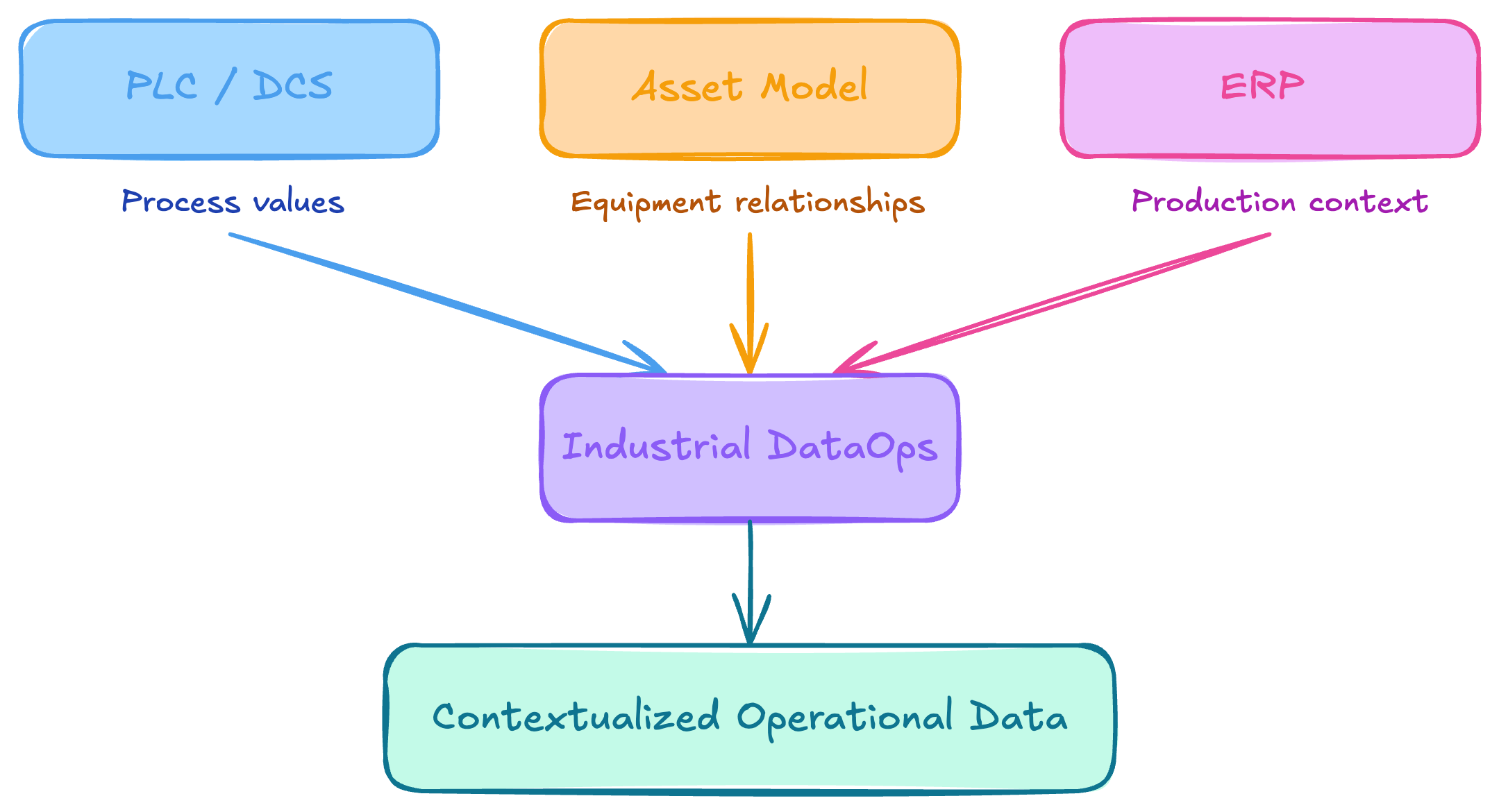
Industrial DataOps provides the layer where these sources can be brought together so that the resulting information carries the context required by downstream applications.
The important architectural shift is that this context is no longer created solely for MES. Once established in the shared data foundation, it becomes reusable infrastructure for dashboards, analytics, operational datastores, custom applications, and AI as well.
3. Transform Source Structures Into Shared Data Models
Even when plants perform similar manufacturing processes, they rarely represent equivalent equipment and data in exactly the same way.
Industrial DataOps provides the pipeline layer where these source-specific structures can be mapped into a shared information model.
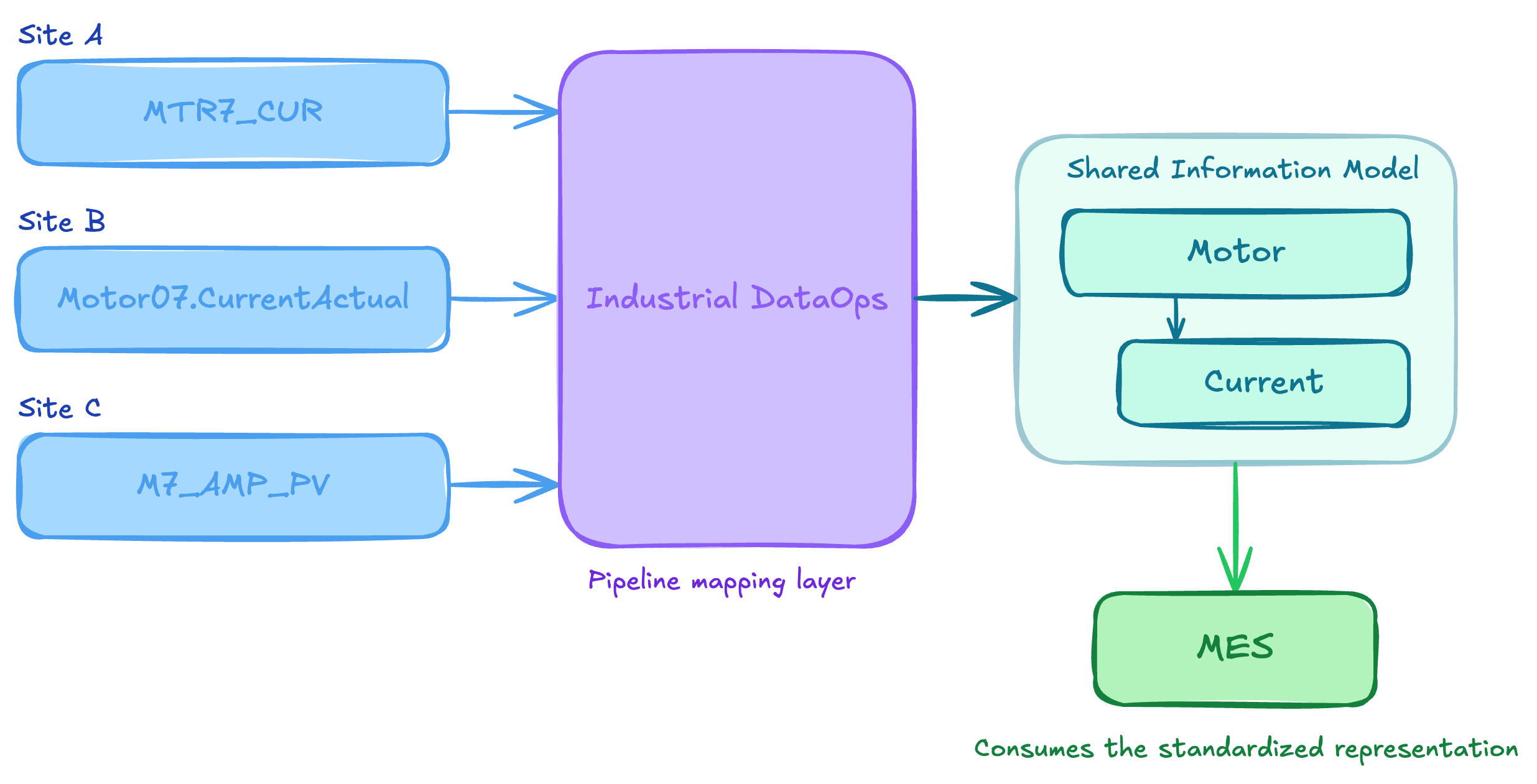
The MES therefore does not need to understand every local naming convention or source-system representation. It can consume the standardized representation exposed through the common data foundation.
This becomes particularly valuable in multi-site MES deployments, where the physical systems may remain different while the data contracts presented to MES become increasingly consistent.
4. Validate Data Before It Reaches MES
Once the organization has defined common schemas and information models, the DataOps layer can also validate information before it is published.
A production event, for example, might require:
OrderId
ProductId
EquipmentId
Timestamp
EventType
Quantity
Unit
The pipeline can verify that the required fields are present, correctly structured, and consistent with the expected schema before the event is allowed into the shared operational data layer.
This establishes a data-quality boundary before information reaches MES or any other enterprise consumer. Rather than leaving each application to independently determine whether incoming data is complete, correctly structured, and trustworthy, those expectations can begin to be enforced upstream as part of the shared foundation.
The Role of the Unified Namespace in MES Integration
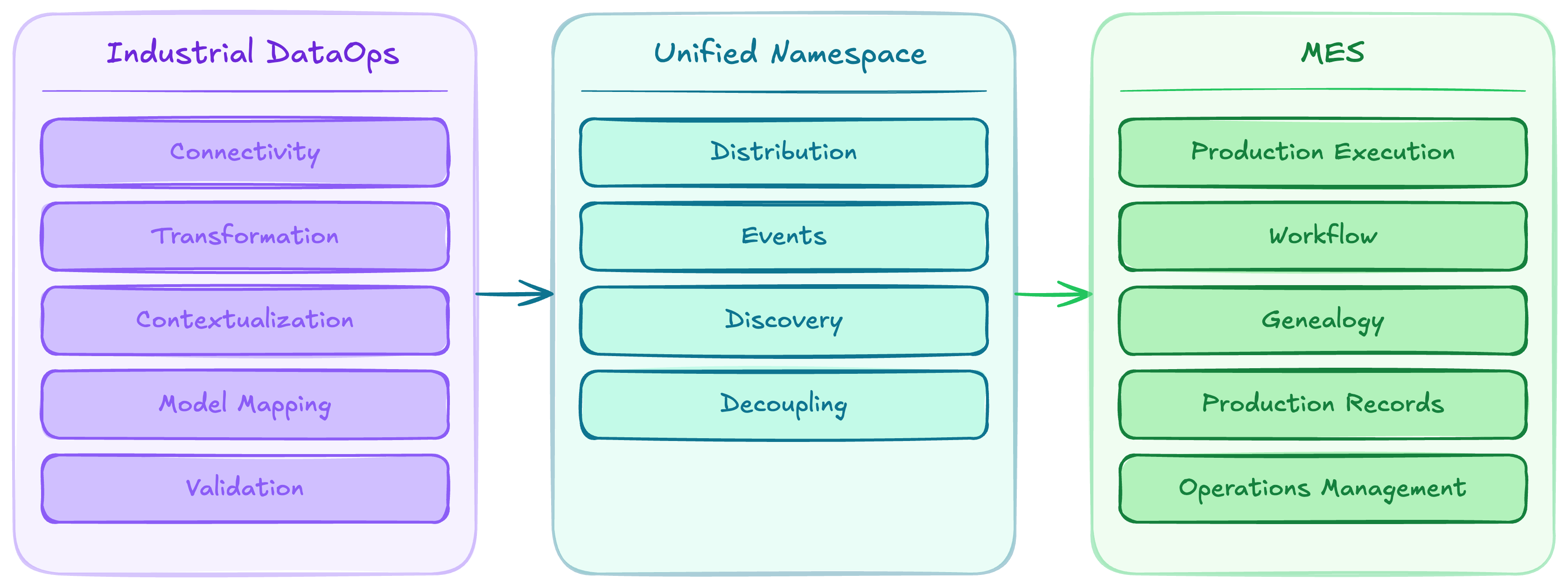
Once Industrial DataOps has prepared and validated the operational information, the next challenge is making it consistently available to MES and the other applications that need it. This is where the Unified Namespace builds on the DataOps layer.
Rather than creating a new point-to-point interface every time an application needs access to plant information, the DataOps pipelines publish the prepared information into the UNS according to agreed namespace structures and data contracts. The UNS then provides the shared, event-driven operational data space through which MES and other consumers can discover and subscribe to it.
The complete flow therefore looks like this:
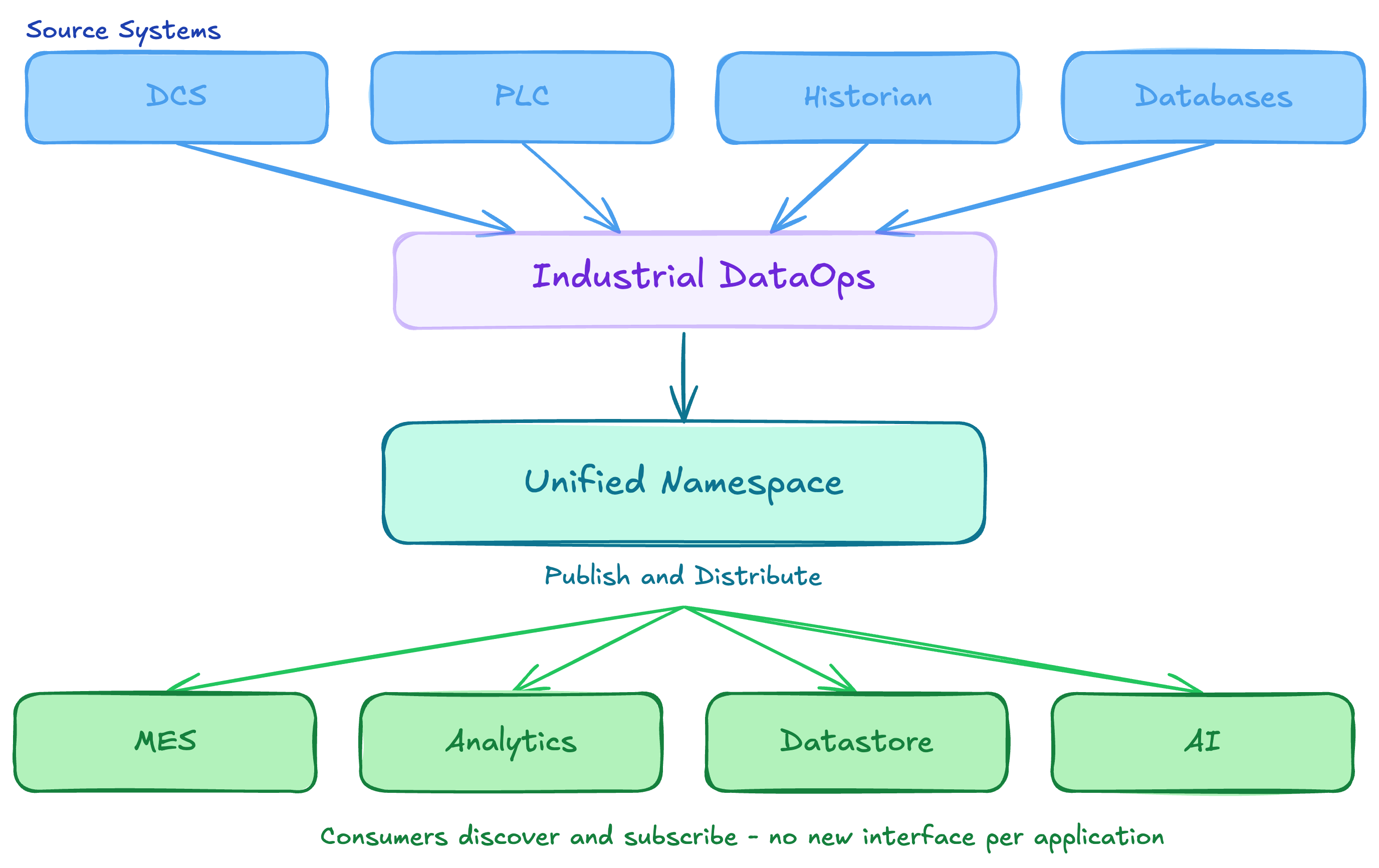
This separation of responsibilities is important. Industrial DataOps deals with the complexity of the source environment and determines how locally represented data becomes usable enterprise information. The Unified Namespace takes that prepared information and makes it continuously available through a common operational interface.
Consider a production event prepared by the DataOps layer. A local automation system may represent production completion using its own event name and identifiers, while the DataOps pipeline resolves the equipment identity, adds the manufacturing hierarchy, maps the event to the common information model, and validates it against the required schema.
Once prepared, that standardized event can be published into a predictable branch of the UNS.
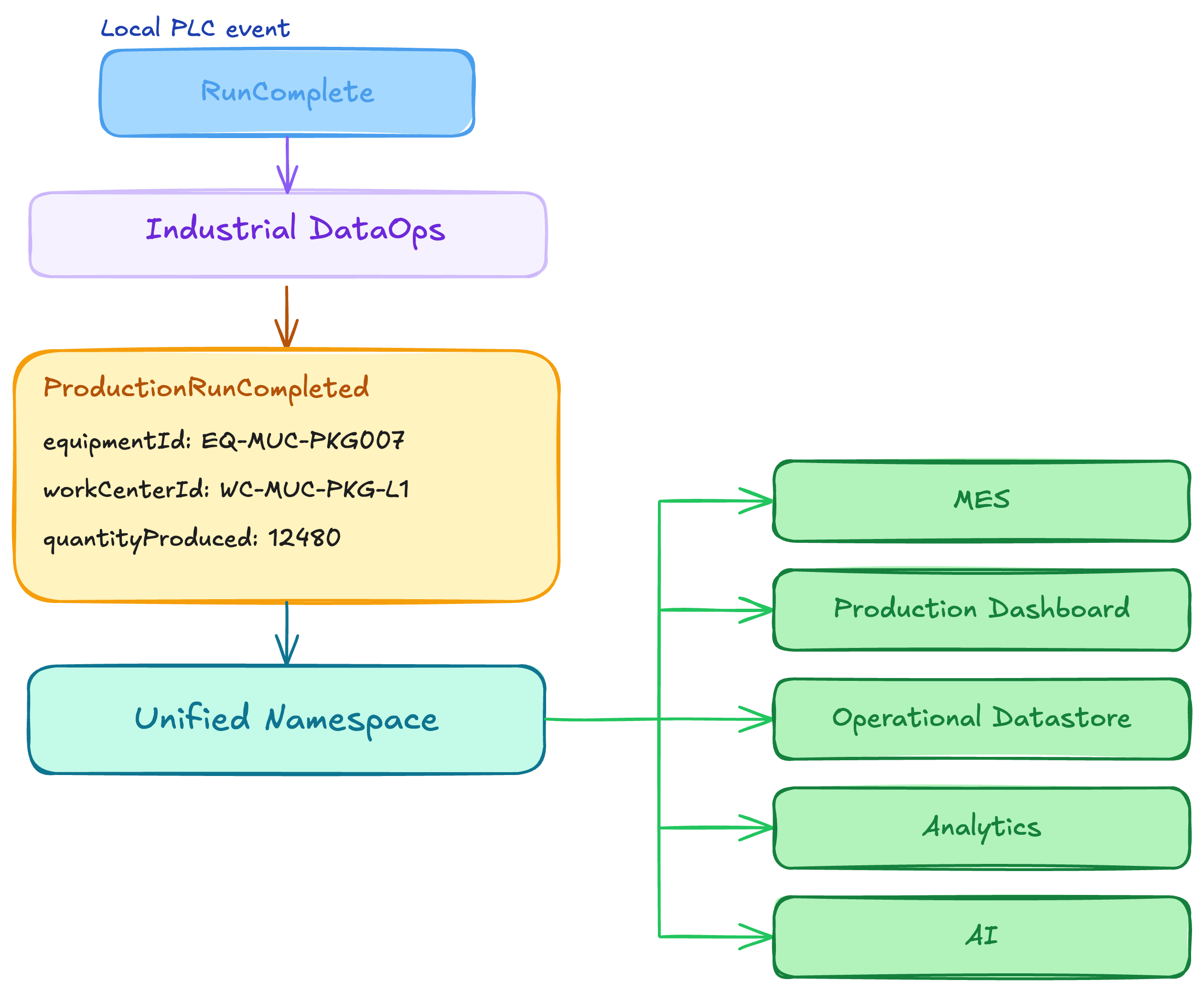
The MES therefore does not need to know that the event originally came from a particular PLC, how that PLC represented production completion, or which transformations were required to make the information usable. It subscribes to an agreed operational event whose location, structure, and meaning are already predictable.
More importantly, the DataOps work was not performed specifically for MES. Once the event is available through the UNS, the same contextualized information can be consumed by any authorized application that needs it. Adding another consumer does not require another integration back into the PLC or another implementation of the contextualization logic.
This is how the two layers combine to create the foundation: Industrial DataOps makes operational data usable, while the Unified Namespace makes that usable information consistently available and reusable across applications.
MES Should Also Publish Back Into the Unified Namespace
The flow should not be interpreted as only:
OT → DataOps → UNS → MES
MES is also an important producer of operational information. It knows which work order has been released, which product is scheduled, when execution begins, which batch is active, which operation is being performed, which equipment has been assigned, and when production has completed.
That context is valuable to the rest of the manufacturing architecture and should therefore be made available through the same common operational layer.
The relationship becomes bidirectional.
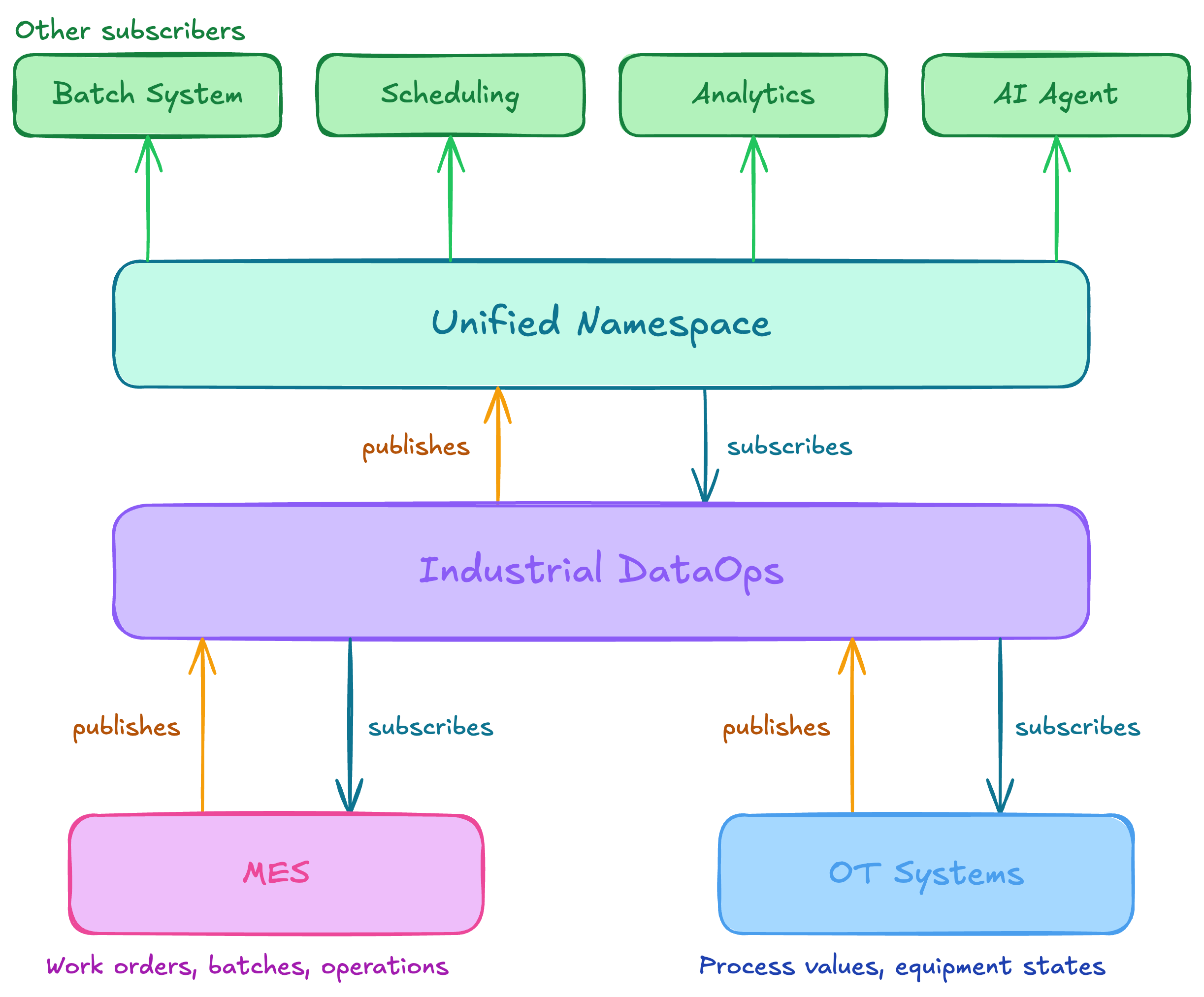
MES might, for example, publish events such as:
WorkOrderReleased
WorkOrderActivated
BatchStarted
OperationCompleted
ProductionCompleted
Once these events are available in the UNS, other systems can subscribe to them without requiring dedicated interfaces back into MES. A batch system may react when BatchStarted is published, a scheduling application can respond when a work order completes, analytics can correlate the start of production with process conditions, and an AI agent can combine MES execution context with equipment states, process measurements, and other operational information.
The Unified Namespace therefore does more than provide a route for DataOps-prepared OT information to reach MES. It creates the common operational space in which MES, OT systems, applications, analytics, and AI can exchange information without making any one application the center of the architecture.
The Real Benefit: Context Is Created Once and Reused
The broader value of this architecture is that the work required to understand the plant becomes reusable. Equipment identities, hierarchy mappings, information models, schemas, and contextualization logic no longer remain buried inside individual MES, analytics, or AI integrations; they become shared infrastructure.
This changes the economics of digital manufacturing. Integration and contextualization work that would otherwise be repeated across multiple projects can be established once in the foundation and reused as new consumers are added.
Why This Matters for Multi-Site MES Rollouts
The value becomes even greater when MES is being deployed across multiple plants.
The first site will inevitably require significant engineering work. Connectors need to be configured, local equipment and production structures mapped, schemas established, DataOps pipelines created, and namespace conventions implemented.
But those decisions can become reusable patterns rather than remaining specific to one deployment.
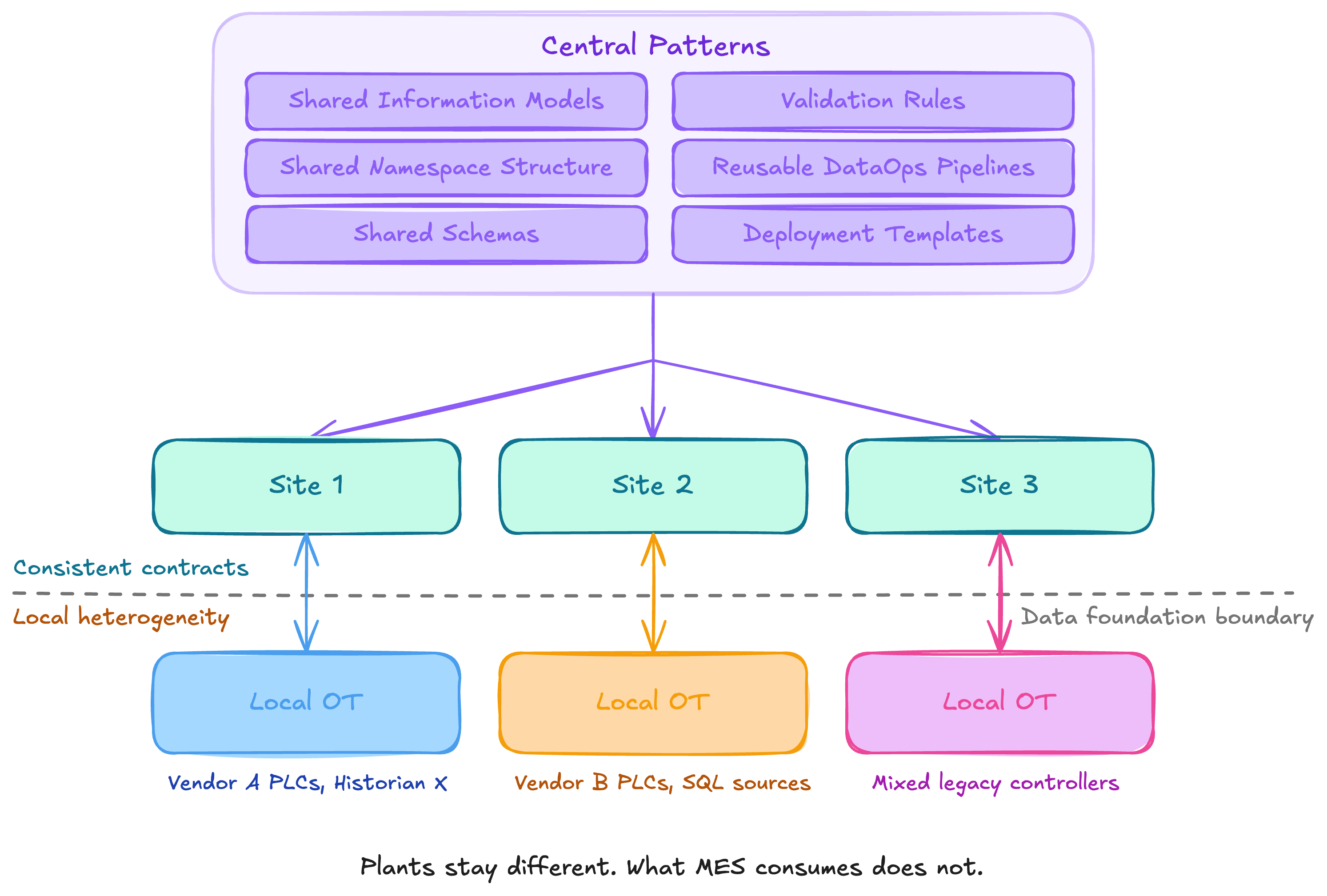
Site 2 may use different controllers, naming conventions, historians, or databases, so some local mapping will always be required. The objective is not to eliminate that heterogeneity, but to prevent it from propagating into every MES implementation.
Instead of trying to standardize every source system, the enterprise standardizes how those source systems are represented at the data foundation boundary.
The physical plants can remain different while the information contracts presented to MES become increasingly consistent. Over time, new site deployments become less about designing integrations from scratch and more about adapting established patterns to the local environment.
MES Can Focus on Manufacturing Execution
Moving connectivity, contextualization, model mapping, and validation into the shared foundation gives MES a cleaner architectural boundary. Plant-specific integration logic no longer needs to accumulate inside or around the MES simply because it was the first application to require the data.
This can also reduce integration lock-in.
MES replacement is difficult not only because production workflows have been configured within the application, but because years of knowledge about the surrounding plant systems often become embedded in the integration layer around it. Equipment mappings, PLC interfaces, historian references, ERP transformations, and site-specific data logic can all become tightly coupled to the MES implementation.
Moving more of that knowledge into a shared foundation changes the dependency.
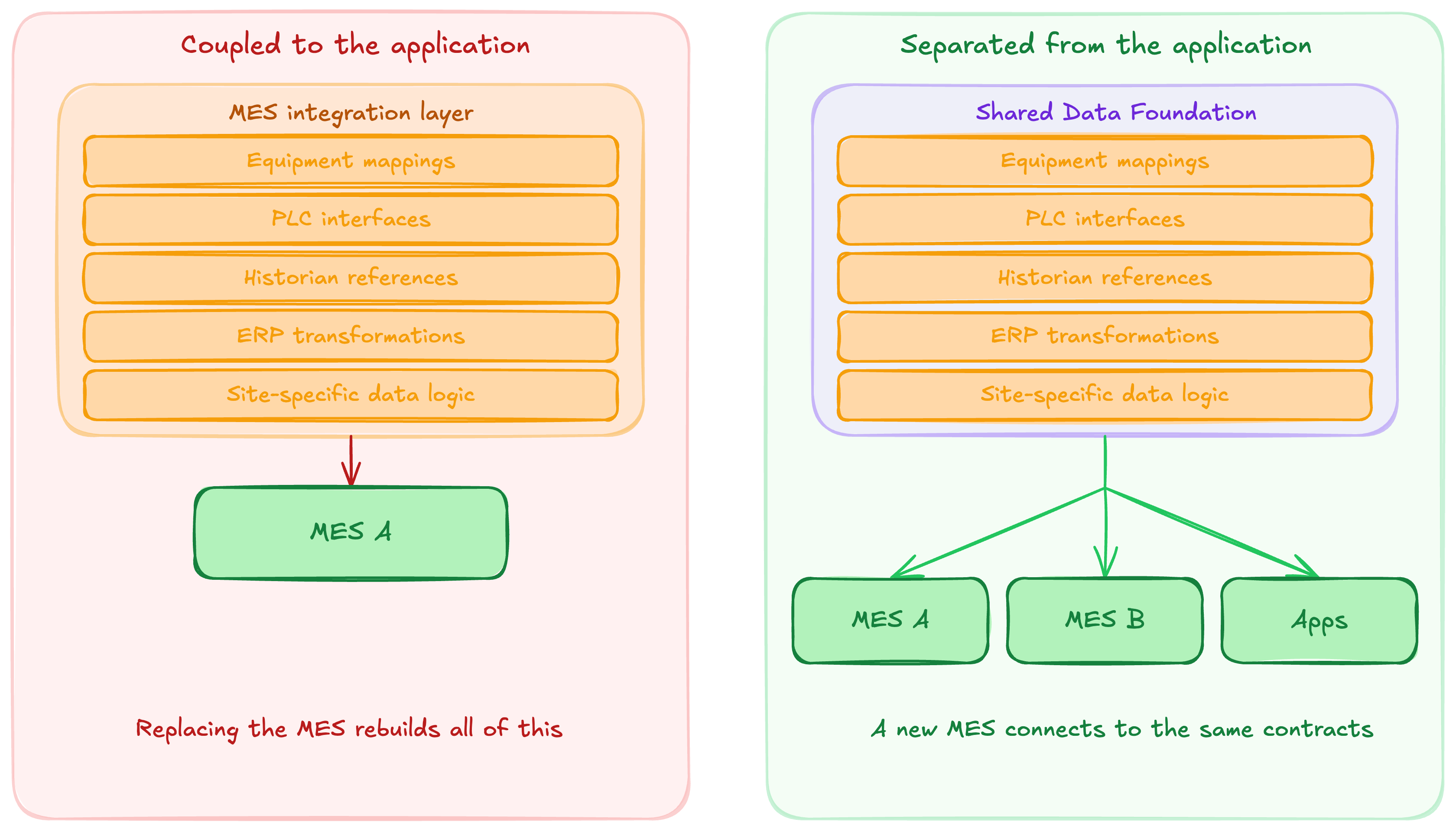
It does not make replacing an MES simple, but it separates a larger portion of the operational data integration estate from the choice of MES application. A new MES can potentially connect to the same established data contracts instead of requiring every OT integration to be rebuilt.
The Same Context Can Support Analytics and AI
The same principle applies to enterprise data platforms such as Snowflake, Databricks, or Microsoft Fabric. These platforms are highly capable of storing and analyzing manufacturing data, but moving poorly contextualized OT data into a lakehouse does not automatically give it manufacturing meaning.
Industrial DataOps and the UNS can provide better inputs by carrying identities, hierarchy, equipment context, production events, batches, products, units, and other operational relationships into the enterprise data environment.
The broader business case therefore goes well beyond simplifying MES integration. The same investment in connectivity, contextualization, models, schemas, and operational events can support dashboards, OEE, quality analytics, predictive maintenance, enterprise data platforms, digital twins, knowledge graphs, custom applications, and AI.
What begins as an effort to make MES integration easier becomes something more valuable: a reusable industrial data foundation for the wider digital manufacturing architecture.
Conclusion
Building a DataOps and Unified Namespace foundation does not require manufacturers to redesign their MES architecture all at once. A more practical approach is to start with one plant, one production area, and a clearly defined MES integration use case, then use that implementation to establish the first reusable connector patterns, information models, schemas, namespace structures, and validation rules.
The key is to design the first deployment with the next site in mind. As the architecture expands, more of the work should shift from custom engineering toward configuring and adapting established patterns to local systems.
Existing MES integrations can continue to operate alongside the new foundation and migrate gradually as upgrades, replacements, and new use cases create natural opportunities for change.
The goal is therefore not a rip-and-replace programme. It is to progressively move integration and contextualization out of individual applications and into a shared data foundation that can support MES today, while also providing a reusable base for the wider digital manufacturing architecture.
Get the Next Guide
New architecture guides, implementation tutorials and use-case blueprints, delivered as they’re published.
More guides
All guides →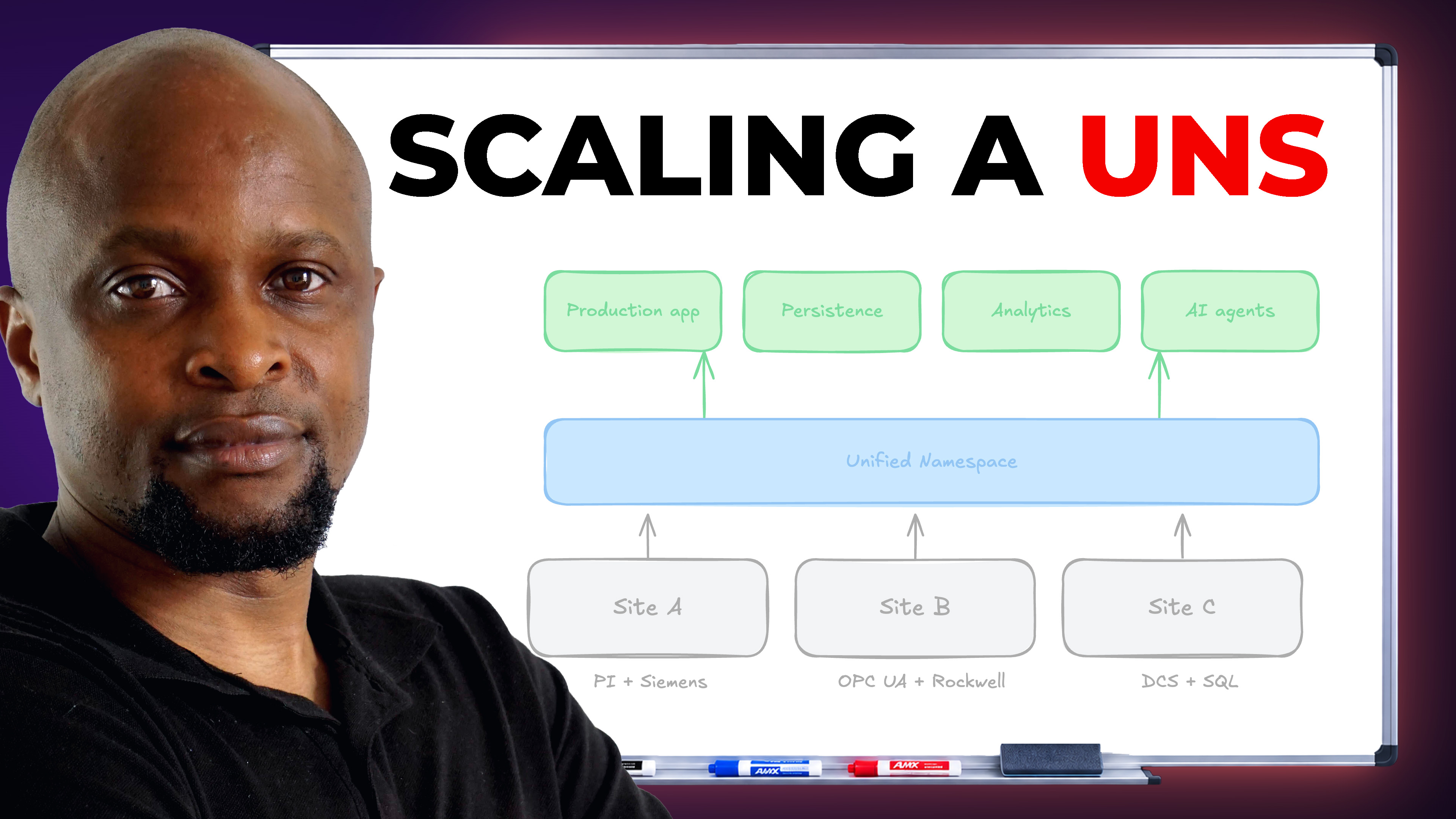

The leading IIoT & AI educational platform for digital manufacturing teams