
11 Best Practices for MQTT Topic Design in a Unified Namespace
A practical guide to designing Unified namespace MQTT topics that are predictable, scalable, and easy to subscribe to and govern.

A Unified Namespace is often introduced as a hierarchical representation of the manufacturing operation.
At the top, you might have the enterprise. Beneath that, sites, areas, lines, work centers, work units, and equipment. Open the broker in an MQTT client, expand the topic tree, and the structure of the operation begins to reveal itself.
That is a useful way to understand the idea. But it is not enough to design a production Unified Namespace.
As the UNS grows, many of its most important consumers will not be people browsing topics in an MQTT client. They will be software: dashboards, historians, stream-processing applications, data platforms, governance tools, analytics services, and AI agents.
Those consumers are less interested in whether the topic tree visually resembles the factory. They need to know whether the namespace is predictable enough to answer questions such as:
- Where can I subscribe to all production events?
- Where can I discover the equipment associated with a work center?
- Where do high-frequency measurements belong?
- Where are production KPIs published?
- What schema should I expect beneath this branch?
That changes how we should think about namespace design.
The topic hierarchy should certainly reflect the structure of the operation, but its more important job is to provide a predictable addressing system for operational information.
A consumer that understands the namespace grammar should be able to infer where a particular class of information will appear, what kind of message it should expect there, and which data-contract or governance rules apply, without having to discover every individual topic beforehand.
That predictability is what turns a collection of MQTT topics into a namespace that can scale.
A Topic Namespace Is Not Just a Tree
Consider a namespace structured roughly like this:
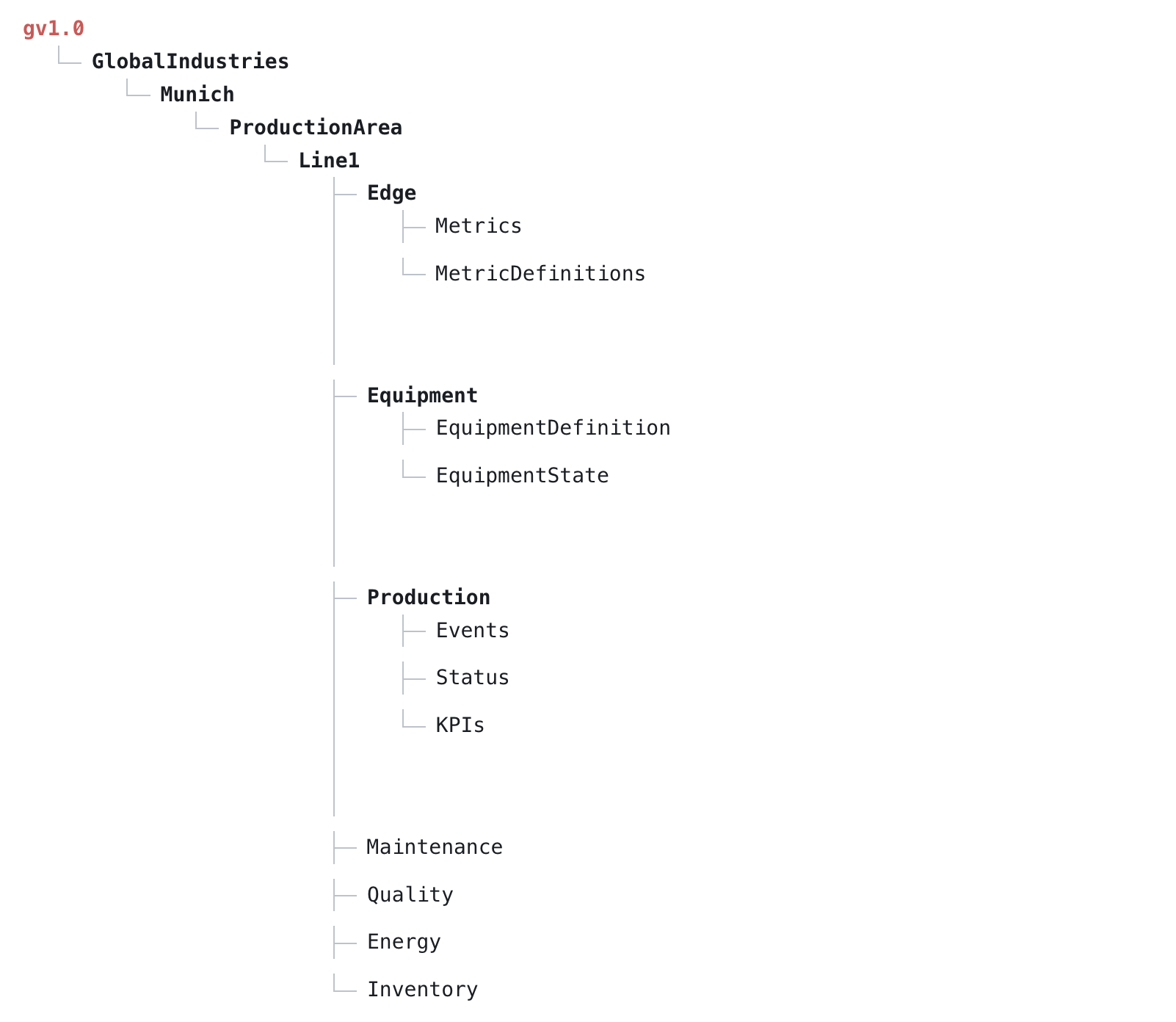
Several different concerns are encoded in that address. The first part establishes a common operational context.
gv1.0/
GlobalIndustries/
Munich/
ProductionArea/
Line1/
The next level identifies the functional domain: Production
The next identifies the class of information: Events
And the final part identifies the specific event: WorkOrderActivated
Conceptually, the topic follows a structure such as:
Namespace version /
Enterprise /
Site /
Area /
Work center /
Functional domain /
Message category /
Category-specific address
The important benefit is not simply that somebody can look at the topic and understand it. It is that when those positions have consistent meanings, consumers can construct useful subscription patterns around them.
For example, a central data-platform application interested in production events across the enterprise could subscribe to:
gv1.0/+/+/+/+/Production/Events/#
It does not need to know every site, area, work center, or event type in advance. It knows where Production and Events will appear because the namespace follows a consistent grammar.
In other words, a good namespace grammar makes classes of operational information addressable.
That leads to the first best practice.
1. Treat the Topic Namespace as an API
Once applications depend on the topic structure, that structure should be treated much like an API. Stability matters more than how neatly the hierarchy looks in MQTT Explorer.
A human may appreciate being able to browse:
Enterprise
└── Site
    └── Area
        └── Line
            └── Equipment
But most consumers of a production UNS will be software.
A dashboard needs a stable subscription for the state or KPI information it depends on. A governance system needs to know which schema applies beneath a particular branch. A central data platform needs predictable addresses from which it can consume information across many sites.
The more useful design question is therefore not, Can somebody browse the tree and recognize the plant? It is, Can a consumer reliably address the class of operational information it needs?
Once consumers depend on that addressing structure, renaming branches, moving topic positions, or introducing local exceptions can have many of the same consequences as changing an API.
Treat the namespace as a machine-consumable addressing contract: design it deliberately, keep it consistent, and avoid breaking changes wherever possible.
2. Define a Namespace Grammar Before Individual Topics
A scalable Unified Namespace should not emerge from hundreds of teams independently deciding what their topics should look like. Define the grammar first.
For example:
{namespaceVersion}/
{enterprise}/
{site}/
{area}/
{workCenter}/
{domain}/
{messageCategory}/
{categorySpecificAddress}
The important point is not that every UNS must use these exact levels. It is that the positions you define have agreed meanings.
If one position represents the functional domain, it should represent the functional domain consistently. If the next represents a message category, that convention should hold wherever the pattern is used.
This is what makes subscription patterns possible.
If Production always occupies the domain position and Events always occupies the message-category position, an enterprise consumer can subscribe to gv1.0/GlobalIndustries/+/+/+/Production/Events/# without maintaining a catalogue of every production event in every plant.
This is different from a naming convention. A naming convention tells teams how to spell things, while a namespace grammar defines how operational information is addressed.
3. Establish a Stable Enterprise Addressing Spine
One of the most useful conventions is to keep the upper part of the namespace consistent across the enterprise.
For example:
{namespaceVersion}/
{enterprise}/
{site}/
{area}/
{workCenter}/
might form a common enterprise addressing spine.
In practice, gv1.0/GlobalIndustries/Munich/ProductionArea/Line1/
This gives every consumer a consistent way to locate information within the organization before the namespace begins branching into different operational domains.
The work-center level is often a useful boundary because this is where variation naturally begins. Different work centers may contain very different equipment, processes, control systems, metrics, or applications. Trying to standardize every level below that point across an enterprise can quickly become restrictive.
Keeping the addressing spine stable gives you consistency where enterprise-wide consumers need it, while still allowing flexibility beneath each work center.
It also makes patterns such as gv1.0/+/+/+/+/Production/Events/# possible because the consumer knows that the four positions between the enterprise and the domain consistently represent enterprise, site, area, and work center.
The hierarchy therefore serves an important purpose: it tells consumers where information belongs operationally and establishes useful subscription, routing, authorization, and governance boundaries.
But consistency does not mean every property of the physical plant needs to become another topic level. Beyond the stable addressing spine, add structure only where it contributes to how the information will actually be addressed and consumed.
4. Put Functional Domains at Predictable Positions
Once the operational context is established, introduce a consistent position for the functional domain. For example:
.../Line1/Edge/...
.../Line1/Equipment/...
.../Line1/Production/...
.../Line1/Maintenance/...
.../Line1/Quality/...
.../Line1/Energy/...
.../Line1/Inventory/...
Here: Edge, Equipment, Production, Maintenance, Quality, Energy and Inventory all occupy the same conceptual position beneath the work center.
A consumer interested in production information can therefore address:
.../{workCenter}/Production/...
while one interested in maintenance information can address:
.../{workCenter}/Maintenance/...
The structure is independent of whichever application originally produced the data.
This also makes the namespace easier to extend. If a new functional domain is introduced, it can be added beneath the same addressing spine without redesigning the rest of the namespace.
5. Standardize Message Categories Within Each Domain
The functional domain tells a consumer what part of the operation the information belongs to. The next level should tell it what kind of information is available.
For Production:
Production
├── Events
├── Status
└── KPIs
For Edge:
Edge
├── Metrics
└── MetricDefinitions
And for Equipment:
Equipment
├── EquipmentDefinition
└── EquipmentState
Other domains can follow the same principle. Maintenance and Quality, for example, may also expose categories such as Events, Status, and KPIs.
The exact categories will vary by domain. What matters is that their position and meaning remain consistent.
A subscription to:
.../Production/Events/#
represents a different class of information from:
.../Production/Status/#
or:
.../Production/KPIs/#
Likewise:
.../Edge/Metrics/#
can contain live measurements, while:
.../Edge/MetricDefinitions/#
contains the relatively static metadata describing those measurements.
This creates an important boundary between namespace design and payload design. The namespace defines where a class of information is addressed, and the payload contract defines how that information is structured.
6. Design the Namespace Around Wildcard Subscriptions
MQTT topic hierarchies become particularly powerful when the namespace is designed around the subscription patterns consumers actually need.
A line-level production application, for example, should not need to know every event topic individually. It should be able to subscribe to: .../Line1/Production/Events/#
and receive all production events beneath that branch.
A historian might subscribe to:
.../Line1/Edge/Metrics/#
while an analytics application could consume:
.../Line1/Production/KPIs/#
This becomes especially valuable as the namespace evolves. If a new event such as ChangeoverStarted is introduced beneath
.../Production/Events/
existing consumers subscribed to
.../Production/Events/#
can receive it without maintaining an updated list of every event topic.
The namespace can grow behind a stable subscription contract. One of the practical tests during namespace design should therefore be: What are the important subscription patterns, and does the hierarchy allow consumers to express them cleanly?
If common use cases require applications to maintain hundreds of individual topic names, the namespace is probably not doing enough of the addressing work.
7. Let Namespace Position Imply the Data Contract
Once a branch of the namespace represents a defined class of information, it can also be associated with a corresponding message contract.
For example:
.../Edge/Metrics/#
can require messages to conform to a Metric contract.
Similarly:
.../Equipment/EquipmentState/#
can imply an EquipmentState contract, while:
.../Production/Events/#
can require a standard production-event envelope.
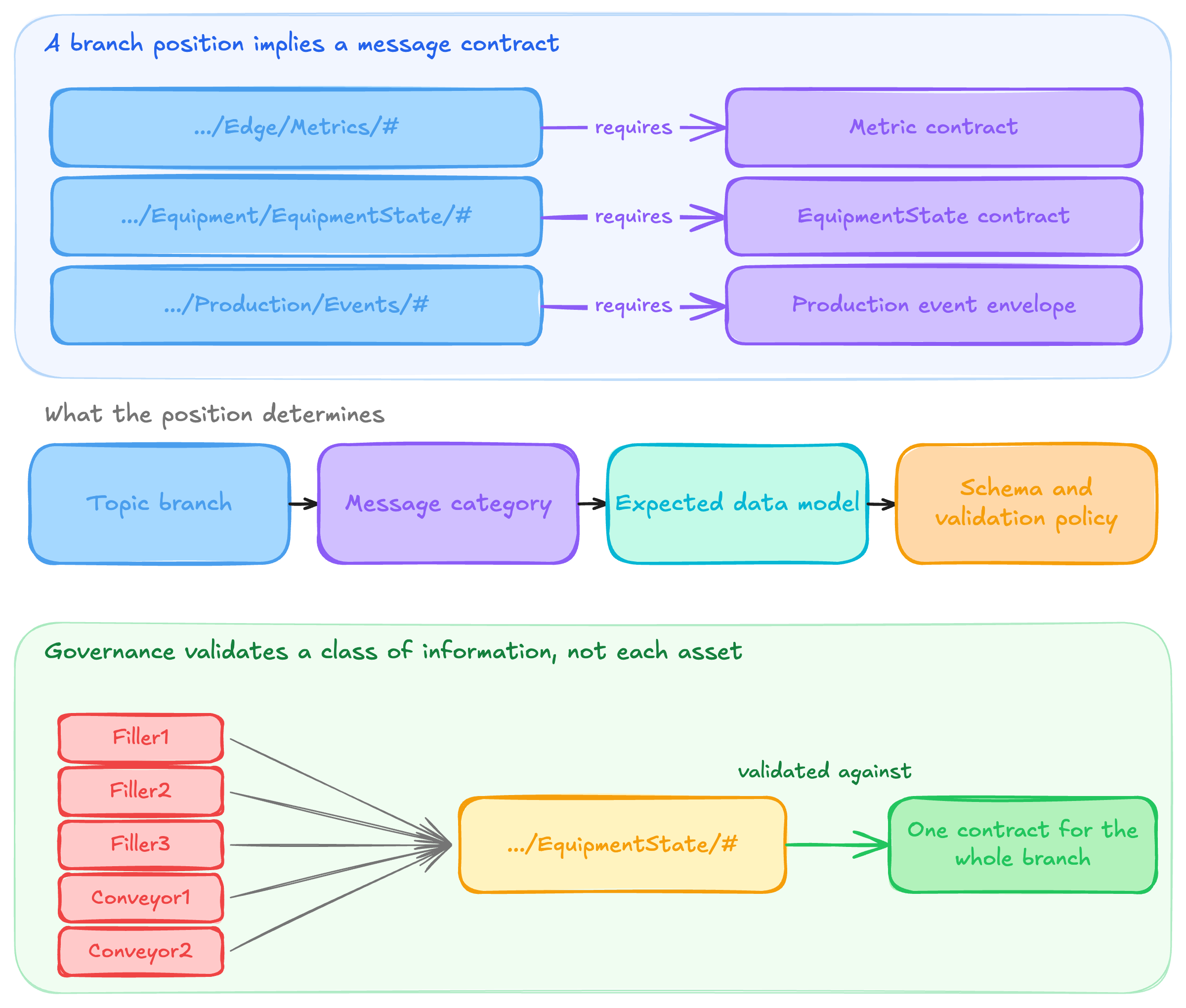
This is useful for governance because validation can be applied to classes of information rather than individual assets.
Instead of maintaining different rules for Filler1, Filler2, Filler3, Conveyor1, Conveyor2
a governance system can validate everything published beneath the relevant branch against the same contract.
The topic path therefore becomes part of the data contract: the address tells consumers what class of information they are subscribing to, and that class determines the expected message structure.
8. Design for Discovery, Not Only Known Subscriptions
A production UNS should also allow consumers to discover what information is available without already knowing every asset, metric, or topic. Consider equipment definitions.
If they are published beneath:
.../Equipment/EquipmentDefinition/#
a new consumer can subscribe to that branch and discover the equipment represented within the relevant work center, area, or site.
The same principle applies to measurement metadata:
.../Edge/MetricDefinitions/#
A consumer can discover which measurements are available before deciding which live metrics it wants to consume.
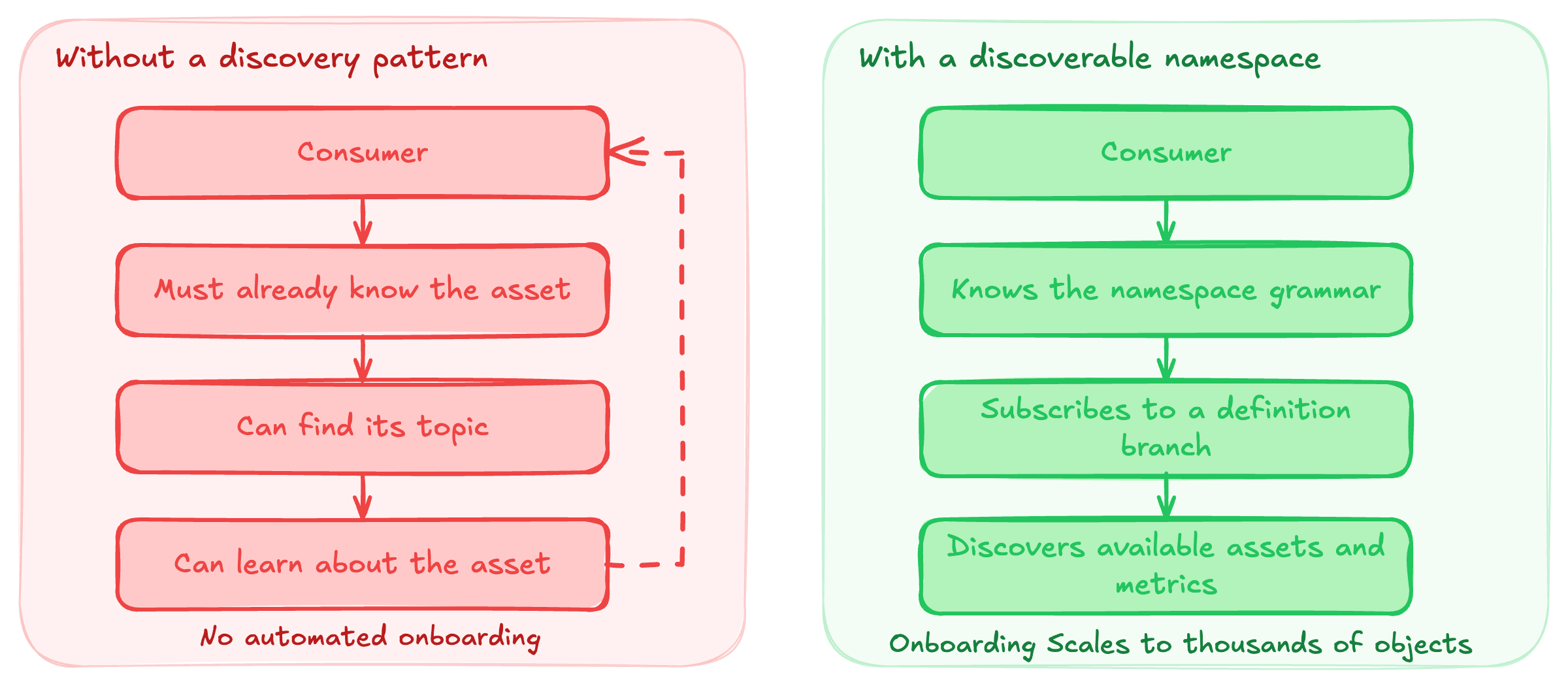
That becomes increasingly important as a UNS represents hundreds or thousands of operational objects.
An analytics service, governance application, or AI agent should not require a hard-coded catalogue of every MQTT topic before it can begin working with the operation.
The grammar gives it a predictable path through which those objects can be discovered.
9. Keep Topic Depth Meaningful
Once teams realize that topic levels provide useful addressing and context, there is a temptation to put everything into the hierarchy.
That can quickly produce structures such as:
Enterprise/
Country/
Region/
Site/
Building/
Floor/
Area/
Department/
Line/
Cell/
Machine/
Subsystem/
Device/
Sensor/
Parameter/
...
The topic becomes more descriptive, but also deeper, more brittle, and harder to govern.
Every level should earn its place by contributing useful operational context or supporting an important subscription, routing, authorization, or governance boundary.
A level should not exist simply because another attribute happens to be available.
The distinction is important. Topic hierarchy is for addressing and operational context, not for representing every property of an object.
If something is descriptive metadata rather than part of how consumers locate or subscribe to information, it will often belong in the payload or a definition object instead.
10. Keep Rich Relationships Outside the Topic Tree
There is another reason not to keep adding structure to the namespace: manufacturing operations are not purely hierarchical.
A topic tree is.
Consider a tank. It may:
feed → Mixer01
contain → MaterialBatch4711
participate in → Mixing
have capability → Heating
be located at → Line1
be maintained by → TeamB
be upstream of → Filler03
There is no single hierarchical position that can represent all of those relationships cleanly. Should the tank sit beneath the line, the process, its equipment class, the upstream asset, or its maintenance area?
All of those relationships may be valid. That is precisely why they should not all be forced into the topic path.
The topic namespace and semantic layer should have different responsibilities.
The namespace should help answer:
- Where can I access this information?
- What operational context and domain does it belong to?
- What class of message should I expect?
- How can I subscribe to it?
A semantic model or knowledge graph can answer richer questions:
- What is this object?
- What is it related to?
- Which processes does it participate in?
- What capabilities or roles does it have?
Conceptually:
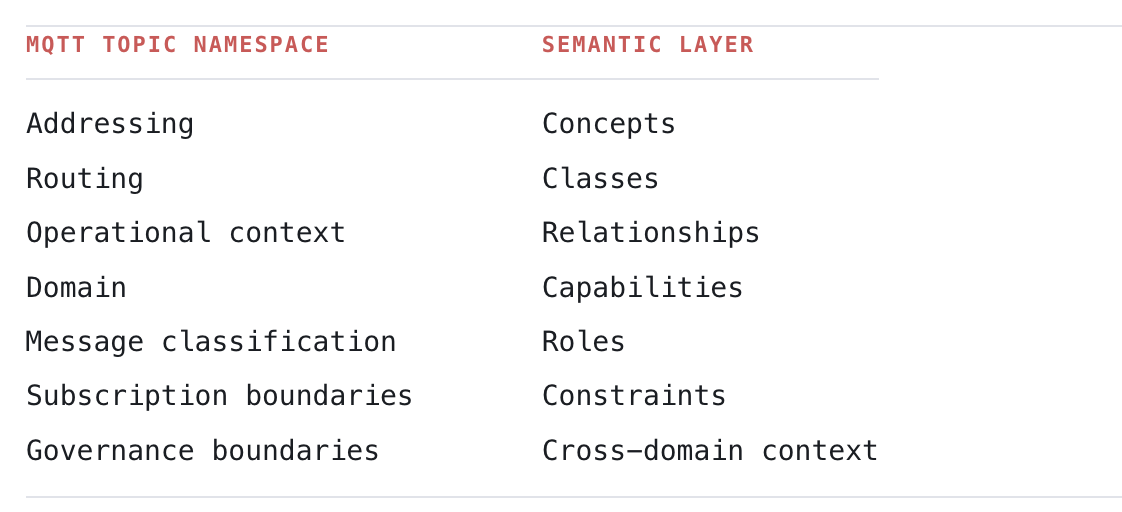
This does not mean the topic namespace should contain no semantics. A topic such as Munich/ProductionArea/Line1/Production/Events/WorkOrderActivated
clearly carries useful meaning.
The point is to include enough semantics to support addressing and consumption, without trying to turn the topic tree into the complete semantic model of the operation.
11. Version the Namespace as a Governed Contract
Once applications depend on the namespace grammar, that grammar becomes infrastructure.
Changing it can affect dashboards, integrations, access-control rules, governance policies, analytics applications, and every other consumer that relies on stable subscription patterns.
That makes versioning important.
In the example namespace, a top-level value such as gv1.0 can identify the version of the global namespace contract.
That is different from the version of an individual message schema.
For example, gv1.0 might define the addressing grammar:
{enterprise}/
{site}/
{area}/
{workCenter}/
{domain}/
{messageCategory}/...
while the payload itself may contain:
{
  "schemaVersion": "2.0.0"
}
These are two different contracts: one versions where information lives, while the other versions how that information is represented.
Keeping them separate allows payloads to evolve without unnecessarily reorganizing the namespace.
Ideally, namespace versions should change rarely. But when a breaking change to the grammar is unavoidable, an explicit namespace version provides a controlled migration boundary rather than silently changing the meaning of existing topic positions.
Conclusion
A well-designed topic namespace gives consumers a predictable way to address classes of operational information.
A line-level application can subscribe to production events for one work center. A central platform can subscribe to the same class of information across the enterprise. A discovery service can find equipment definitions without knowing every asset beforehand. And governance tools can associate data contracts with predictable branches of the namespace.
That is why consistency in the namespace matters. It allows the structure to scale beyond people browsing topics and become a stable interface for software.
But knowing where information lives is only half of the contract.
The next question is what the message published there should actually look like.
If producers use completely different payload structures beneath an otherwise standardized namespace, consumers still face an integration problem. Topic namespace design and data modelling therefore need to work together: the namespace defines where information lives and what class it belongs to, while the data model defines how that information is structured and understood.
That is the focus of the next article: 11 Best Practices for Data Modelling in the Unified Namespace.
Get the Next Guide
New architecture guides, implementation tutorials and use-case blueprints, delivered as they’re published.
More guides
All guides →

The leading IIoT & AI educational platform for digital manufacturing teams