
The Role of Industrial DataOps in a Unified Namespace Architecture
How Industrial DataOps and the Unified Namespace work together to standardize, govern, and distribute operational data across the enterprise.

The Role of Industrial DataOps in a Unified Namespace Architecture
In the previous article, we looked at Industrial DataOps as the data engineering discipline for turning heterogeneous industrial data into trusted, contextualized, and standardized information that can be used across the wider data architecture.
One of the most important places this capability comes into play is around the Unified Namespace.
A Unified Namespace can provide the shared, real-time data backbone through which operational information is published, discovered, and consumed across the enterprise. But the usefulness of that architecture depends heavily on the quality and consistency of the information being published into it.
This article explores that relationship in more detail: where the responsibilities of Industrial DataOps end and those of the Unified Namespace begin, how the two work together to create consistent operational data products, and how the pattern can be scaled across plants without requiring every site to standardize its underlying OT technology.
DataOps and the Unified Namespace Solve Different Problems
The two concepts are closely related, but their responsibilities are different.
A Unified Namespace is primarily concerned with decoupling data producers from consumers and making operational information broadly accessible through a shared, semantically structured real-time data backbone. Systems publish state, events, and other operational information into a common MQTT-based environment, organized through a consistent topic hierarchy, while authorized consumers discover and subscribe to the information they need without establishing separate point-to-point integrations with every source.
This makes the UNS less about transforming the data itself and more about creating a consistent, event-driven mechanism for representing and distributing operational information across the enterprise.
Industrial DataOps addresses a different question: What needs to happen to source data before it can be published into that shared data space in a consistent and usable form?
A value coming from a PLC, DCS, historian, or MES may first need to be contextualized, transformed, mapped into an agreed information model, validated against a schema, and then published to the appropriate location within the namespace hierarchy.
The simplified relationship looks like this.
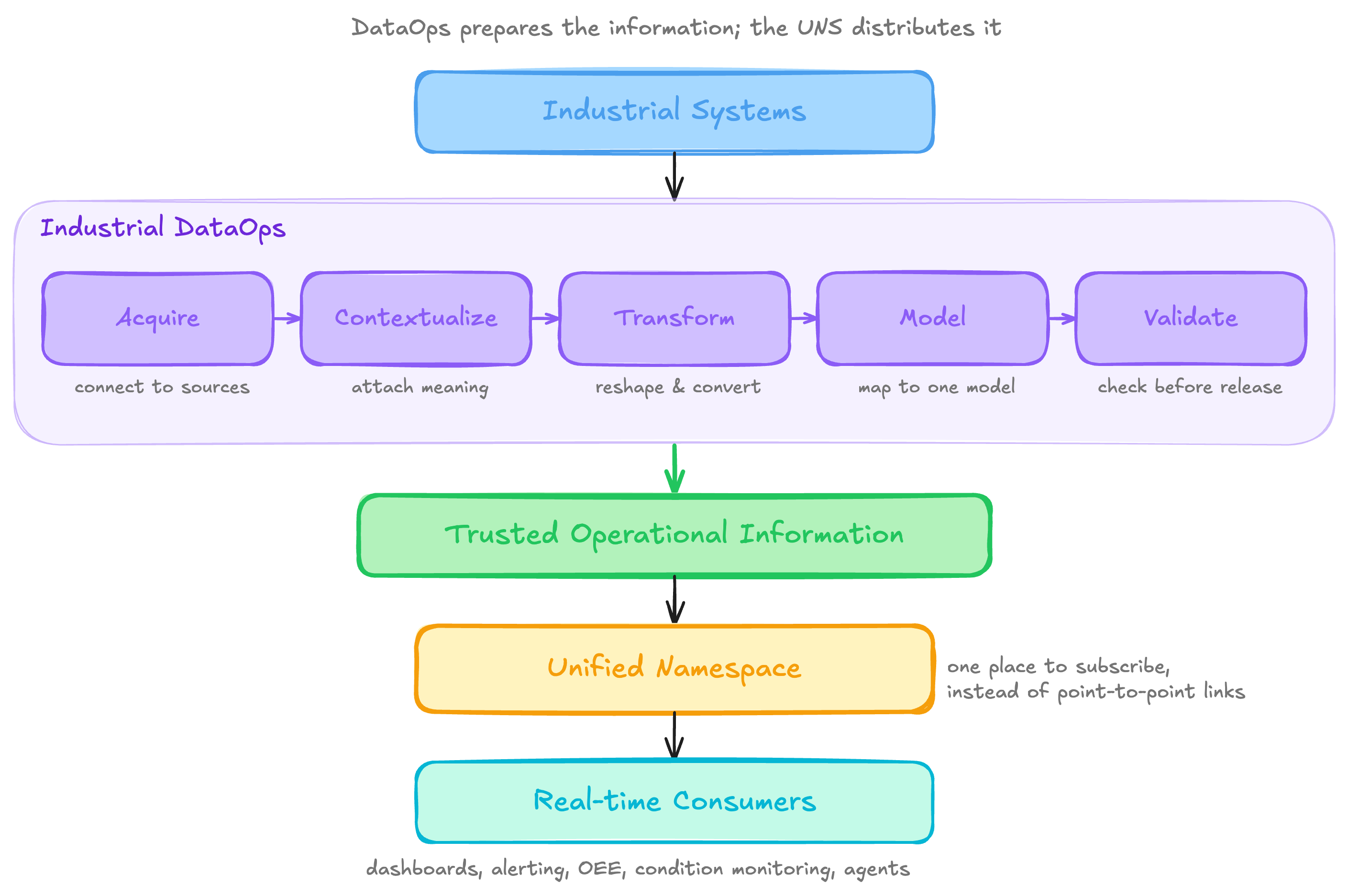
The practical benefit is that consumers of the UNS do not need to understand the naming conventions, database schemas, tag hierarchies, or proprietary interfaces of the industrial systems underneath it.
Industrial DataOps absorbs much of that source-system complexity, allowing the UNS to expose a more consistent and usable representation of operational information.
DataOps Does Not Simply Sit in Front of the UNS
The diagram above is useful, but it can also create the impression that Industrial DataOps is simply a preprocessing layer sitting directly in front of the Unified Namespace.
In practice, its role is broader.
At the site level, DataOps may acquire information from PLCs, SCADA, DCS, databases, and historians and prepare it for publication into the Site UNS.
Elsewhere, DataOps may move historical process information directly from a site historian into an enterprise warehouse or lakehouse without passing through the UNS at all. Replicating years of high-frequency historical measurements through the real-time namespace is often unnecessary when a direct batch or bulk data movement pattern is more appropriate.
DataOps can also sit between the operational data architecture and enterprise applications. Information from the UNS may need to be translated into the structures expected by ERP, MES, QMS, or other systems. Likewise, production orders, schedules, product definitions, and quality information originating in business systems may need to be transformed before being introduced into the operational environment.
The relationship therefore looks more like this.
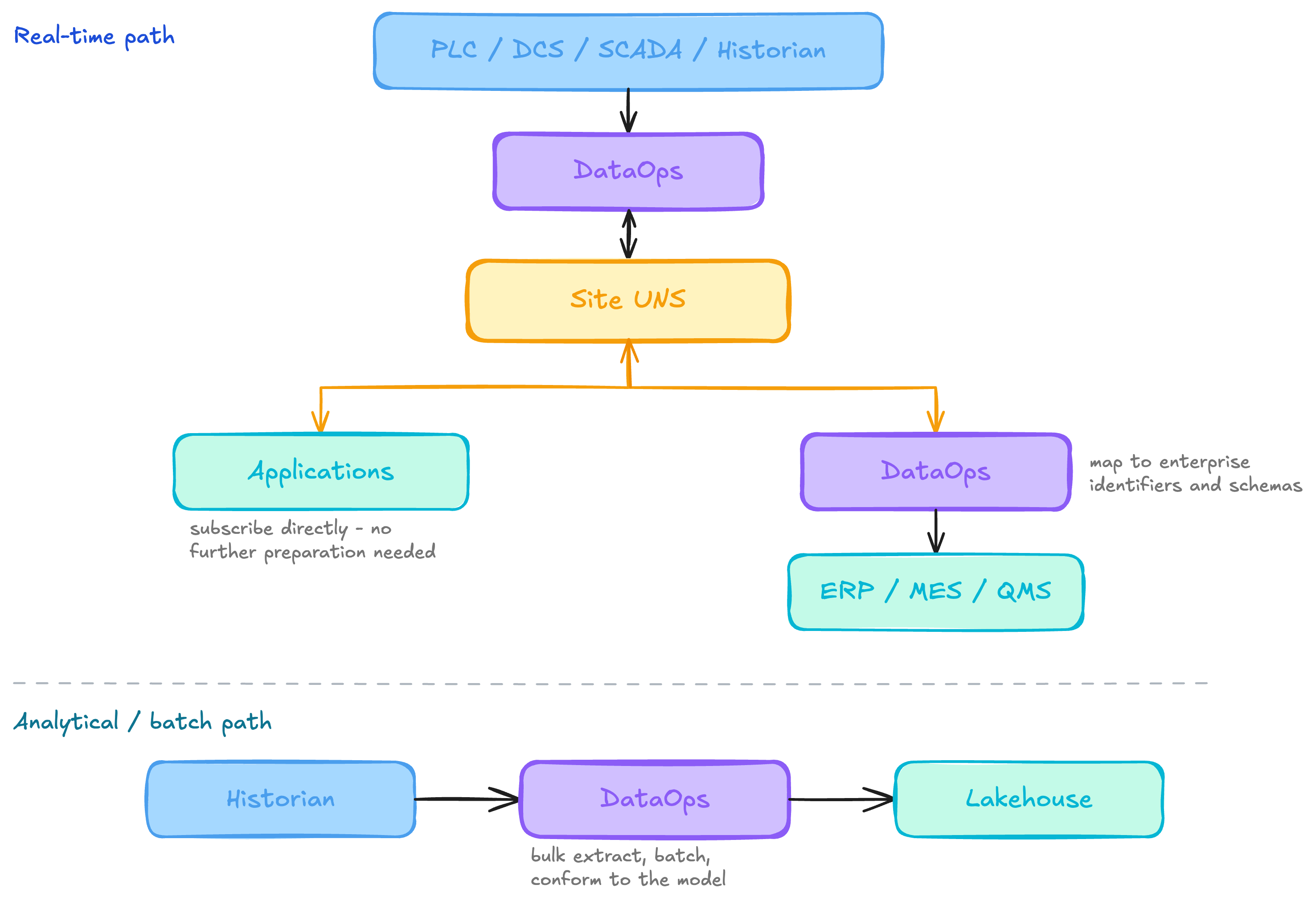
Industrial DataOps operates around the movement of information. The Unified Namespace is one important destination and source within that wider flow, but not the only one.
Building Consistent Data Products for the UNS
This becomes particularly important when a manufacturer begins scaling the Unified Namespace beyond a single line or plant.
Consider a BatchPhaseCompleted event. In the source batch or DCS system, there may be no single message that already contains everything the enterprise wants that event to represent. The phase identifier may exist in one table, the batch and recipe context in another, the equipment assignment elsewhere, while completion time, state, and production results may be recorded separately.
Publishing one of those source records directly into MQTT would make the data accessible, but it would not necessarily create a useful enterprise event.
Instead, the organization might define a standard BatchPhaseCompleted event containing information such as the batch and phase identities, the phase definition, the equipment on which it executed, the completion timestamp, its final state, and relevant production context.
Industrial DataOps performs the work required to construct that event. A pipeline might detect that the phase has completed, retrieve the associated batch and recipe information, resolve the equipment identity, normalize timestamps and identifiers, map the source values into the organization's event model, validate the resulting payload, and publish it to the appropriate location in the namespace hierarchy.
The result might look conceptually like this:
{
  "eventType": "BatchPhaseCompleted",
  "eventId": "EVT-PHASE-DONE-26154-0022",
  "eventVersion": "2.0",
  "timestamp": "2026-06-03T06:50:00+02:00",
  "source": {
    "origin": "BatchPlantSimulator_OPCUA",
    "uri": "opc.tcp://localhost:26543/BatchPlantServer",
    "gateway": "Ignition-Gateway-MUC-Line1",
    "originSystemId": 1015
  },
  "correlationId": "batch-BR-MUC-LINE1-260603-0419",
  "data": {
    "batchRecordId": "BR-MUC-LINE1-260603-0419",
    "producedBatch": "B-20260603-001",
    "workOrderId": "WO-MUC-26154-0007",
    "controlRecipeNumber": "CR-1000234567-01",
    "processOrderNumber": "1000234567",
    "operationNumber": "0020",
    "operationName": "Cook",
    "phaseNumber": "0022",
    "phaseName": "HeatToTarget",
    "unitName": "KT-301",
    "isa95Context": {
      "enterprise": "GlobalIndustries",
      "site": "Munich",
      "area": "ProductionArea",
      "processCell": "Line1"
    },
    "startTime": "2026-06-03T06:42:00+02:00",
    "endTime": "2026-06-03T06:50:00+02:00",
    "durationSec": 480,
    "expectedDurationSec": 480,
    "durationDeviationPct": 0,
    "status": "Complete",
    "completionReason": "SetpointReached",
    "reportParameters": {
      "actualTemperature": 90.1,
      "rampRate": 2.4,
      "steamConsumedKg": 24.6
    },
    "exitSnapshot": {
      "kettleTempC": 90.1,
      "kettleVolumeL": 1850,
      "agitationRpm": 50,
      "jacketPressureBar": 3.2
    },
    "deviations": [],
    "alarmsFired": [],
    "operatorInterventions": [],
    "phaseSignature": {
      "signedBy": "system",
      "signedAt": "2026-06-03T06:50:00+02:00",
      "reason": "Auto-sign on SetpointReached"
    }
  }
}
By the time the event reaches the Unified Namespace, consumers do not need to understand how the batch system stores phases, which DCS tables contain the equipment assignment, or how the source system represents completion states. They consume a predictable production event that conforms to the organization's agreed model.
This separation allows the underlying systems to remain optimized for control and production execution, while the information exposed through the UNS is structured for interoperability and broader consumption.
As the same pattern is applied across sites, a BatchPhaseCompleted event can mean the same thing to downstream applications regardless of which DCS, batch system, or local database produced the underlying data.
One Enterprise Model, Different Plant Technologies
Consider a manufacturer operating three production sites.
At the first site, much of the required equipment information exists in an Aveva PI historian. The second exposes process and equipment data through OPC UA. The third stores important operational context inside DCS database tables.
The company wants all three plants to publish standardized equipment information into the same Unified Namespace.
Without a systematic DataOps approach, each plant might create its own integration:
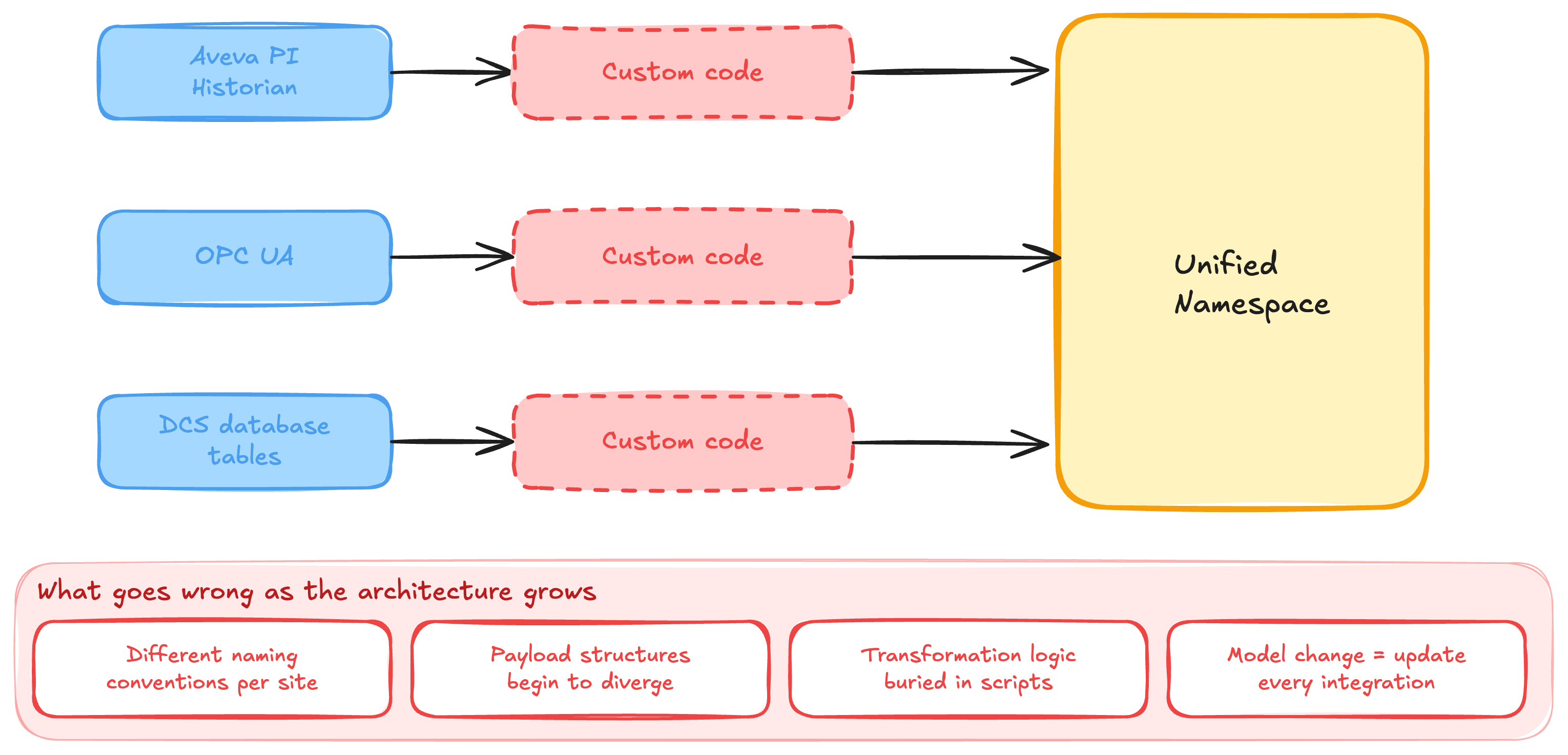
That can work initially. The problem appears as the architecture grows.
Different developers introduce different naming conventions. Payload structures begin to diverge. Transformation logic becomes buried in scripts. When the enterprise information model changes, each integration has to be found, understood, and updated independently.
Industrial DataOps changes the pattern.
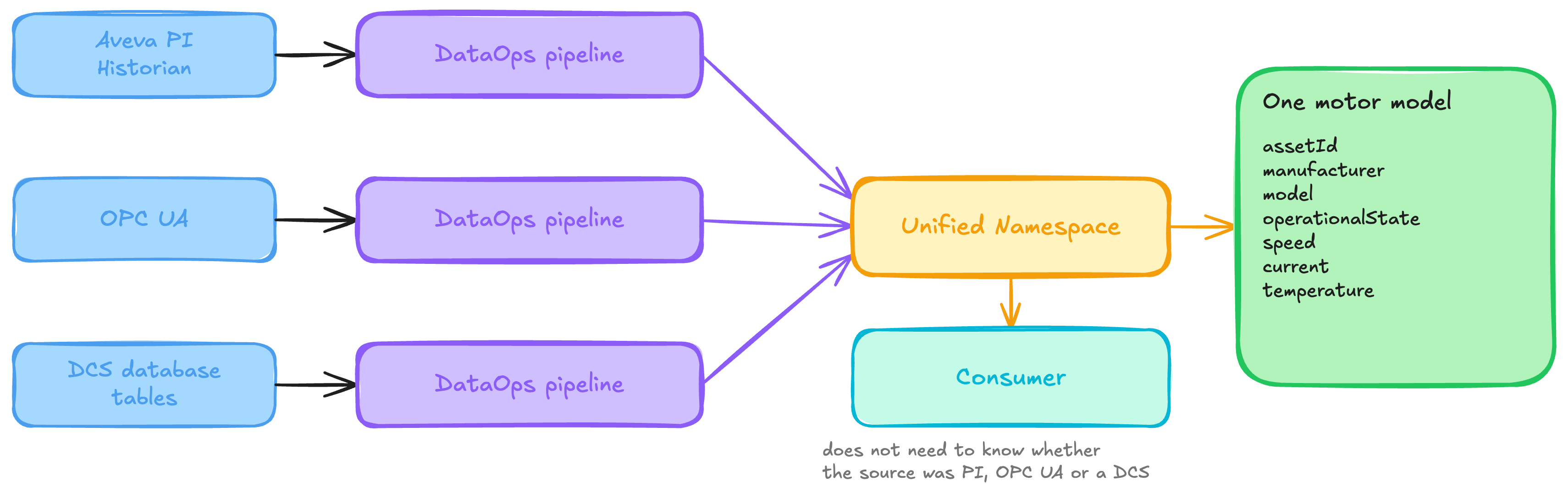
The pipeline at each site does not have to be identical.
The PI implementation may map existing asset structures from the historian. The OPC UA implementation may obtain equipment and measurement metadata from its information model. The DCS pipeline may have to join several database tables before enough information exists to construct the required payload. What matters is the output.
All three sites can ultimately expose the same organizational representation of a motor, pump, work order, batch, production event, or other operational concept.
A consumer subscribing to the Unified Namespace therefore does not need to know whether the underlying source was PI, OPC UA, a DCS database, or something else entirely.
This captures one of the most useful architectural properties of Industrial DataOps:
It standardizes the data exposed by the architecture without requiring every plant to standardize the technology underneath it.
That is important because replacing established control systems, historians, and plant applications simply to achieve enterprise-wide data consistency is rarely practical.
Bidirectional Integration Matters
The relationship between Industrial DataOps and the Unified Namespace is also not limited to moving OT data north. Operational applications often need context originating elsewhere in the business.
An ERP may release a production order. A scheduling system may update the planned sequence. An MES may provide the active work order. A QMS may release a material or publish an inspection result.
That information may need to become part of the operational data space.
Industrial DataOps can acquire the source information, translate it from the enterprise application's schema into the agreed operational model, validate it, and publish the appropriate state or event into the Unified Namespace.
The reverse also applies.
Operational information from the UNS may be consumed by a DataOps pipeline and translated into the structure required by another application or central platform. The flow can therefore be bidirectional.
This allows the UNS to remain focused on representing and distributing operational information without having to adopt the internal schema of every system connected to it.
DataOps handles the translation at the boundaries.
Scaling the Pattern Across Sites
The value of this pattern becomes even clearer when the Unified Namespace expands across multiple plants.
At that point, the challenge is not simply getting each site connected. The organization needs a way to create a consistent enterprise-wide data contract while still allowing individual plants to work with the OT systems they already have.
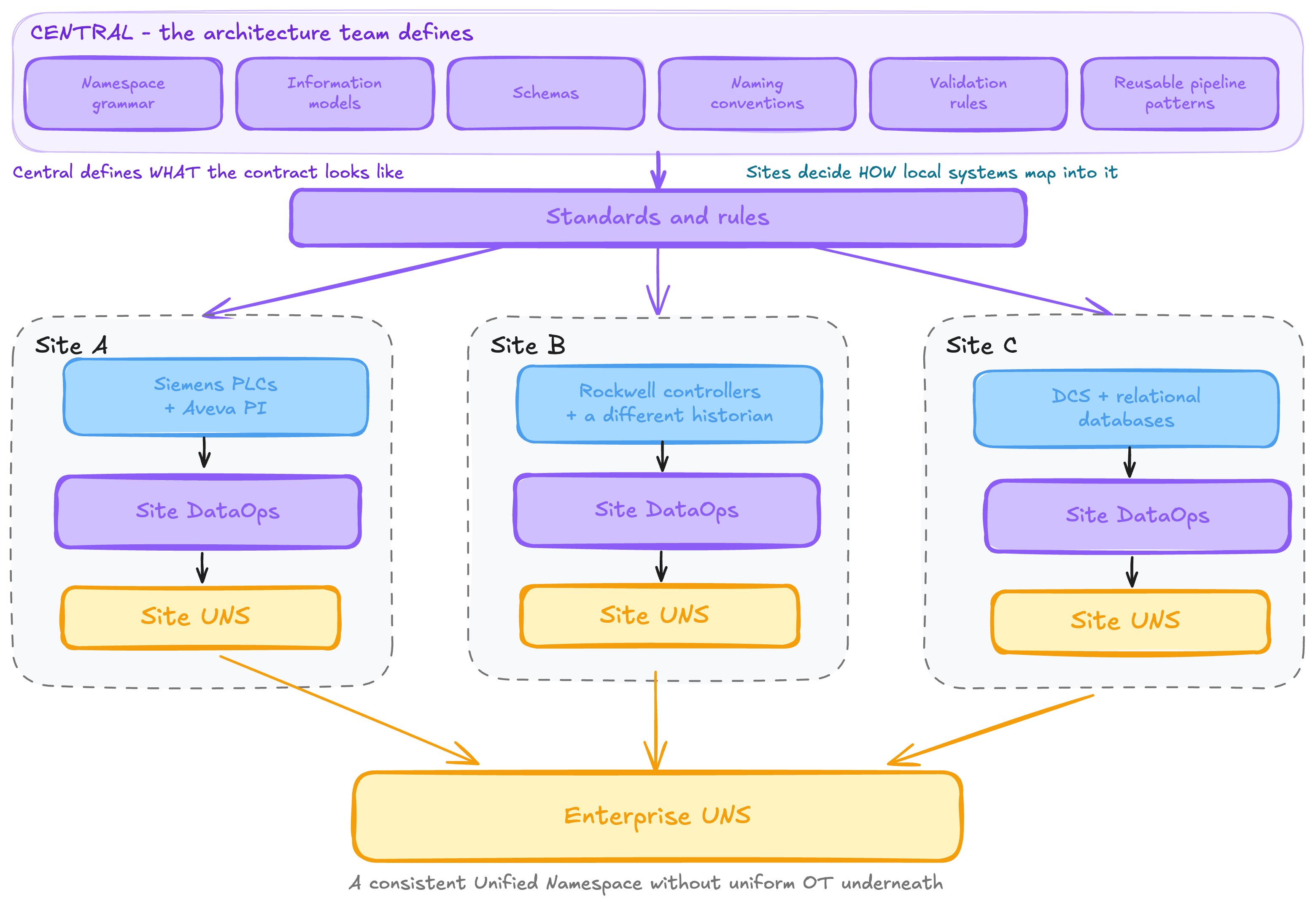
A central architecture team can define the common standards that shape the Unified Namespace: the namespace grammar, information models, schemas, naming conventions, validation rules, and reusable pipeline patterns. These establish what information published into the UNS should look like and how it should be represented across the organization.
The individual sites then determine how their local systems map into those standards.
Site A might use Siemens PLCs and AVEVA PI. Site B may rely on Rockwell controllers and a different historian. Site C may obtain much of its operational context from a DCS and relational databases. The source technologies are different, and the DataOps pipelines required to work with them will be different as well.
That variation is not a problem.
At each site, Industrial DataOps performs the local work of acquiring information from those systems, contextualizing and transforming it, mapping it into the centrally defined models, validating it against the agreed rules, and publishing the resulting information into the Site UNS.
The Site Unified Namespaces can then contribute to an Enterprise UNS while preserving a consistent structure and meaning across the organization.
The architectural principle is therefore:
Central teams define what the shared data contract looks like. Sites determine how their local systems map into it.
This creates an important separation between enterprise standardization and local implementation. The organization can maintain common models, namespace conventions, schemas, and validation rules without requiring every plant to use the same PLCs, historians, databases, or control systems.
In other words, the objective is not to make the plants technically identical. It is to make the information they expose through the Unified Namespace consistent.
Standardize the contract, not the plant.
That is what allows a manufacturer to build a consistent enterprise Unified Namespace without demanding uniform OT technology underneath it.
Conclusion
A Unified Namespace solves an important architectural problem: it gives operational systems and applications a common, real-time environment through which information can be published, discovered, and consumed.
The quality of the UNS depends heavily on the quality of the data products being published into it.
Industrial DataOps provides much of the engineering discipline required to create those data products. It acquires information from heterogeneous industrial systems, adds context, transforms source-specific structures, maps data into agreed models, validates the result, and routes it to the appropriate location.
The Unified Namespace then does what it is designed to do: make that trusted operational information broadly and consistently available in real time.
The two therefore solve different problems, but together they form a powerful architectural pattern.
Industrial DataOps prepares and governs the information. The Unified Namespace makes it available.
Get the Next Guide
New architecture guides, implementation tutorials and use-case blueprints, delivered as they’re published.
More guides
All guides →


The leading IIoT & AI educational platform for digital manufacturing teams