
Unified Namespace for Industrial AI and AI agents
How the Unified Namespace gives industrial AI agents real-time operational context, while historical and semantic layers provide evidence and meaning.

As manufacturers begin exploring industrial AI agents, one of the first challenges is how to give those agents meaningful access to the operational environment. Documents, databases, and enterprise systems can provide important context, but many manufacturing use cases also depend on knowing what is happening on the plant floor as conditions change.
An AI agent operating around a production environment needs to understand not only what is known, but what is happening now. Changes such as a batch starting, a line entering a faulted state, a work order completing, a quality hold being placed, or a pump beginning to draw abnormal current may require attention within seconds rather than after the next database query or scheduled refresh.
This is where the Unified Namespace becomes particularly important for industrial AI. The UNS can provide AI agents with a live, event-driven view of operational state. It does not replace historical data platforms, semantic models, enterprise applications, or systems of record.
Instead, it gives the agent something traditional AI architectures often lack: a reliable way to recognize that operational reality has just changed.
A useful AI-ready architecture therefore combines three complementary sources of context.
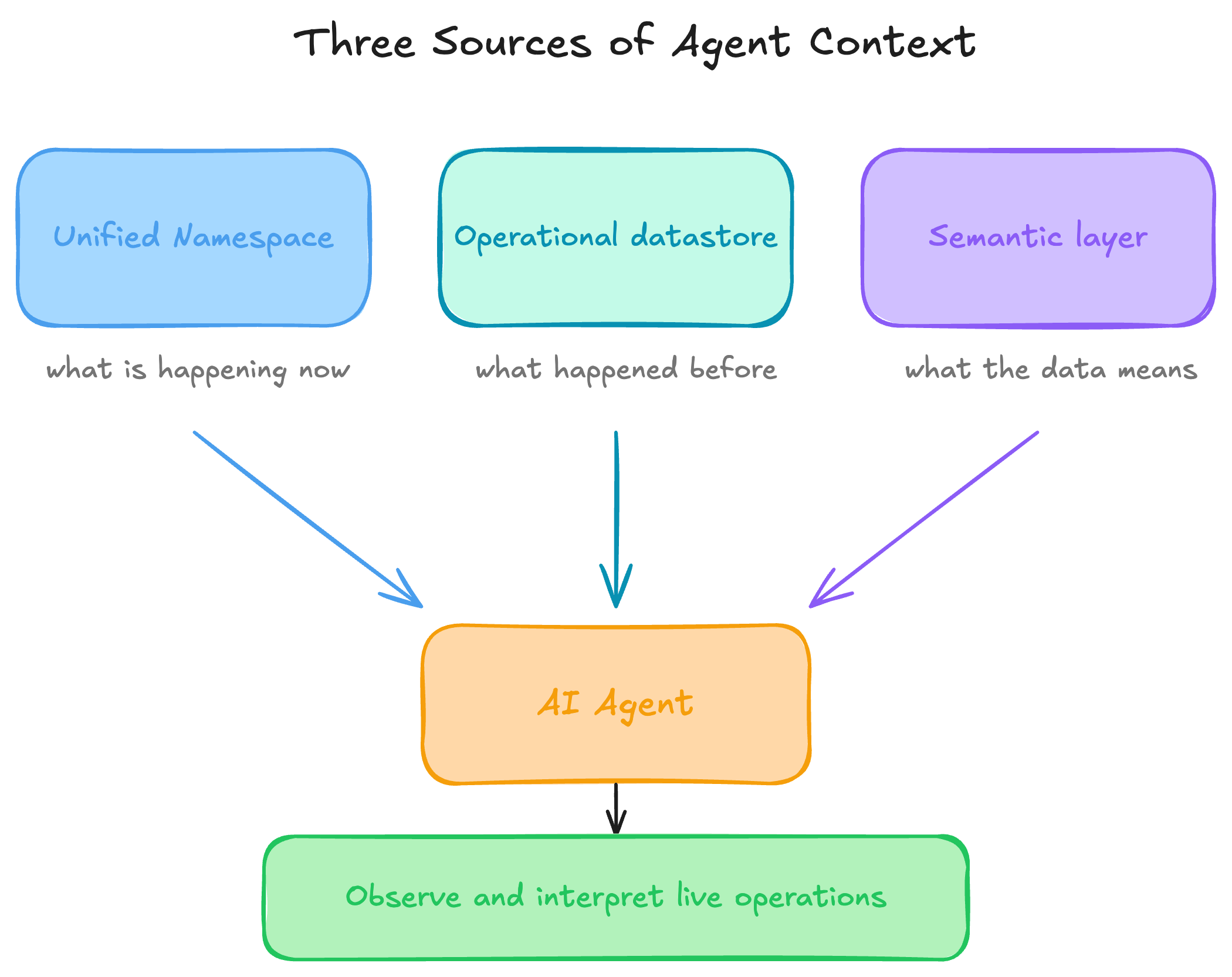
Together, these layers allow an AI agent to move from answering questions about manufacturing to observing and interpreting live operations.
Why database access alone is not enough
Imagine an AI agent helping supervise a packaging line. If the agent only has access to a historian, SQL database, or lakehouse, it can answer questions such as, “How often has this filler faulted over the past 30 days?” That can be valuable, but the architecture still leaves another important question unanswered: how does the agent know that the filler has faulted right now?
It could poll a database, query an API every few seconds, or depend on another application to tell it that something has changed. An event-driven architecture works differently.
When equipment state changes, that state can be published into the Unified Namespace. Interested consumers subscribe to the relevant part of the namespace and receive the change as it happens. A dashboard can update, a maintenance workflow can react, an operational datastore can persist the event, and an AI agent can be notified.
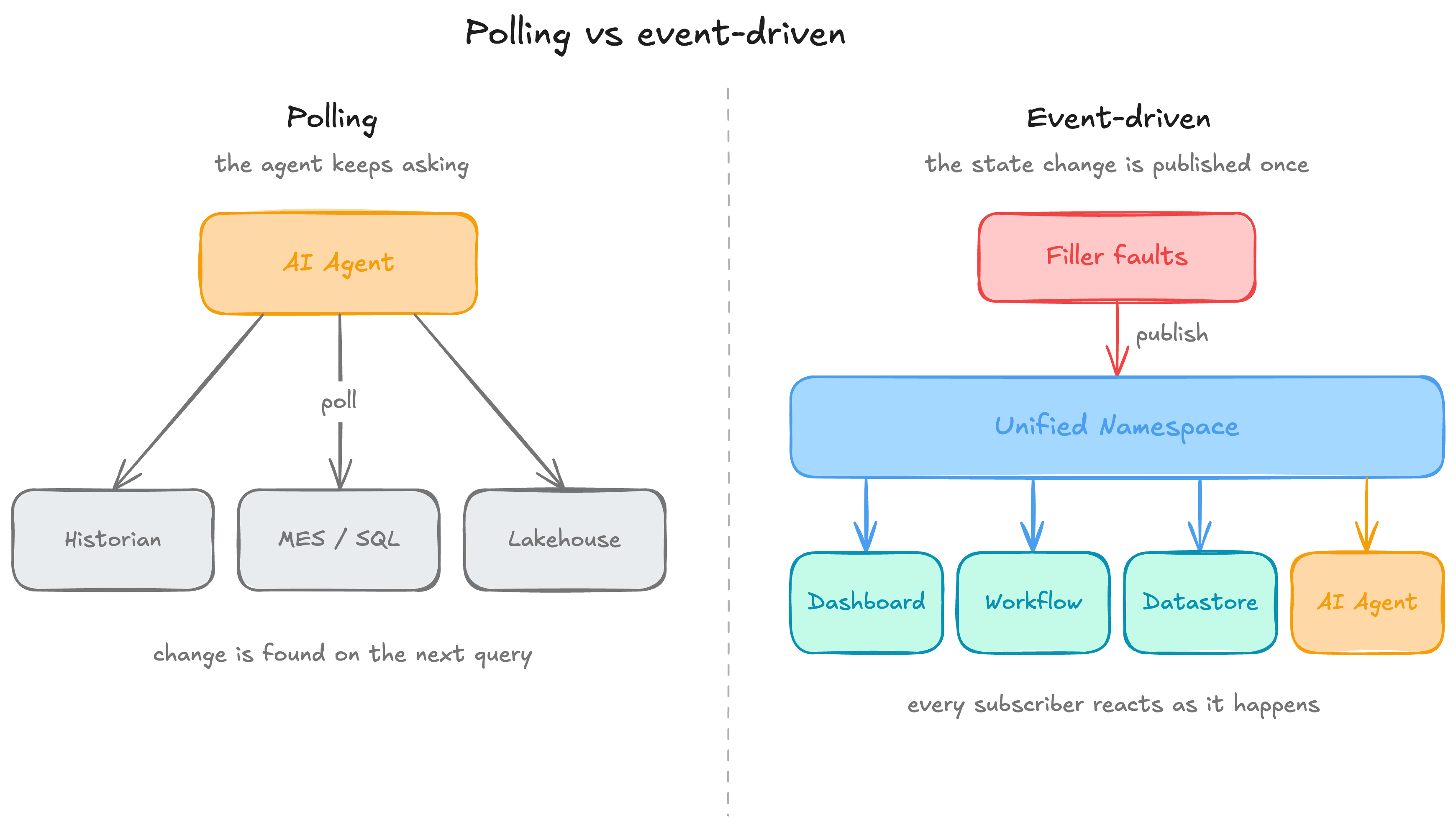
The agent therefore does not need to keep asking every plant system whether something changed. It can listen for the operational events that matter. This is a different interaction model from simply giving an LLM a collection of tools and expecting it to decide when to call them. The UNS can provide the trigger that tells the agent when there is something worth investigating.
The UNS gives the agent a live operational picture
A well-designed Unified Namespace represents current operational information in a predictable hierarchy and common data model. Instead of an agent learning separate interfaces for a PLC, historian, MES, quality system, energy platform, and maintenance application, relevant operational information can be exposed through a shared event-driven structure.
An agent might subscribe to equipment state changes, work order lifecycle events, batch events, production KPIs, quality events, alarms, abnormal conditions, or selected live process measurements. The greater value is not simply that MQTT can deliver messages quickly, but that the UNS provides a common operational interface across heterogeneous systems.
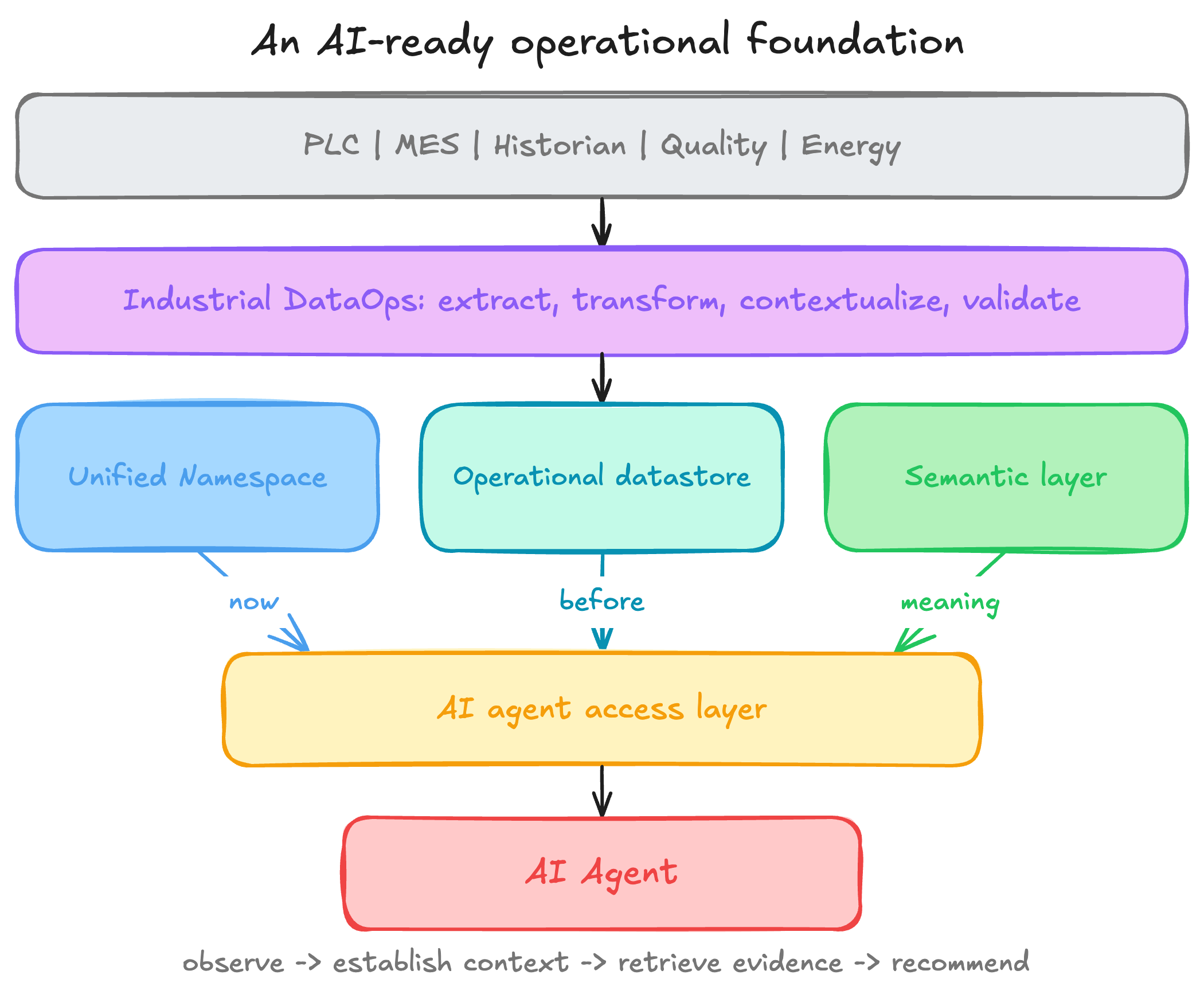
The underlying applications can continue performing their established roles, with the MES managing production execution, the historian storing time-series history, and the PLC controlling equipment. Industrial DataOps pipelines can then extract, transform, contextualize, and validate the relevant information before publishing it into a common operational structure.
For the AI layer, this means less source-specific integration. The agent can work with a consistent representation of operational information instead of needing to understand the proprietary interfaces and data structures of every system underneath it.
Events are especially important for agents
Not every value published through a UNS is an event. Telemetry such as temperature, pressure, speed, current, and vibration still matters, particularly during an investigation. But meaningful operational events can be especially useful because they identify moments when something has changed and reasoning may need to begin.
Events such as BatchStarted, BatchCompleted, WorkOrderActivated, WorkOrderCompleted, EquipmentFaulted, QualityHoldPlaced, and QualityHoldReleased each represent a change in operational reality.
An AI agent does not need to reason about every value flowing through the plant. It can subscribe to the events and conditions that define when reasoning should begin.
For example, a QualityHoldPlaced event could trigger an agent to gather the affected work order, batch, equipment, recent process conditions, active recipe, and previous quality deviations. The agent could then prepare an investigation summary for a quality engineer.
An EquipmentFaulted event could trigger a different workflow. The agent might retrieve recent operating history, compare the fault with previous incidents, check available maintenance information, and present likely causes with supporting evidence.
The UNS therefore provides the event signals that can initiate industrial AI workflows.
Different layers answer different questions
The Unified Namespace is only one part of an AI-ready operational architecture. An agent investigating a live manufacturing condition usually needs several kinds of context at the same time.
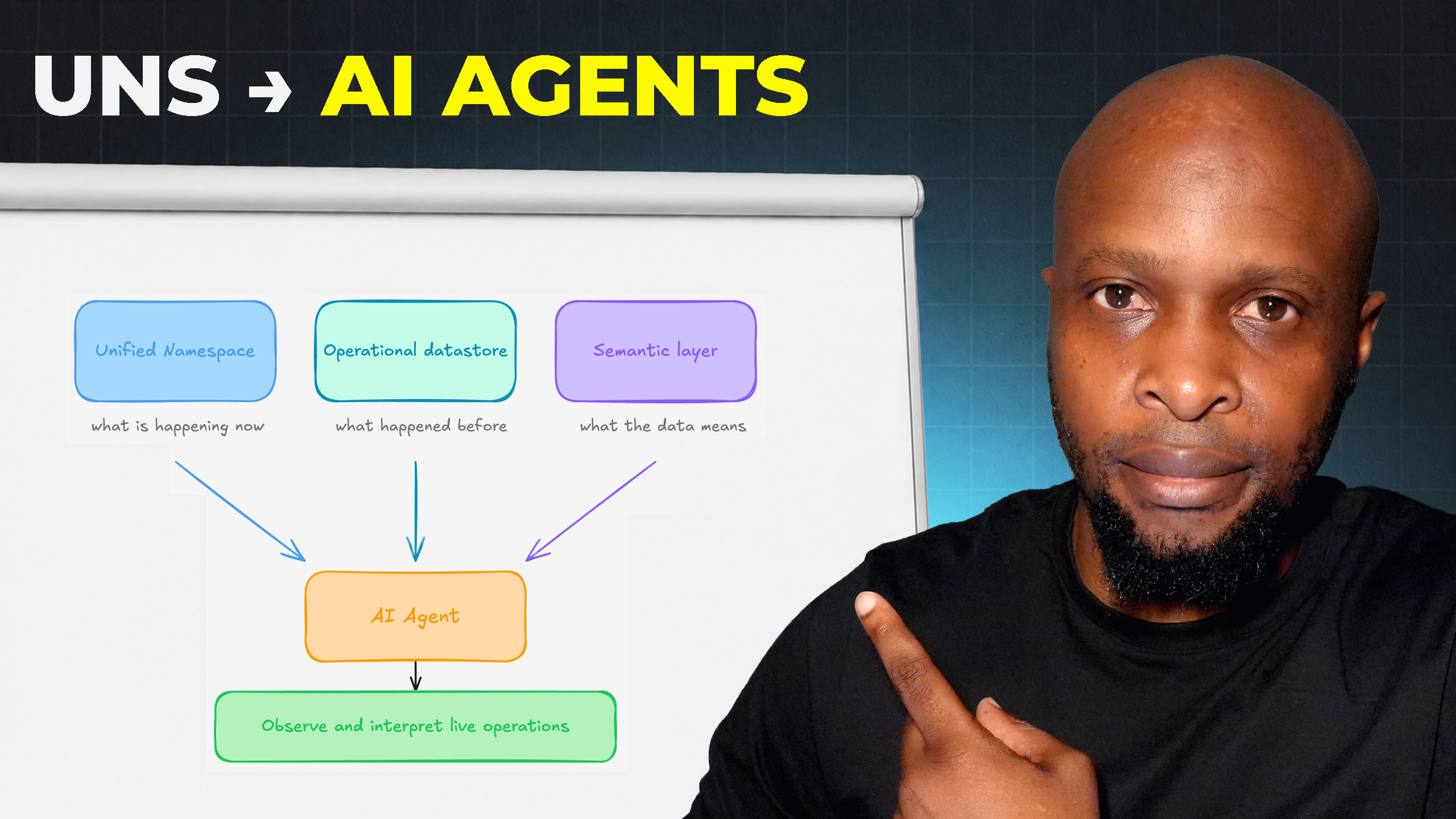
The UNS answers what is happening now. An operational datastore answers what happened before. A semantic layer answers what does this mean.
Suppose a homogenizer enters a faulted state during an active batch. The UNS may tell the agent that HG401 has just transitioned from Running to Faulted, that Batch B-4711 is active, and that Work Order WO-123 is currently executing. That provides the live operational picture.
The operational datastore can provide the historical evidence. The agent might retrieve pressure, motor current, temperature, previous state changes, batch history, and earlier faults involving the same equipment.
The semantic layer adds meaning. It can tell the agent that HG401 is a homogenizer, where it sits in the production hierarchy, which process it participates in, what a particular pressure measurement represents, and how the equipment, process, product, and production records are related.
The value emerges when the agent can combine all three rather than treating each source as an isolated tool.
From notification to investigation
A useful industrial AI agent should rarely respond to an event in isolation. Take an equipment fault as an example. The UNS message should be treated as the beginning of an investigation, not the complete context.
The agent can use the equipment identifier contained in the event to retrieve related information from the other layers. It might query the semantic layer to establish what the equipment is, where it is located, which line it belongs to, and which measurements are relevant. It can then query the operational datastore for the previous 30 minutes of operating conditions, the active work order, recent states, similar historical faults, and related quality events.
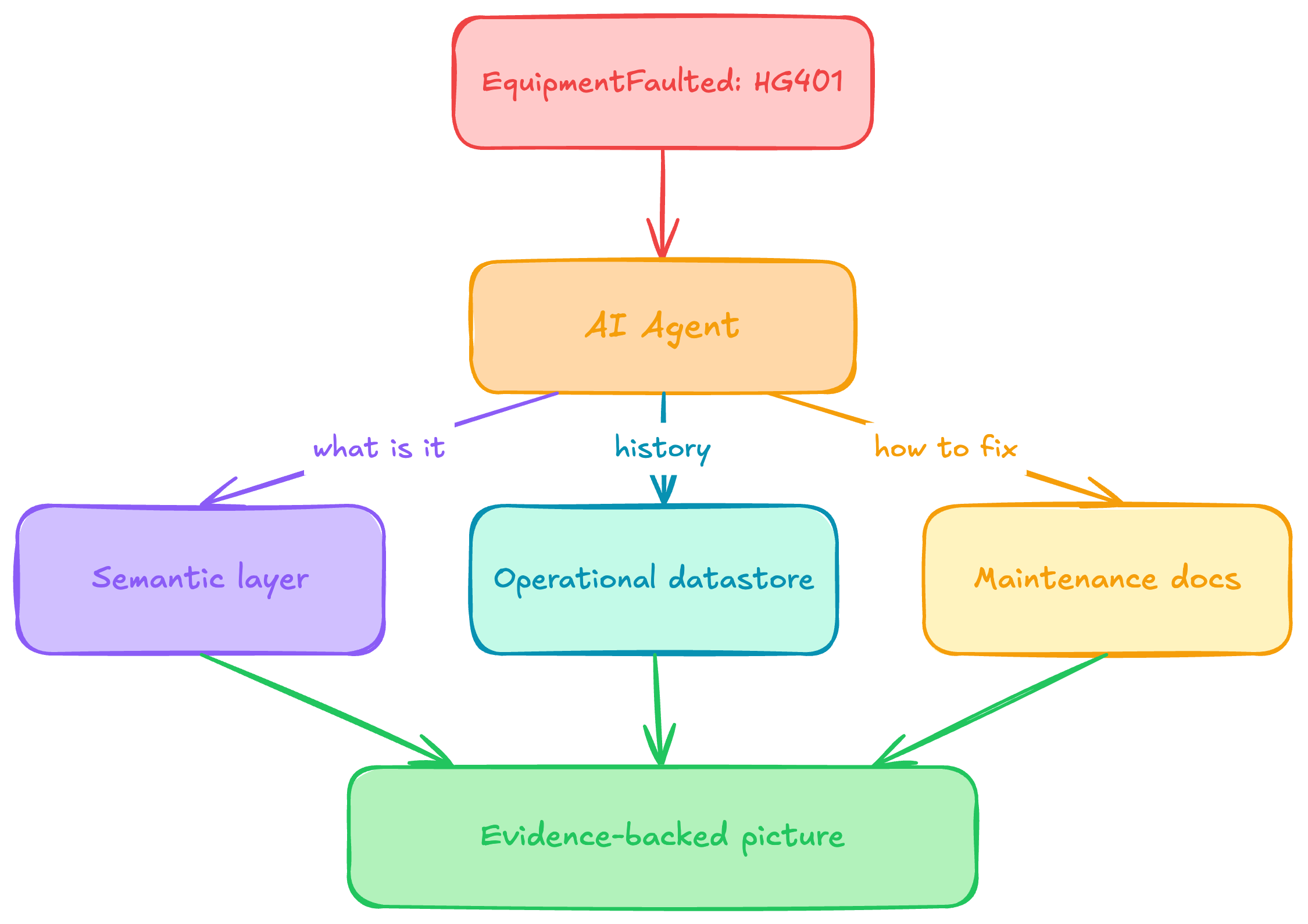
If maintenance documents or procedures are available through a separate enterprise knowledge system, the agent can retrieve those as well. The result is an evidence-backed operational picture assembled around a live event, rather than a model trying to answer “Why did the filler stop?” without structured manufacturing context.
This pattern can be applied far beyond equipment faults. A production agent could investigate why a work order is falling behind schedule. A quality agent could gather the process conditions surrounding a deviation. An energy agent could investigate a sudden increase in consumption relative to the active production state.
The real-time event determines when to investigate. The other layers provide the evidence needed to determine what is happening and why.
The agent should not subscribe to everything
Making operational data available to AI does not mean streaming the entire plant into an LLM. The agent access layer should determine which information an agent is allowed to observe and which conditions are relevant to its role.
A maintenance agent may care about equipment faults, abnormal vibration, runtime thresholds, maintenance states, and selected process conditions. A production agent may care more about work orders, batch transitions, cycle performance, downtime, and schedule deviation. A quality agent may subscribe to holds, releases, deviations, inspection outcomes, and process conditions associated with affected material.
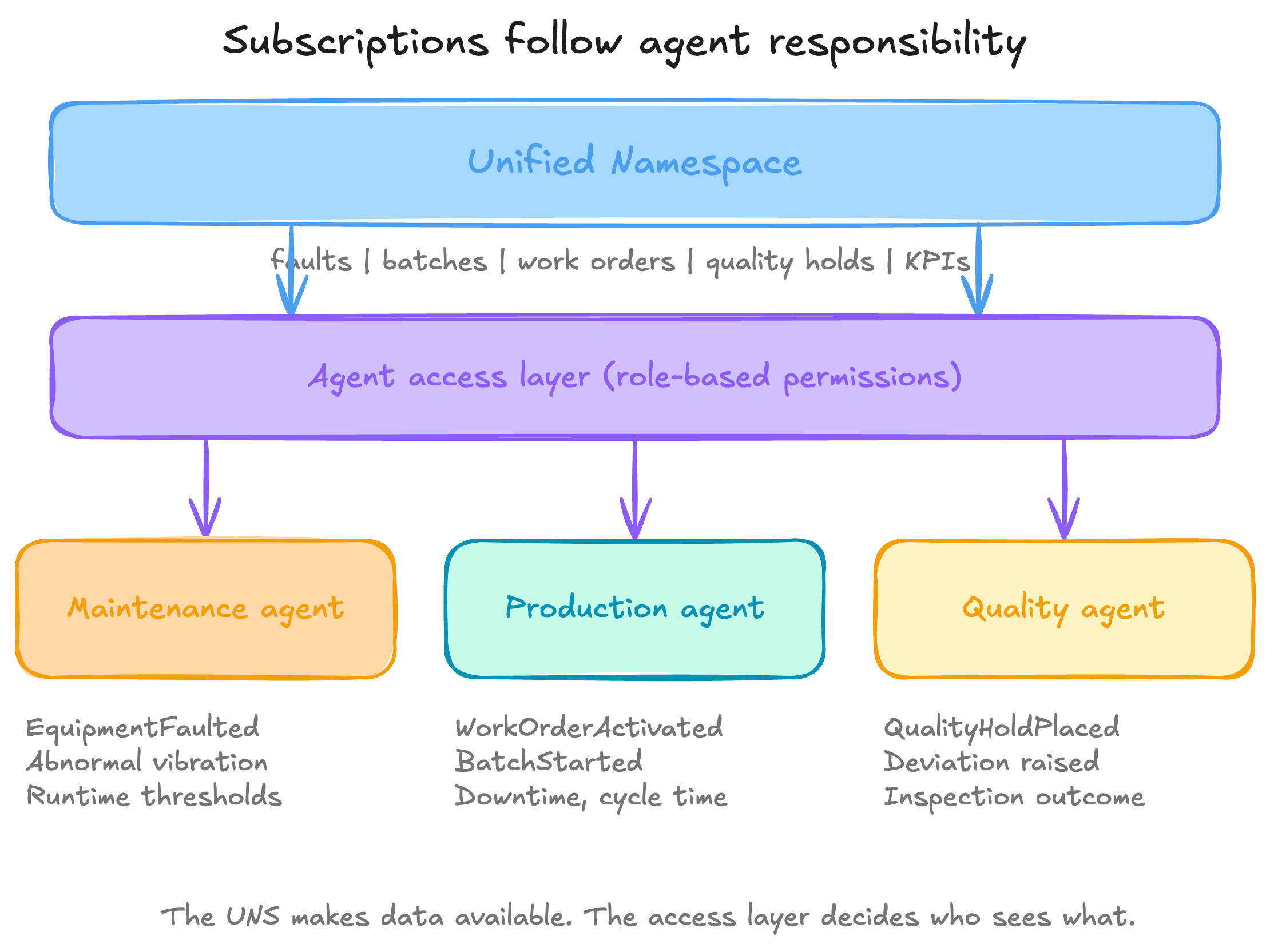
This suggests an important design principle: subscriptions should be aligned with agent responsibilities. The UNS provides broad operational availability, while the agent architecture narrows it into controlled, role-specific access.
That access layer can also determine which historical queries, semantic relationships, documents, applications, and actions are available to the agent. The objective is not unrestricted access to manufacturing information, but deliberate access to the operational context needed for a specific responsibility.
Stable identities connect the layers
For an agent to move reliably between real-time, historical, and semantic context, the same operational entities must be identifiable across the architecture. If an event refers to equipment as HG401, the historical platform, semantic model, and related enterprise systems need a way to resolve that identity consistently.
The same applies to work orders, batches, materials, products, production lines, recipes, and other operational entities. A live event might therefore include identifiers such as equipmentId, workOrderId, batchRecordId, productCode, eventId, timestamp, source, and correlationId.
Those identifiers let the agent use the event as a starting point and gather supporting context. Without shared identity, it is left performing brittle entity matching across disconnected sources.
This is why AI readiness begins much further down the architecture than the AI model itself. Consistent identity, models, timestamps, provenance, and relationships make it possible for the AI layer to assemble a coherent view of the operation.
Semantic context becomes a guardrail for reasoning
Industrial operations contain many terms whose meaning depends on context. A state called Running may refer to equipment, a process, or a work order. A pressure value may represent inlet pressure, discharge pressure, or a stage-specific measurement. A work center may contain several pieces of equipment performing different roles.
An ontology or knowledge graph can make those relationships explicit. The agent can determine that a specific equipment instance is a Homogenizer, that it is located in Line 1, that it participates in a Homogenization process, that a pressure metric represents a defined process property, and that the active batch is associated with a particular product and recipe.
This structured context constrains interpretation. Instead of asking the model to infer important relationships each time, the architecture provides them as part of the operational knowledge model.
The semantic layer therefore complements rather than replaces the UNS. The UNS tells the agent that something has happened. The semantic layer helps it understand the entities and relationships involved.
Real-time does not mean autonomous control
Once an AI agent can observe live operations, it is tempting to jump directly to autonomous action. That should not be the default assumption, because there is a significant difference between detecting a production condition, recommending an action, initiating a governed workflow, and directly writing to a control system.
For many industrial use cases, early adoption will focus on observation, investigation, decision support, and workflow coordination. An agent may detect that a batch has deviated from expected conditions, gather evidence, explain the likely cause, and notify the appropriate engineer. It might create a maintenance recommendation or prepare information for a quality review.
Where actions are permitted, they should pass through clearly defined interfaces, authorization rules, and deterministic business logic. The UNS can distribute state and events, but it should not become a shortcut around the controls that govern production systems.
AI-ready operations require both access and boundaries.
Building an AI-ready operational foundation
The architectural pattern is relatively straightforward. Industrial DataOps prepares trusted operational information from heterogeneous source systems. The Unified Namespace exposes current state and meaningful events through a common real-time interface. The operational datastore preserves historical evidence, while the semantic layer provides shared meaning and relationships.
An AI agent access layer can bring those sources together under controlled permissions and tools. The agent can then observe a change, establish context, retrieve supporting history, reason over the evidence, and either recommend or initiate an appropriate next step.
The model itself is only one component. The harder architectural problem is creating an environment in which it can reliably determine what is happening, what happened before, what the information means, and what it is allowed to do.
The UNS as part of the AI interface to operations
The Unified Namespace should not be described as an AI platform, and it does not need to become one. Its role is more foundational.
It gives applications and agents a decoupled, event-driven interface to operational state. That makes it possible for AI systems to participate in manufacturing without requiring every agent to understand the proprietary details of every PLC, MES, historian, database, and plant application underneath it.
For industrial AI agents, that changes the interaction model. The agent can listen rather than constantly poll. It can react to meaningful events rather than repeatedly search for change. It can use stable identities to move from a live signal into historical and semantic context. And it can build its reasoning around a structured representation of the operation rather than an improvised collection of disconnected data sources.
That is what makes the architecture AI-ready.
The goal is not simply to connect AI to more manufacturing data. It is to give AI a coherent operational context: what is happening now, what happened before, and what it means.
Get the Next Guide
New architecture guides, implementation tutorials and use-case blueprints, delivered as they’re published.
More guides
All guides →

The leading IIoT & AI educational platform for digital manufacturing teams