
A practical guide to turning fragmented plant-floor data into trusted, contextualized and reusable operational information that can support a Unified Namespace, MES, enterprise analytics, machine learning and AI.
Industrial DataOps is the data engineering layer between raw industrial systems and the applications that need trusted, usable operational data. It acquires data from heterogeneous OT and plant IT sources, gives it identity and context, maps it into common information models, validates it, and delivers it in the form required by each destination.
Connecting a PLC, historian, DCS or MES to another application does not automatically make its data usable. Industrial systems expose information according to the needs, conventions and constraints of the systems that produced it. Industrial DataOps is the layer that turns that source-specific data into information other systems can reliably understand and reuse.
The term covers a set of engineering practices and capabilities rather than a single product. A DataOps pipeline may connect to OPC UA, a PI System historian, a relational database or a controller; resolve identities and plant hierarchy; normalize engineering units and timestamps; transform proprietary structures into common models; validate the result; and then publish or persist the information for downstream consumers.
What has to happen to the source data before it is useful enough to be shared?
This becomes increasingly important as the same operational information is expected to support more than one application. A motor current value that was once used only by a local SCADA screen may now need to support maintenance analytics, an enterprise performance dashboard, an operational datastore and an AI agent. Those consumers should not each have to learn the tag naming conventions and quirks of the original control system.
Modern plants already contain enormous quantities of useful operational data. The difficulty is that the information is fragmented across decades of automation and plant IT systems, each with its own protocols, structures, timestamps, identifiers and semantics.
At one plant, the mixer speed may be exposed as MIX04.SPD_PV. At another, the equivalent value might be Line1/Mixer4/ActualSpeed. A third site may only expose it through a historian tag. Even when the measurements mean the same thing, their source representation does not.
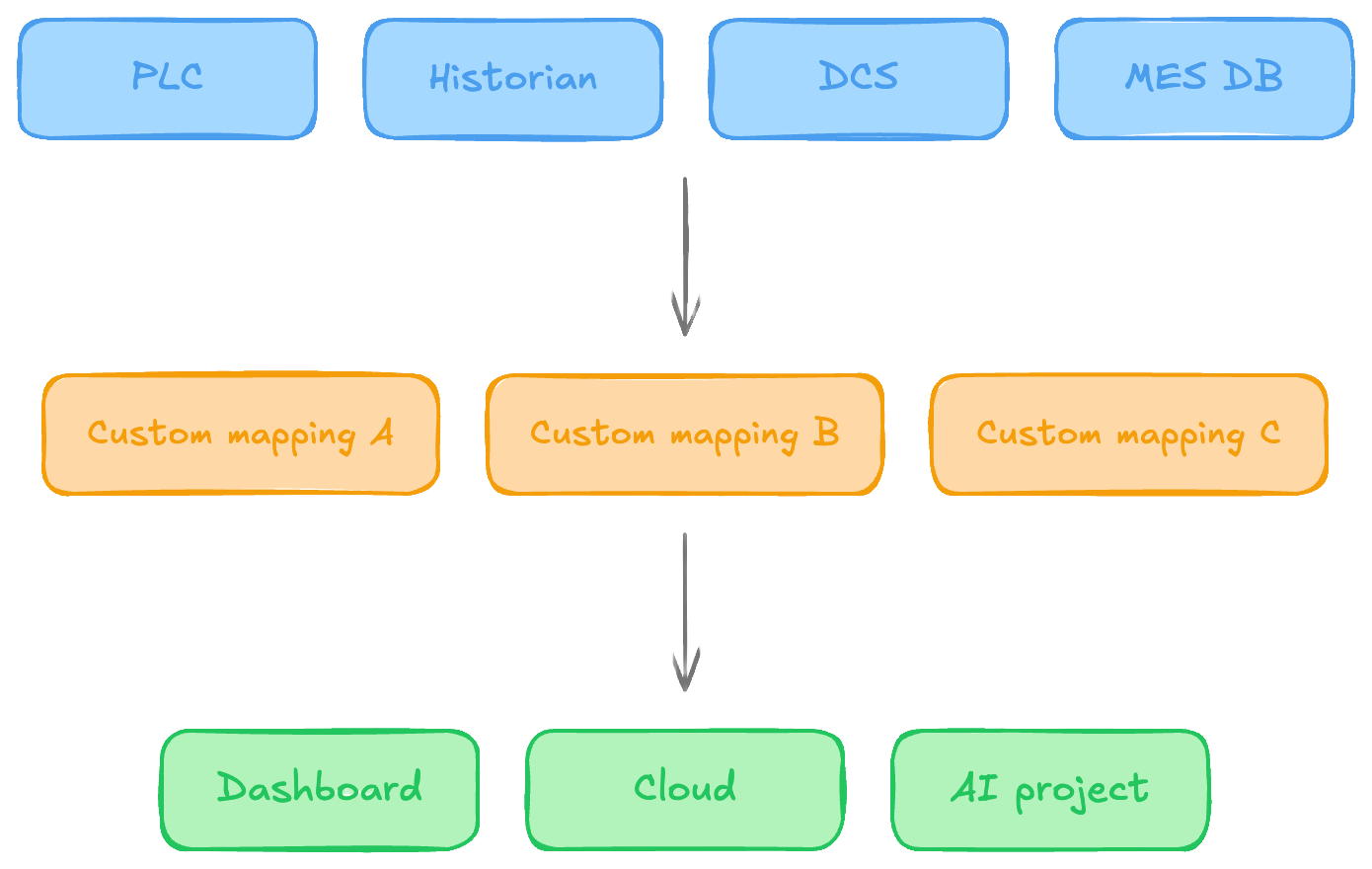
Industrial DataOps replaces that repeated effort with managed pipelines and reusable information contracts.
DataOps sits close enough to the operational systems to understand their source data, but its purpose is not simply connectivity. The objective is to create a governed translation layer between local plant reality and the information models expected by the rest of the architecture.
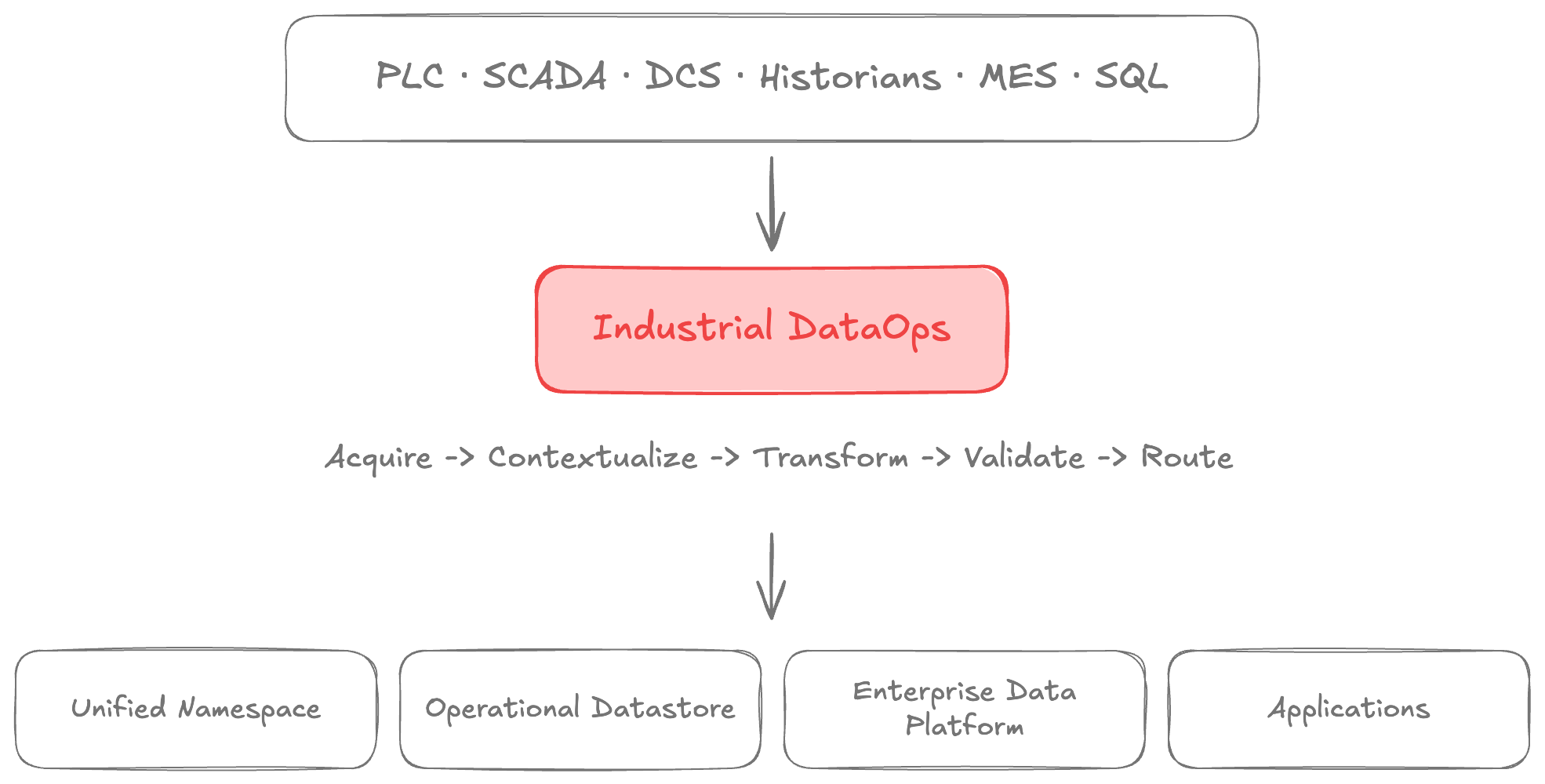
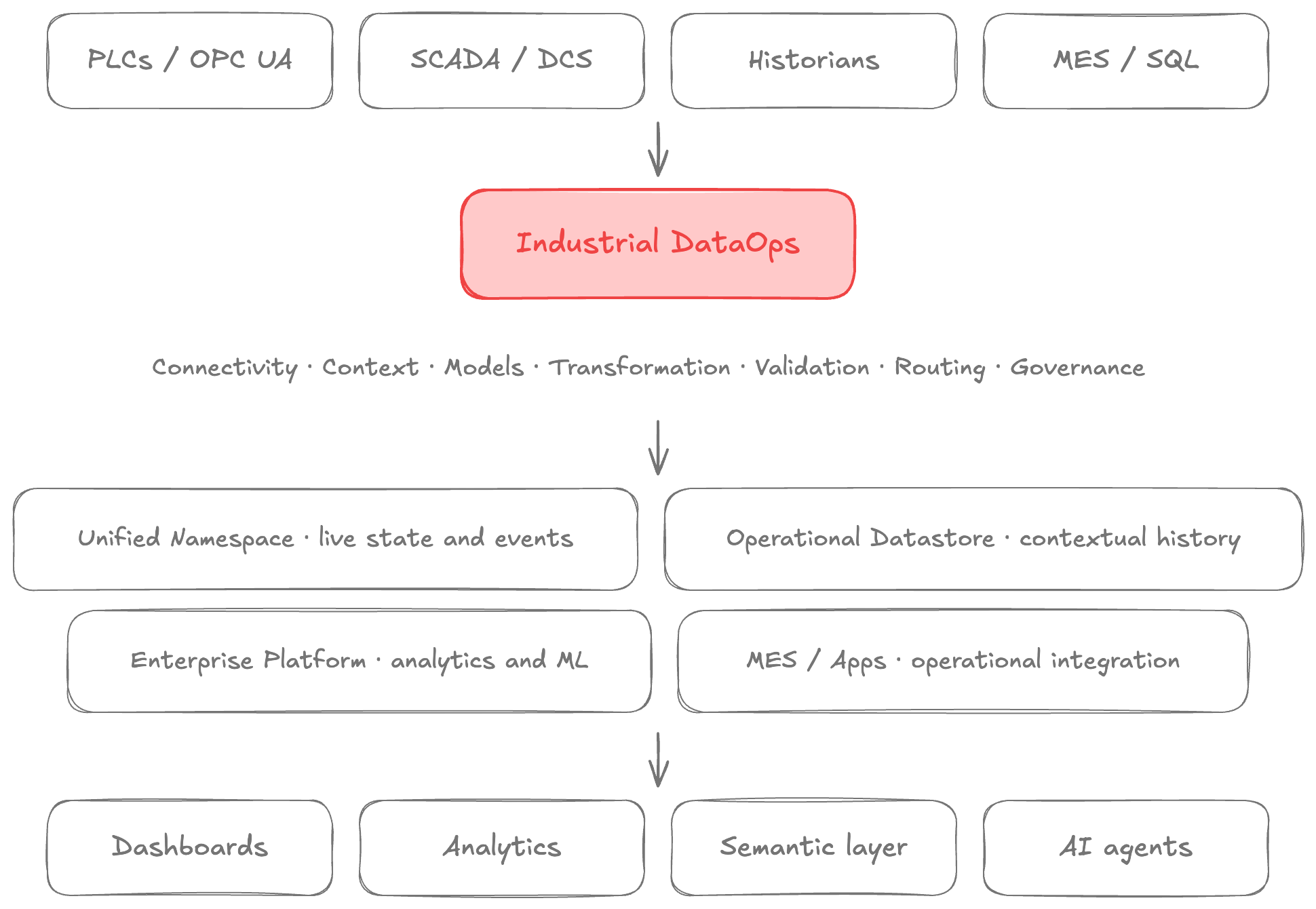
The same DataOps environment can support more than one destination. Live state and events may be published into the Unified Namespace. High-volume historical data may be aggregated and delivered directly to an enterprise data platform. Plant IT records may be transformed into a schema expected by MES or another business application.
Implementations vary, but the architectural responsibilities are remarkably consistent. They form a pipeline that converts local source data into governed operational information.
Connect to OT and plant IT systems using the protocols and access patterns those systems actually support.
Resolve what a value represents, where it belongs, which asset produced it and which operational entity it relates to.
Normalize source structures, units, names and events into reusable enterprise information models.
Check schemas, timestamps, units, ranges, required context and other rules before bad data propagates downstream.
Deliver each class of information to the systems that need it, in the shape and cadence appropriate for that destination.
Version models, manage pipelines, track deployment differences and make changes reusable across lines and sites.
Industrial DataOps starts with reality: brownfield plants are heterogeneous. One site may rely on Siemens PLCs and PI System, another on Rockwell controllers and FactoryTalk, while a third exposes process data from a DCS and operational records from relational databases.
The aim is not to force those underlying environments to become identical. DataOps provides the connectors and extraction patterns required to interact with them while keeping the downstream information contract consistent.
Connectivity retrieves the data. DataOps makes the retrieved data usable. A protocol conversion from OPC UA to MQTT is useful, but it is not sufficient if the consumer still receives cryptic node names, missing context and inconsistent units.
A source value such as FIC101.PV, Speed_04 or MTR7_Current may make perfect sense to the engineer who owns the system. It is much less useful to an enterprise application that needs to compare assets across sites or reason about production conditions.
Contextualization attaches the identities and relationships that make the value understandable outside its source system.
Source tag:   MIX04.SPD_PV
Value:        1180
Unit:         rpm

Contextualized information:
equipmentId:      EQ-MUC-MX004
equipmentClass:   Mixer
workCenterId:     WC-MUC-200-L1
siteId:           SITE-MUC
enterpriseId:     GLOBAL-IND
metric:           ActualSpeed
unit:             rpm
sourceSystem:     PLC-L1
quality:          Good
Once stable identities exist, the same information can be related to work orders, batches, products, recipes, equipment definitions and other operational entities without each consumer reverse-engineering local tag structures.
Context is most useful when it follows repeatable information models rather than being added ad hoc. DataOps therefore applies mappings between local source structures and a common representation that the organization can reuse across sites.
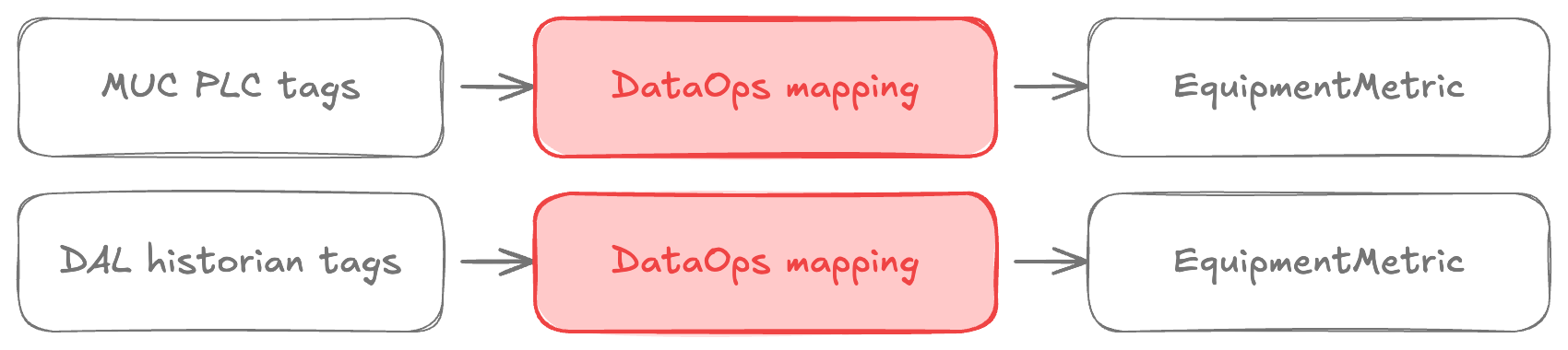
Models can cover measurements, equipment definitions, equipment state, production events, work orders, batches, quality events, energy information and other operational concepts. The objective is not to model the entire factory on day one. Model the information required by real use cases, then expand the common vocabulary deliberately.
Once operational data leaves the local OT environment, its consumers often no longer have the tribal knowledge needed to recognize bad values. A process engineer may know that a particular sensor briefly reports zero during a cleaning cycle; an enterprise analyst or AI model may interpret that zero as a real process condition.
Validation should therefore happen as part of the pipeline, close to where the data is transformed.
Validation rules can also protect shared interfaces from accidental breaking changes. If a site begins publishing an incompatible payload or omits a required identifier, the issue should be caught at the DataOps boundary rather than discovered later by every downstream application.
The same source data may support very different workloads. A live operational application needs timely current state and event signals. A machine-learning pipeline may need months of historical data, aggregates and carefully selected features. An MES integration may need transactional or event objects mapped into a specific schema.
Publish selected current state and meaningful events into the Unified Namespace for dashboards, workflows, coordination and agents that react to change.
Aggregate, contextualize and prepare history before loading it into an operational datastore, warehouse or lakehouse for analytics, model training and root-cause investigation.
Do not force every destination to consume the same raw representation simply because it came from the same source. Reuse the context and models, but shape the delivery for the workload.
Industrial architectures become easier to reason about when each layer has a clear responsibility. DataOps is often confused with connectivity, the Unified Namespace, a historian or an enterprise data platform because real products may combine several of these capabilities.
| Layer | Primary responsibility | Typical question |
|---|---|---|
| Connectivity | Access protocols and move data from source systems. | How do I retrieve this value? |
| Industrial DataOps | Contextualize, transform, validate and route source data into trusted information. | What must happen before this data is useful? |
| Unified Namespace | Distribute and discover current operational state and meaningful events through a shared real-time interface. | How do consumers access what is happening now? |
| Operational datastore | Persist queryable operational history and context. | What happened, and under what conditions? |
| Semantic layer | Represent meaning, classes, relationships and rules across domains. | What does this entity mean and how is it related? |
DataOps and the Unified Namespace are complementary. The UNS provides a common real-time distribution and discovery layer. DataOps prepares the source data so that what enters that shared layer is already contextualized, structured and trustworthy.
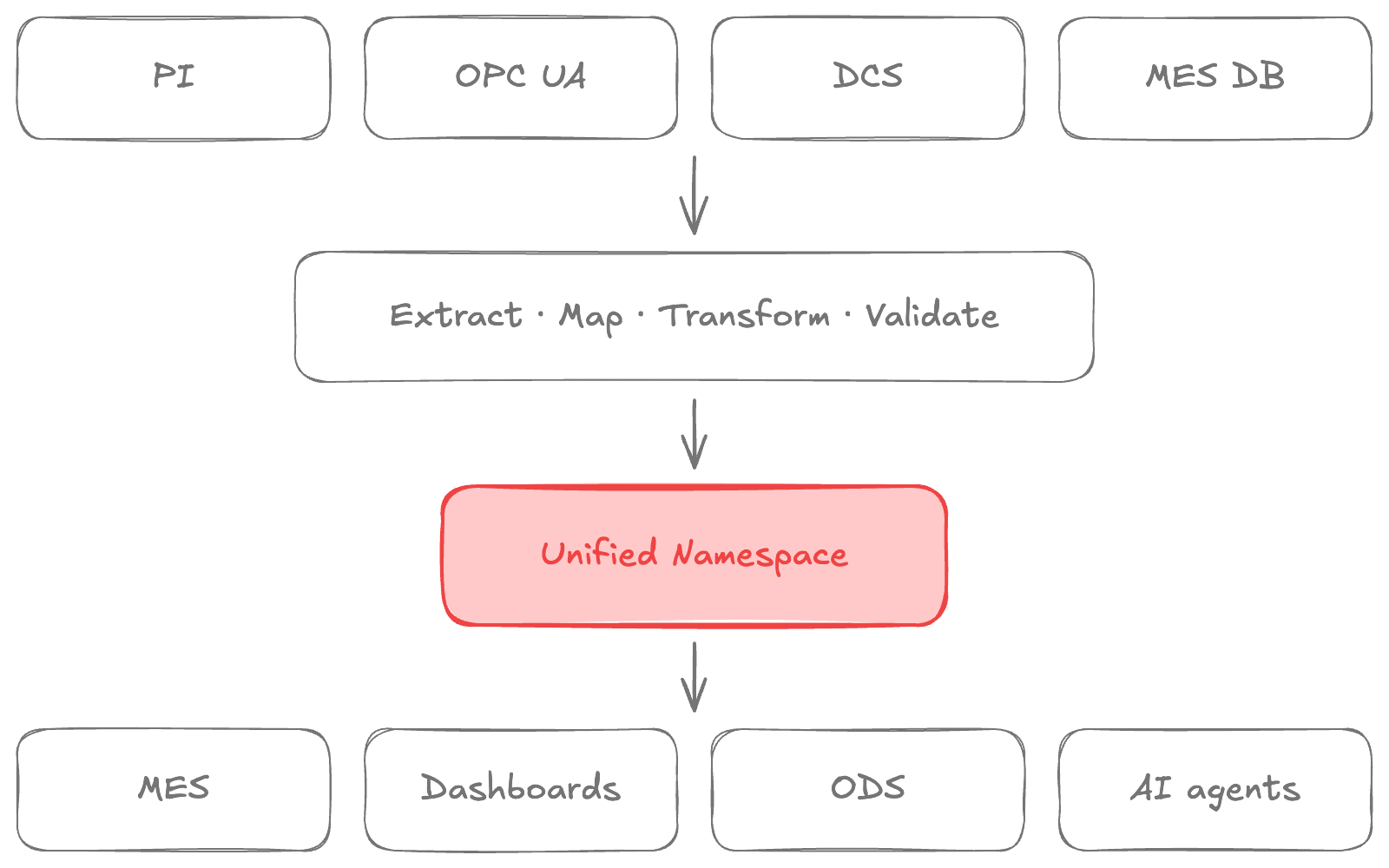
This separation prevents a common anti-pattern: publishing raw tags into MQTT and expecting every downstream consumer to interpret them independently. A shared namespace is most valuable when the information within it already follows common identities, semantics and contracts.
Many manufacturers already have years or decades of trusted process history in systems such as PI. Rebuilding that data collection directly from thousands of controllers is often unnecessary. The historian can remain the authoritative source for historical time-series data while DataOps adds the context, models and delivery mechanisms required by new consumers.
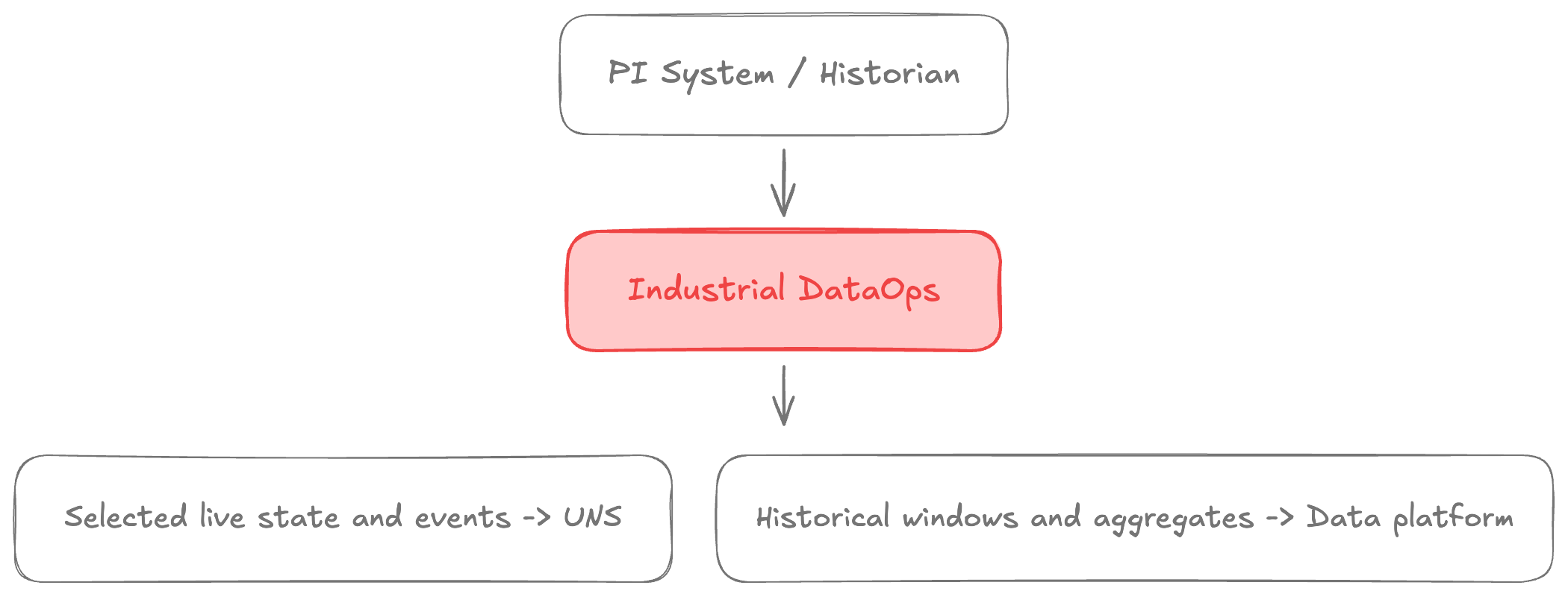
For historical analytics and machine learning, DataOps can aggregate, contextualize and prepare PI history before sending it to an enterprise platform. For live operational intelligence, selected state and meaningful events can be published into the UNS. The historian continues doing what it is good at; DataOps makes its information reusable in the broader architecture.
An MES often needs information from many of the same plant systems that dashboards, historians, maintenance applications and AI will eventually need. If every MES rollout creates its own point-to-point integrations, the organization solves the immediate project while increasing the cost of every future use case.
A DataOps layer moves those reusable integrations below the application layer.
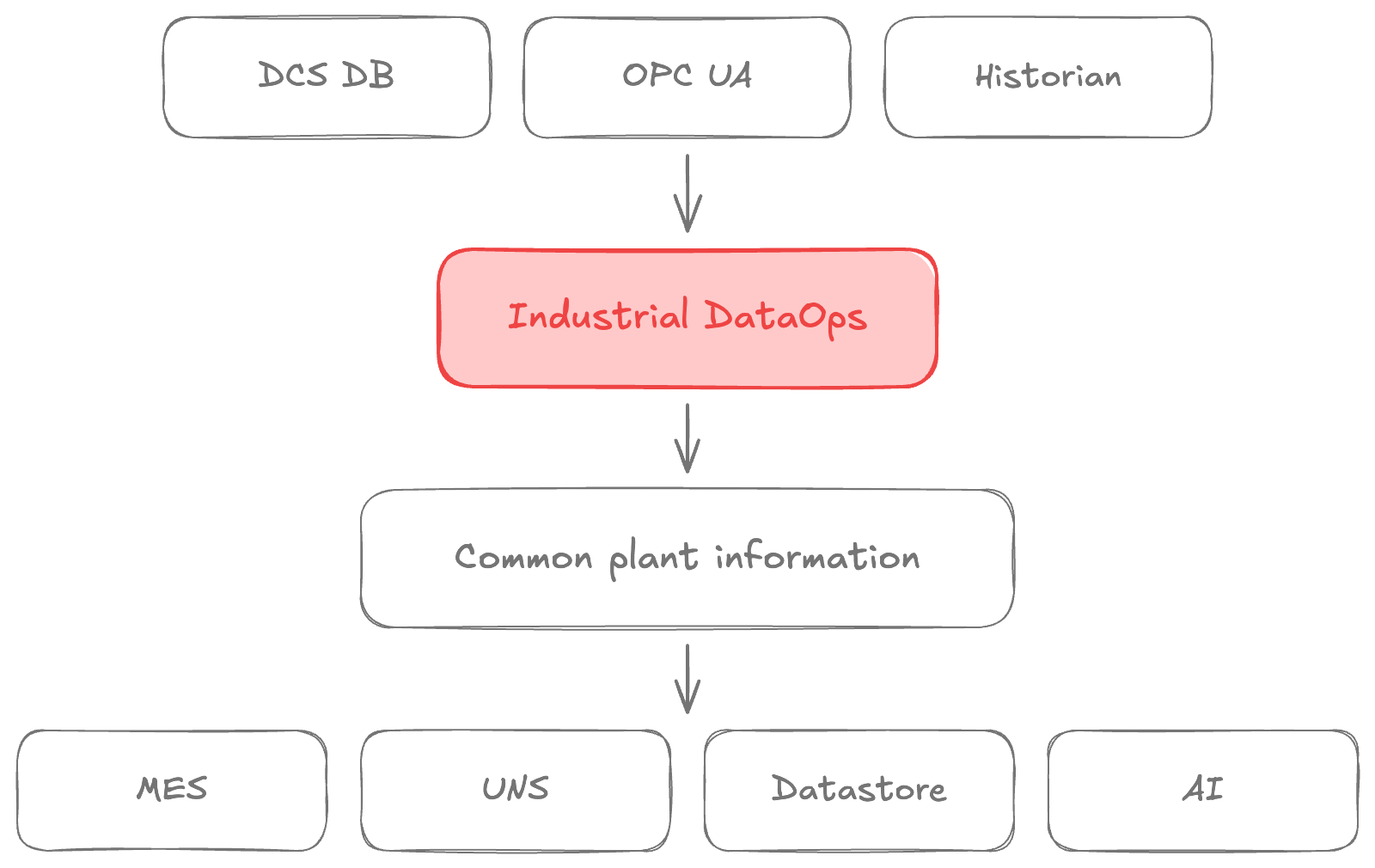
MES can then consume stable equipment identities, states, production context and process information while publishing its own execution events, such as WorkOrderActivated, BatchStarted or QualityHoldPlaced, back into the shared data foundation.
Not every industrial workload should flow through the Unified Namespace. Large historical extracts, compressed time windows, engineering aggregates and other analytical datasets may be better delivered directly from historians or plant systems into an enterprise data warehouse or lakehouse.
DataOps can provide a governed egress path: select the required history, attach plant and asset context, normalize structures, validate quality, and deliver the result in the format expected by the enterprise platform.

Scaling DataOps across many plants creates a tension between enterprise consistency and local autonomy. The enterprise needs common identities, models, schemas and rules. Individual plants still need the freedom to connect to their actual control systems, historians and databases.
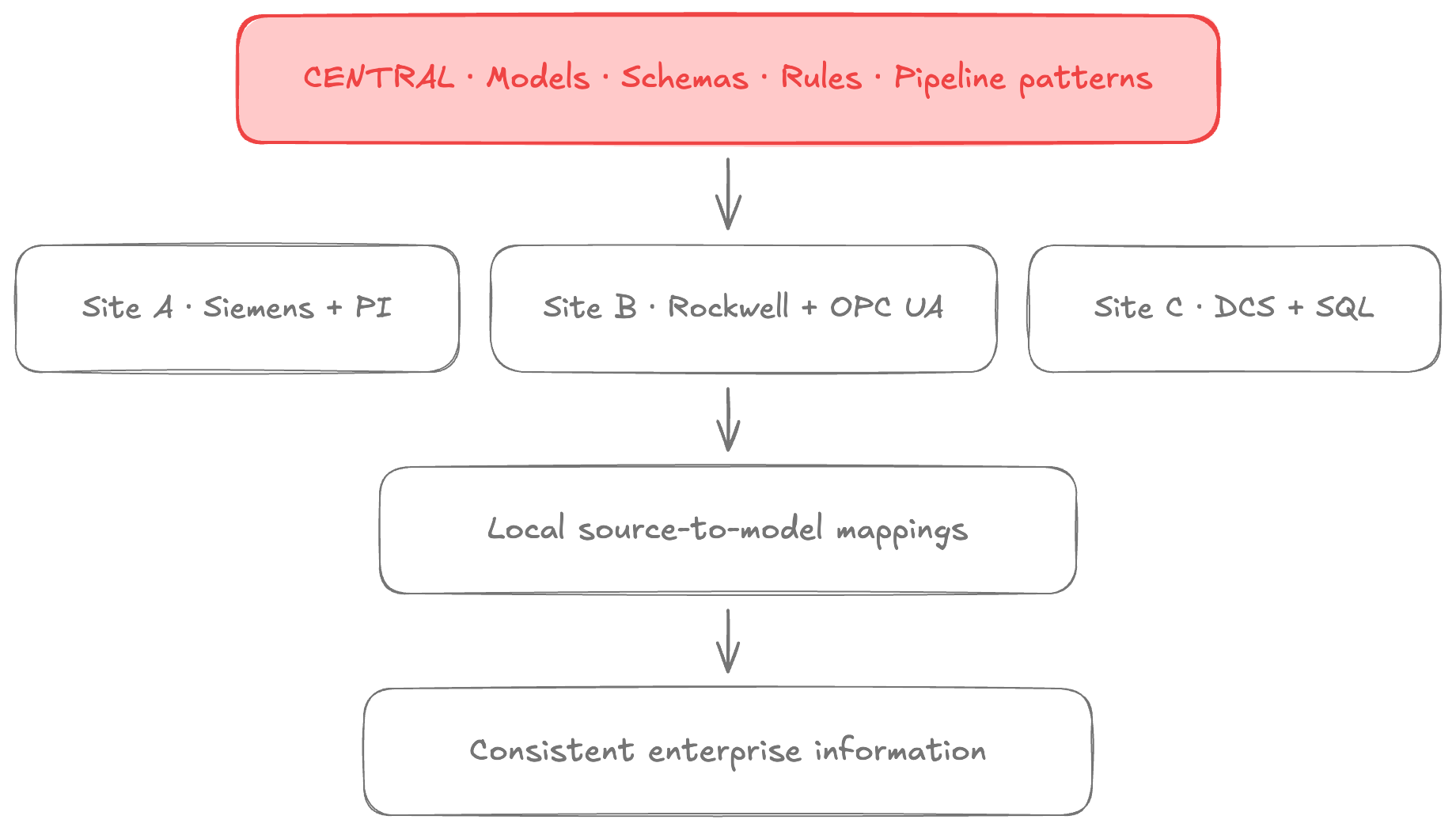
Common information models, schemas, naming, validation rules, namespace grammar, template pipelines and deployment standards.
Connector configuration, tag mapping, source-system nuances, protocol details and plant-specific adaptations.
This is how Site 2 becomes a parameterization exercise rather than a complete rebuild, and how Sites 3, 4 and 20 increasingly become configuration rather than custom engineering.
The first version of a mapping is rarely the hard part. The difficult question is what happens after the architecture is running across twenty factories and the enterprise model changes.
Suppose a new motor information model adds a required ratedPower attribute. A governed DataOps environment should make it possible to answer questions such as:
Model and schema versions should be visible across deployments.
Reusable pipeline instances should be inventoryable rather than hidden in custom code.
Configuration differences should be comparable before centrally managed updates are rolled out.
Validation and versioning should allow gradual rollout rather than synchronized enterprise disruption.
At enterprise scale, DataOps therefore includes configuration management, model lifecycle, deployment visibility, testing and change control, not only data transformation.
AI rarely fails because a factory has no data. It fails because the available data is difficult to identify, combine, interpret and trust. A model or agent needs to know not only that a pressure value is 6.2, but which asset it belongs to, the engineering unit, whether the reading is valid, what production was occurring, where the value came from and how it has been transformed.
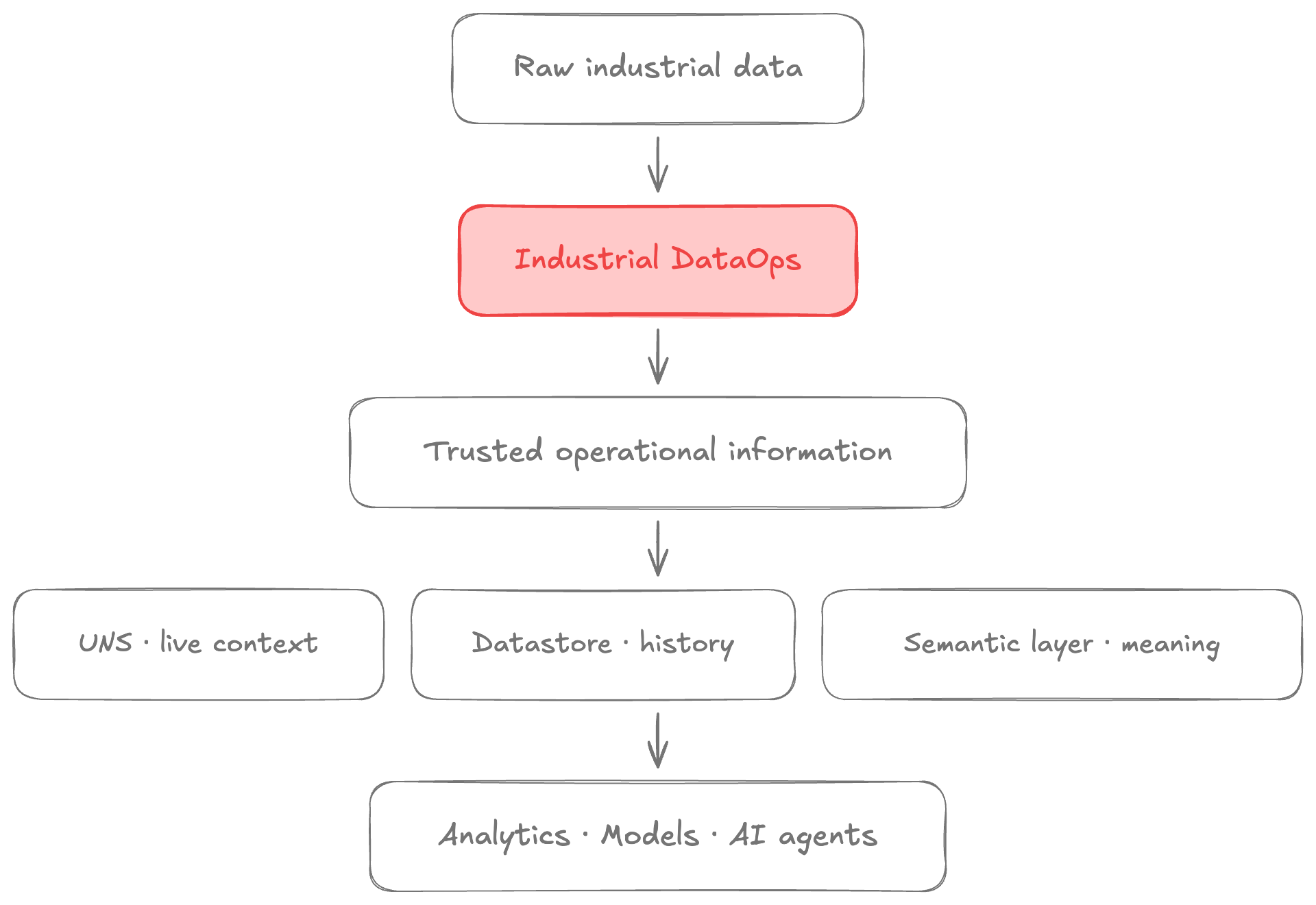
DataOps is therefore one of the foundational capabilities of industrial AI. It does not make data intelligent by itself, but it creates the reliable, reusable input on which analytics, machine learning, knowledge graphs and agentic systems depend.
Point-to-point integrations are not only difficult to maintain; they also make data movement difficult to see and control. When every application establishes its own connection to plant systems, an organization can lose track of who is consuming what, which credentials are in use and which integrations are still required.
A managed DataOps layer provides an explicit inventory of connectors, pipelines, transformations and destinations. It becomes easier to enforce network segmentation, certificate and credential management, rate limits, store-and-forward behavior, quality monitoring and controlled shutdown of data routes.
Data pipelines serving production environments should be treated as operational infrastructure: observable, versioned, testable and recoverable.
Changing OPC UA into MQTT does not solve identity, semantics, quality or model consistency.
A cloud data lake full of cryptic plant tags is still a contextualization problem, just in a different location.
DataOps should create reusable information contracts, not automate the creation of more point-to-point integrations.
Enterprise consistency should exist in the models and contracts presented downstream, not by forcing every plant to use identical technology.
Mappings need versioning, testing and deployment governance once they are reused across sites.
Different destinations have different latency, granularity and context requirements. Route deliberately.
The architecture below shows DataOps as a reusable preparation layer that can feed the real-time, historical and enterprise paths without forcing each destination to integrate directly with every industrial source.
Industrial DataOps should be introduced through real use cases rather than as a multi-year enterprise modelling program. The first implementation should solve an immediate integration need while establishing patterns that can be deliberately reused.
Define the operational outcome and the applications that need the information.
Start with one or two OT or plant IT sources that contain the required data.
Model only the equipment, events, measurements and context needed by the use case.
Extract local data and map it into the common representation.
Make schema failures, missing context, pipeline errors and delivery status visible.
Publish live state to the UNS, persist history, or transform records for the target application.
Separate parameters from logic so the same pipeline can be instantiated at another line or site.
By Sites 3 and 4, the objective should increasingly be deployment of governed patterns rather than custom engineering.
Use this page as the architectural overview. The resources below provide deeper explanation, examples and adjacent implementation patterns.

The leading IIoT & AI educational platform for digital manufacturing teams