
How to Scale a Unified Namespace Across Plants
A practical guide to scaling a Unified Namespace across plants by combining enterprise standards with flexible local DataOps mappings.

A Unified Namespace is straightforward to demonstrate at a single line or plant. Connect industrial systems, define a topic structure, publish contextualized data, and applications can consume a shared operational view. The harder problem begins when the same architecture has to work across ten, twenty, or fifty plants, each with its own controllers, historians, MES products, naming conventions, data structures, and engineering practices.
At enterprise scale, the challenge is no longer simply how to connect data into MQTT. It is how to create consistency across different sites without forcing those sites to become technically identical.
Manufacturing environments are rarely standardized from the bottom up. Trying to eliminate that diversity before building a Unified Namespace would be impractical and creates resistance.
A more scalable approach is to standardize the information contracts exposed at the shared data-foundation boundary while allowing each plant to retain the technologies that fit its operations. The principle: centralize the standards that consumers depend on, and localize the mappings required to translate each plant into those standards.
Standardize the data foundation, not the plant
An enterprise Unified Namespace does not require every site to publish data from identical systems. What matters is whether the information exposed to the rest of the organization is predictable.
Imagine three sites: Site A uses PI System and Siemens automation, Site B combines OPC UA with Rockwell, and Site C relies on a DCS and SQL-based production systems. Their source data may look completely different. Tag names, object hierarchies, units, identifiers, timestamps, and state definitions can all vary. Yet an enterprise application should not need to understand those differences just to determine which lines are running, which work orders are active, or which assets are faulted.
That local variation should be absorbed before the data reaches enterprise consumers. A production application, persistence service, analytics pipeline, or AI agent should be able to subscribe to a known structure and receive information that follows a known contract, regardless of whether the original signal came from a PLC tag, OPC UA node, historian attribute, or SQL query.
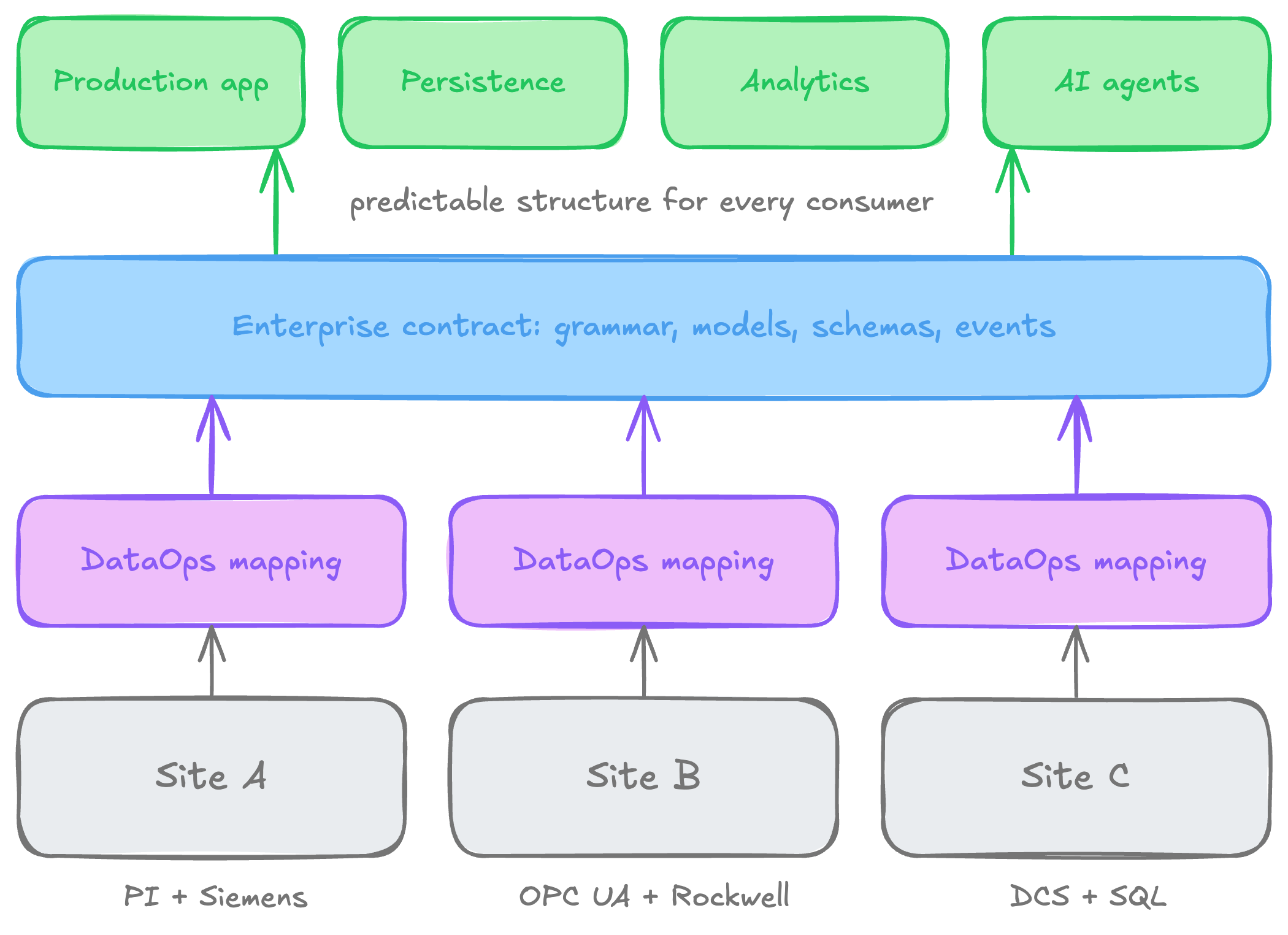
This turns enterprise scaling into a problem of governance, modeling, and Industrial DataOps rather than connectivity alone.
Define enterprise information contracts
Think of a multi-site Unified Namespace as a set of information contracts.
A contract defines what consumers can expect to find, where they can find it, and what it means. In a UNS, that contract is expressed through the namespace grammar, information models, schemas, event semantics, validation rules, and versioning.
The enterprise might define a topic grammar such as:
gv1.0/
{enterprise}/
{site}/
{area}/
{workCenter}/
{domain}/
{messageCategory}/
{specific}
It might also define a standard EquipmentDefinition containing fields such as equipmentId, equipmentClass, siteId, areaId, workCenterId, manufacturer, model, and source, together with common event structures for messages such as WorkOrderActivated or BatchCompleted.
The contract describes the information that must be exposed, not the exact path by which each site produces it. Site A may derive workCenterId from PI Asset Framework, Site B from an OPC UA hierarchy, and Site C from a SQL join. Those implementation details can remain local as long as the published result conforms to the enterprise model.
This is the balance enterprise architecture needs: consistency where information is shared, flexibility where data is produced.
What should be centralized
Certain decisions become more valuable when they are made once and reused across the organization.
The namespace grammar should be centrally governed so applications can use predictable subscriptions across sites. If every plant invents its own topic hierarchy, the enterprise ends up with a collection of MQTT silos rather than a coherent namespace.
The same applies to core information models. Concepts such as Site, Area, WorkCenter, Equipment, WorkOrder, Batch, Material, ProductionEvent, EquipmentState, and QualityEvent need shared definitions if their data is expected to move beyond one plant.
Schemas should also be centralized. They define required fields, data types, allowed values, and version expectations, turning an informal publishing convention into a verifiable contract. Without them, sites may publish to similar topics while carrying structurally different payloads, pushing complexity back onto every consumer.
Event semantics are equally important. BatchStarted, WorkOrderCompleted, or QualityHoldPlaced must mean the same thing wherever they are published. If one plant considers a batch complete when processing ends while another waits for quality release, a shared event name creates false consistency.
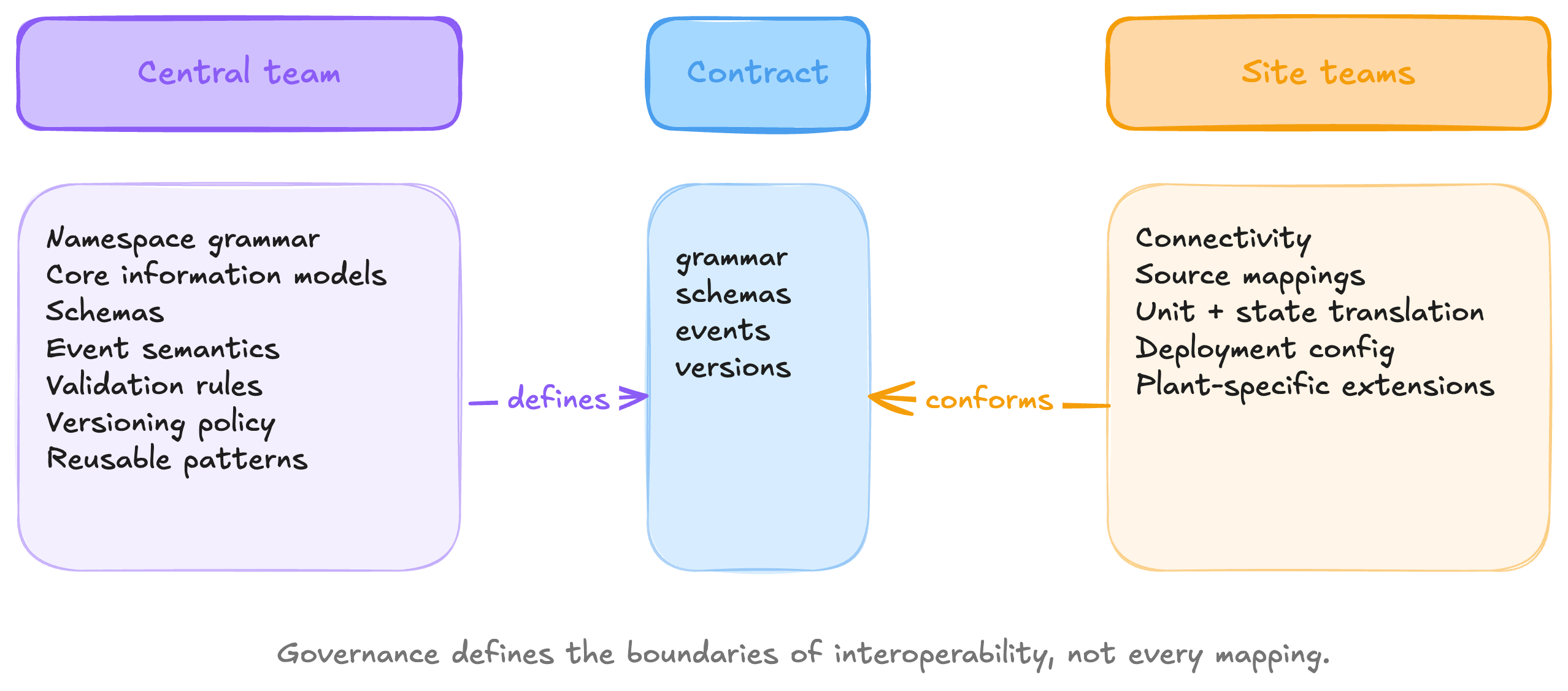
The central architecture team should therefore own the namespace grammar, enterprise models, schemas, event definitions, validation rules, versioning policies, and reusable pipeline patterns. Its role is not to map every tag in every plant, but to define the contracts local implementations must satisfy.
What should remain local
The physical connection to plant systems should remain close to the site because that is where the source knowledge exists.
Local teams understand their automation environment, network constraints, production processes, and legacy systems. They know how a local PLC state, OPC UA node, historian attribute, or SQL field relates to the enterprise information model.
Local DataOps mappings therefore become the translation layer between plant-specific reality and enterprise-defined information. A site pipeline may connect to PLCs, historians, MES systems, DCS platforms, databases, or gateways, extract the required values, add context, normalize units, resolve identifiers, transform states, validate the message, and publish it into the UNS.
The same logical output can be produced in different ways. One site might assemble an EquipmentDefinition from PI Asset Framework and Siemens metadata, while another derives it from OPC UA nodes and an engineering database. What matters is that the final message conforms to the enterprise contract.
Industrial DataOps becomes the translation layer
This is where Industrial DataOps becomes essential to enterprise UNS architecture.
The flow is simple.
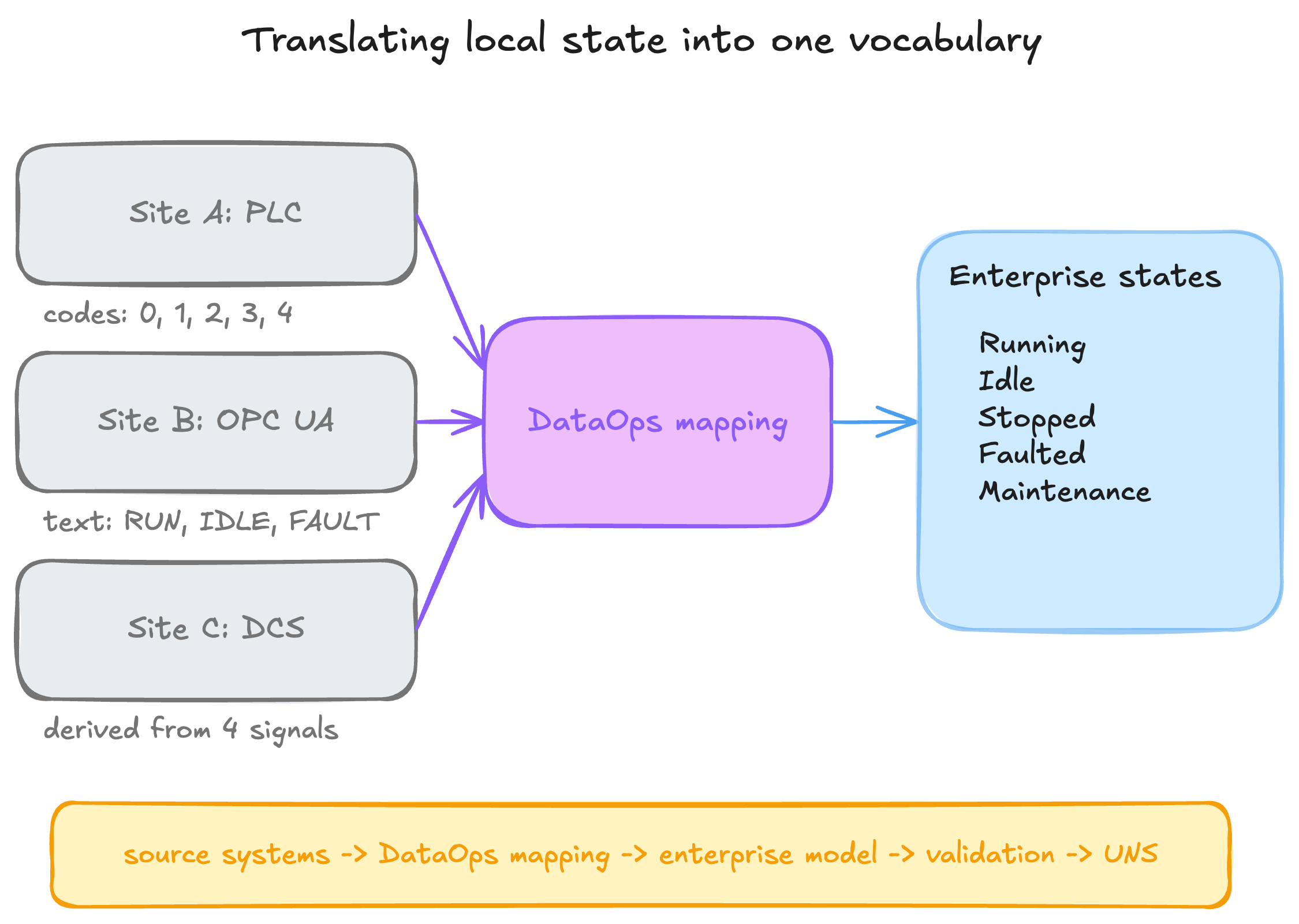
The complexity sits inside the mapping.
Suppose the enterprise defines an equipment-state vocabulary containing Running, Idle, Stopped, Faulted, and Maintenance. Site A may expose integer codes from a PLC, Site B may provide text values through OPC UA, and Site C may calculate state from several DCS signals. Each site's DataOps pipeline translates those local representations into the common enterprise vocabulary.
This is why a scalable UNS should not become a dumping ground for raw plant structures. If each site simply publishes whatever its source systems provide, the broker may centralize access, but the integration problem remains. Every consumer still has to understand each site's naming, data shapes, and semantics.
A useful enterprise UNS moves that complexity upstream. DataOps pipelines perform the translation before data crosses the shared boundary, so consumers work with information that is already aligned to common contracts.
Reuse patterns instead of rebuilding integrations
Local mapping does not mean every plant should start from zero.
Once the enterprise has defined its models and message contracts, it can create reusable patterns for common integration scenarios. These might include templates for OPC UA equipment ingestion, historian mapping, work-order event generation, schema validation, namespace construction, or metric normalization.
The reusable pattern contains the repeated logic while site configuration supplies the local mappings. An OPC UA pipeline, for example, may already know how to create an EquipmentDefinition payload, apply enterprise identifiers, validate the schema, and publish to the correct namespace. The site then configures which nodes correspond to the required fields.
This changes the economics of scaling. The first site may require architecture work because the organization is defining its models, contracts, and pipeline patterns for the first time. Site 2 should reuse much of that work. By Sites 3 and 4, the objective should increasingly be configuration rather than custom engineering.
Validation protects enterprise consistency
Central standards only matter if the enterprise can verify that sites follow them.
Validation should therefore be part of the publishing pipeline. Before a message enters the governed namespace, the pipeline can check whether required identifiers exist, the payload matches its schema, units are valid, event types are recognized, timestamps are correctly formatted, and the topic follows the namespace grammar.
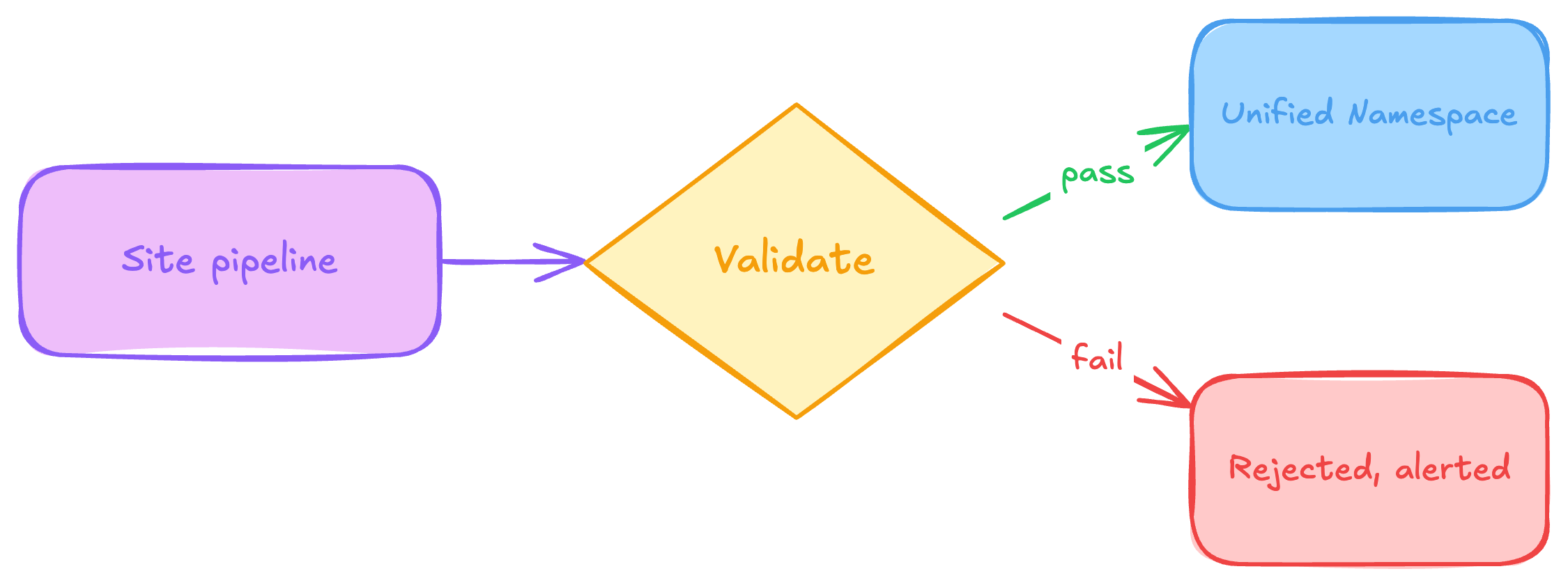
Some checks need to go beyond payload structure. A WorkOrderActivated event may be valid JSON but still be unusable if its work center does not exist in the enterprise model or its site identifier conflicts with the topic path.
These checks become especially valuable because plant environments change. A historian may be upgraded, an MES table modified, or a new PLC program may introduce different state codes. Without validation, those changes can silently break downstream applications. Validation allows problems to be detected close to the source before inconsistent information spreads across the shared data foundation.
Version the contracts so the architecture can evolve
Enterprise models cannot remain frozen. New use cases will require additional fields, new event types, and better semantics, so the architecture needs a controlled way to evolve.
A new optional field may be backward compatible, while a change in event meaning or topic structure may require a new major version. Publishing teams need to know which versions are supported, consumers need to know what they can rely on, and migrations should be deliberate rather than accidental.
This is important across many sites because they will not all upgrade at the same time. Site A may adopt a newer contract while Site C remains temporarily on the previous version. A versioned architecture allows both to coexist without forcing a synchronized enterprise-wide migration.
The namespace and its message contracts should therefore be managed more like products or APIs than informal naming conventions.
Governance should create boundaries, not bottlenecks
There is always a risk that enterprise standardization becomes too heavy. If every local mapping change requires central approval, the architecture will slow down the plants it is supposed to support.
Governance should define the boundaries of interoperability while allowing sites to operate independently inside them. The central team can own the namespace grammar, core models, schemas, validation rules, and reusable patterns. Site teams can own connectivity, source mappings, deployment configuration, and plant-specific extensions.
The two sides meet at the contract, aligning responsibility with knowledge. Enterprise teams define what common information should look like, while plant teams determine how their systems will produce it. Local extensions should also be possible where needed, provided they follow agreed conventions and do not redefine shared concepts. The goal is a stable center with flexible edges.
The payoff is a reusable enterprise data foundation
Once multiple plants expose consistent contracts, the value of the Unified Namespace changes significantly.
Applications no longer need one integration per site. A production monitoring service can use the same subscription patterns across the organization. A persistence service can store the same event classes from every plant. Analytics teams can compare sites using common identifiers and models. AI agents can discover equipment, states, work orders, and events without learning a different data structure for every facility.
New plants also become easier to onboard because the target is already defined. Instead of asking how a plant should publish its data, the implementation team can ask how the plant should be mapped into the enterprise contracts that already exist.
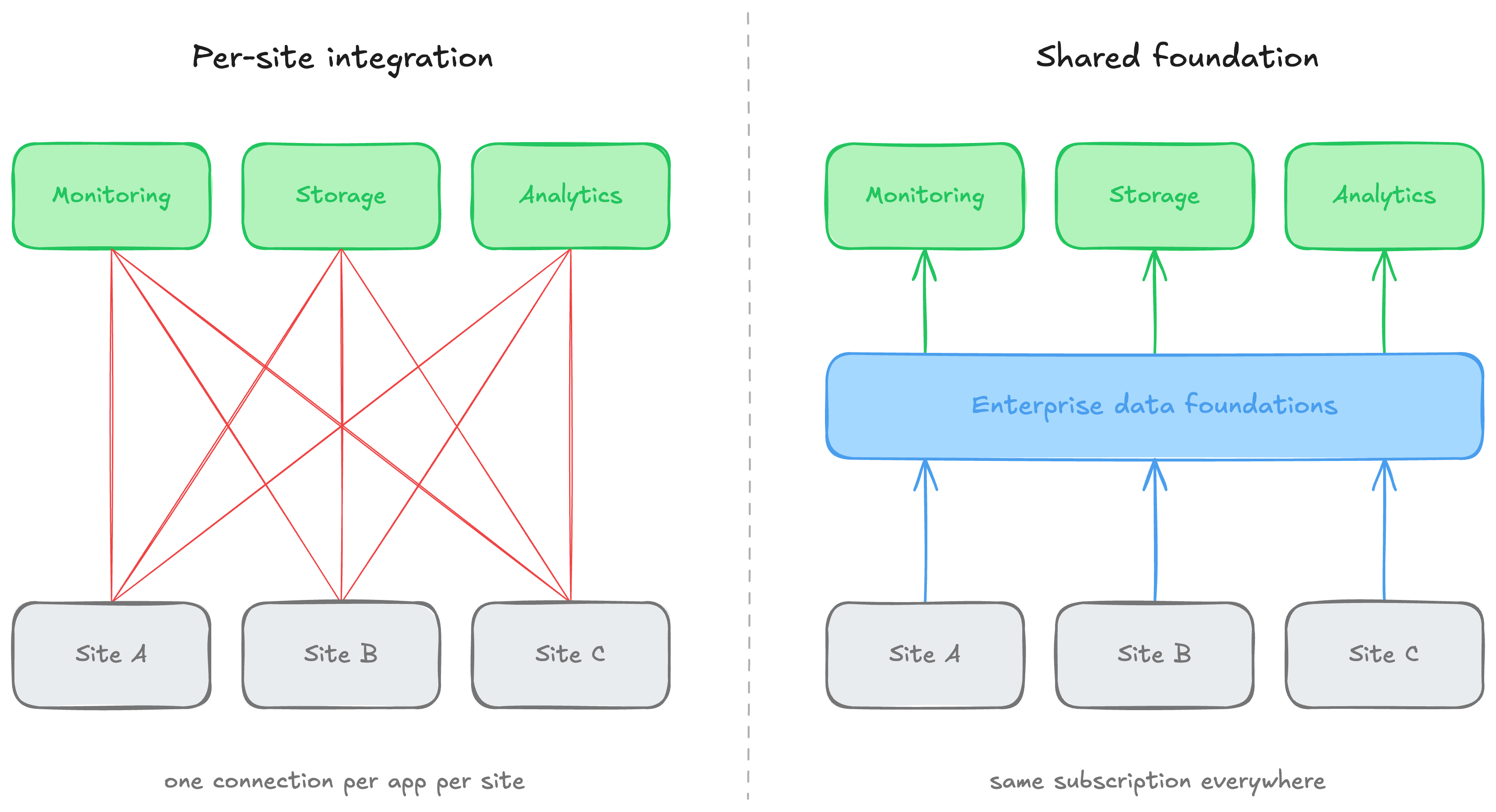
The underlying technologies can continue to change independently. One site can replace its historian, another can migrate to a new MES, and a third can add OPC UA servers. Those changes may require local mapping updates, but they do not have to break enterprise consumers if the external contracts remain stable.
That is the real objective of scaling a Unified Namespace across plants: not identical factories, but a consistent operational boundary. Above that boundary, applications see predictable namespaces, shared models, governed events, validated schemas, and stable identifiers. Below it, sites remain free to use the controllers, historians, MES products, databases, and protocols that suit their operations.
Industrial DataOps connects those two worlds by translating local source structures into enterprise information contracts. Central standards provide consistency, local mappings preserve flexibility, and the Unified Namespace becomes a common operational interface that can scale across the enterprise.
Get the Next Guide
New architecture guides, implementation tutorials and use-case blueprints, delivered as they’re published.
More guides
All guides →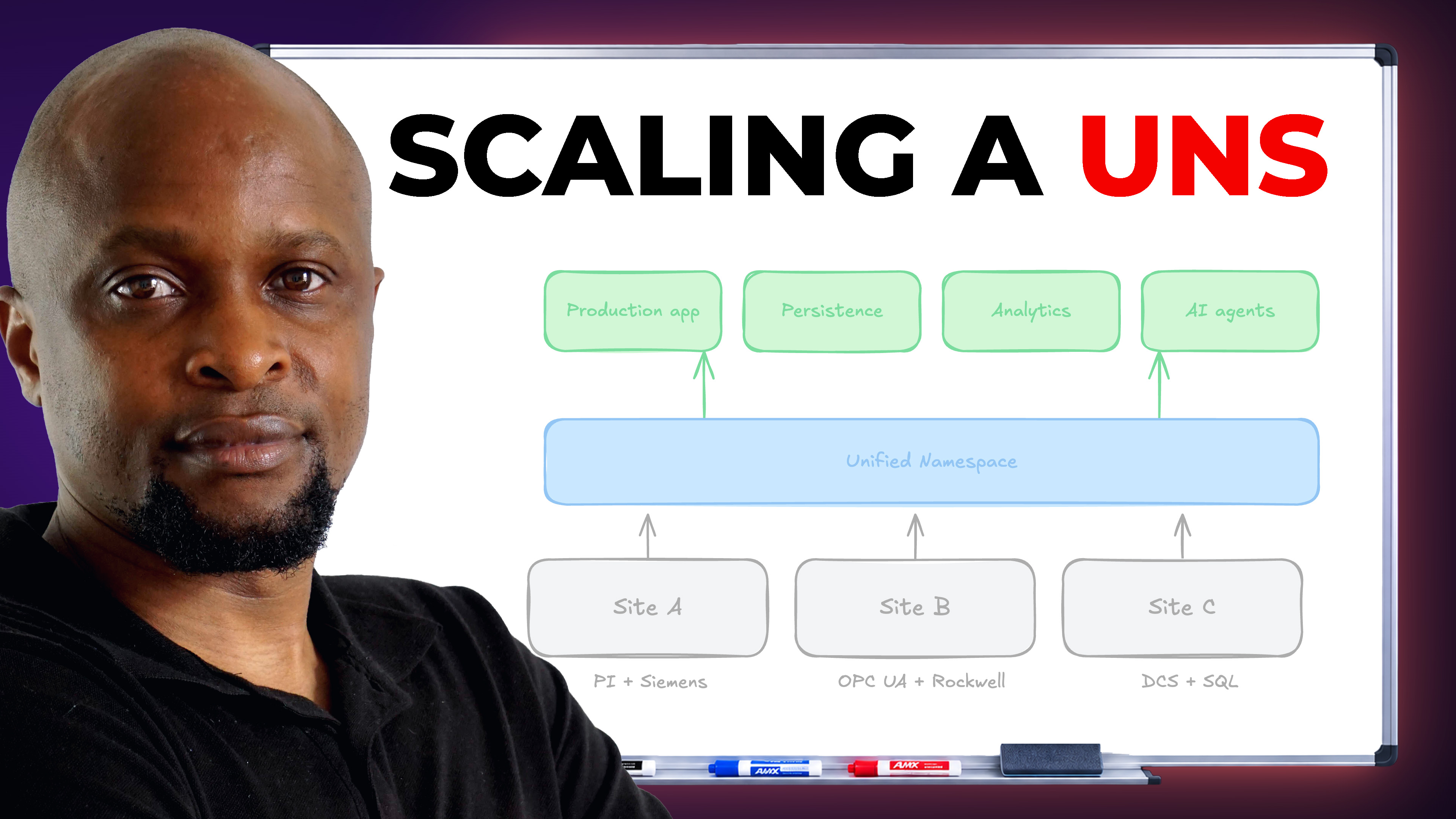


The leading IIoT & AI educational platform for digital manufacturing teams