
A practical guide to how AI agents can safely discover, interpret and use live, historical and semantic manufacturing data to investigate conditions, coordinate workflows, support decisions and interact with industrial systems.
An Industrial AI Agent is an AI system that can reason about an operational goal, discover the information and tools required to pursue it, use those resources in a controlled way, and return a result or initiate an approved action. In manufacturing, the agent becomes useful only when it is connected to trusted operational context, governed tools and clear execution boundaries.
An AI agent is more than a model that answers a prompt. It combines a reasoning model with access to data, tools, state and rules so it can pursue a goal through multiple steps. In manufacturing, that might mean investigating an abnormal condition, retrieving production context, comparing current behavior with history, consulting maintenance records, and proposing the next action.
The model provides reasoning and language understanding. The surrounding architecture provides operational truth, tool access, identity, permissions, context and execution control. Without that surrounding architecture, an “agent” is often just a chatbot with access to a few documents.
How can an AI system discover the right operational context, reason over it, and use industrial tools safely?
A chatbot is usually reactive: a user asks a question and the model returns an answer. An agent can plan, retrieve, call tools, evaluate intermediate results and continue working until it reaches a defined stopping condition.
| Chatbot | Industrial AI agent | |
|---|---|---|
| Primary interaction | Question → answer | Goal → multi-step reasoning and tool use |
| Data access | Usually documents or retrieved text | Live state, history, semantics, records and APIs |
| Operational awareness | Limited to what is supplied in the prompt | Can discover context dynamically through governed interfaces |
| Actions | Normally advisory | Can invoke approved tools, workflows or systems under policy |
| Control model | Conversation-level | Identity, permissions, audit, tool policy and execution boundaries |
Operational questions routinely cross systems and domains. An engineer investigating a drop in throughput may need live equipment state, production order context, historical process values, quality holds, maintenance events and the physical relationships between assets.
The answer may require live state, work-order context, recent faults, upstream equipment and historical cycle-time evidence.
The agent may need the active recipe, product, process phase, historical operating envelope and sensor quality.
The answer may depend on asset class, failure history, recent vibration trends and current production constraints.
The agent may combine current progress, rate, downtime history, material availability and planned maintenance.
Traditional applications solve these problems by predefining the workflow and every system interaction in code. Agents introduce a more flexible reasoning layer that can decide which information and tools are relevant for a particular operational situation.
Agents should sit above the data and semantic foundation, not become the foundation themselves. Their reasoning depends on the quality and structure of the services beneath them.
An agent should not need direct, unrestricted connections to every PLC, historian, database and enterprise application. The access layer should present governed capabilities that abstract those systems behind stable interfaces.
The model should reason in terms of operational capabilities: get the current state of a work center, retrieve pressure history for an asset, find the active batch, resolve upstream equipment, or create a maintenance investigation request.
It should not need to know that one plant uses MQTT, another uses PI Web API, a third exposes a SQL view, and a fourth uses a vendor-specific MES endpoint.
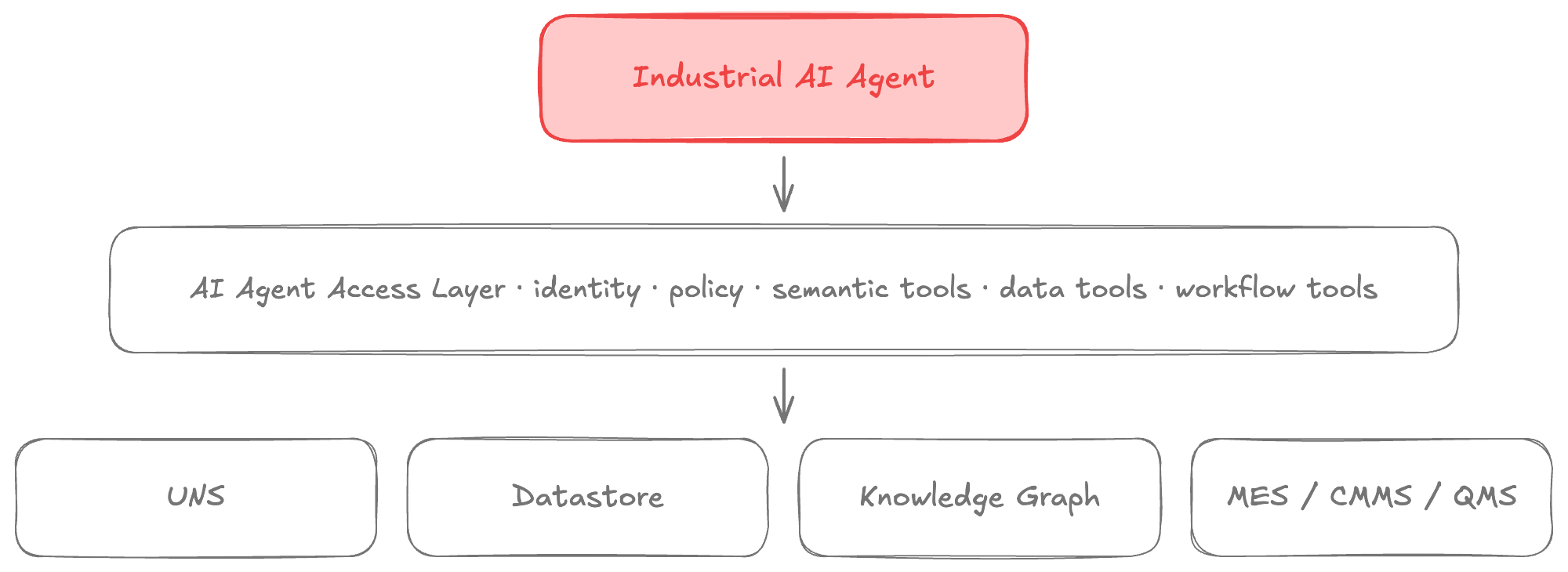
This abstraction also makes governance easier. The organization can control which tools exist, what each tool is allowed to return or change, and which identities are permitted to invoke it.
Many industrial use cases are event-driven. An agent may need to react when equipment faults, a batch completes, a quality hold is placed or production begins to drift outside expected conditions.
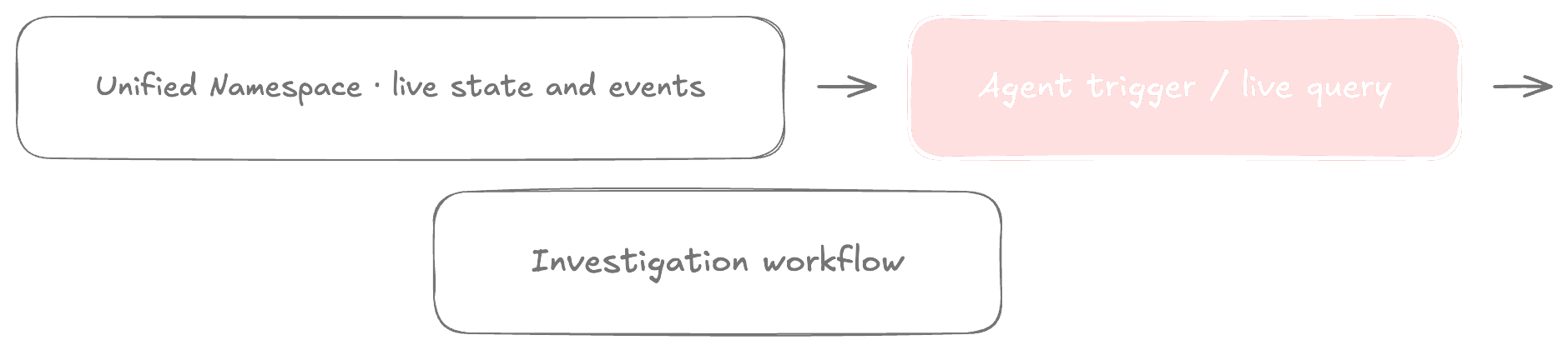
The agent does not necessarily subscribe directly to every MQTT topic. A service can expose approved live-state queries, event streams or trigger conditions. The important point is that the agent can receive operational change signals rather than relying entirely on scheduled polling or static documents.
Live state tells the agent what is happening. Historical evidence helps it determine whether the condition is unusual, when it began, what happened previously under similar conditions and how earlier interventions affected the process.
Get process measurements for a specific asset, batch, phase or production period.
Compare current performance with prior batches, products or operating states.
Relate faults, operator actions, maintenance work and quality events to process behavior.
For this reason, agents should normally have separate tools for current state and historical analysis rather than treating the real-time backbone as the historical database.
Without semantics, the model has to infer operational relationships from names, payloads and source-system conventions. A knowledge graph or ontology gives the agent a structured map of entities and relationships before it begins retrieving evidence.
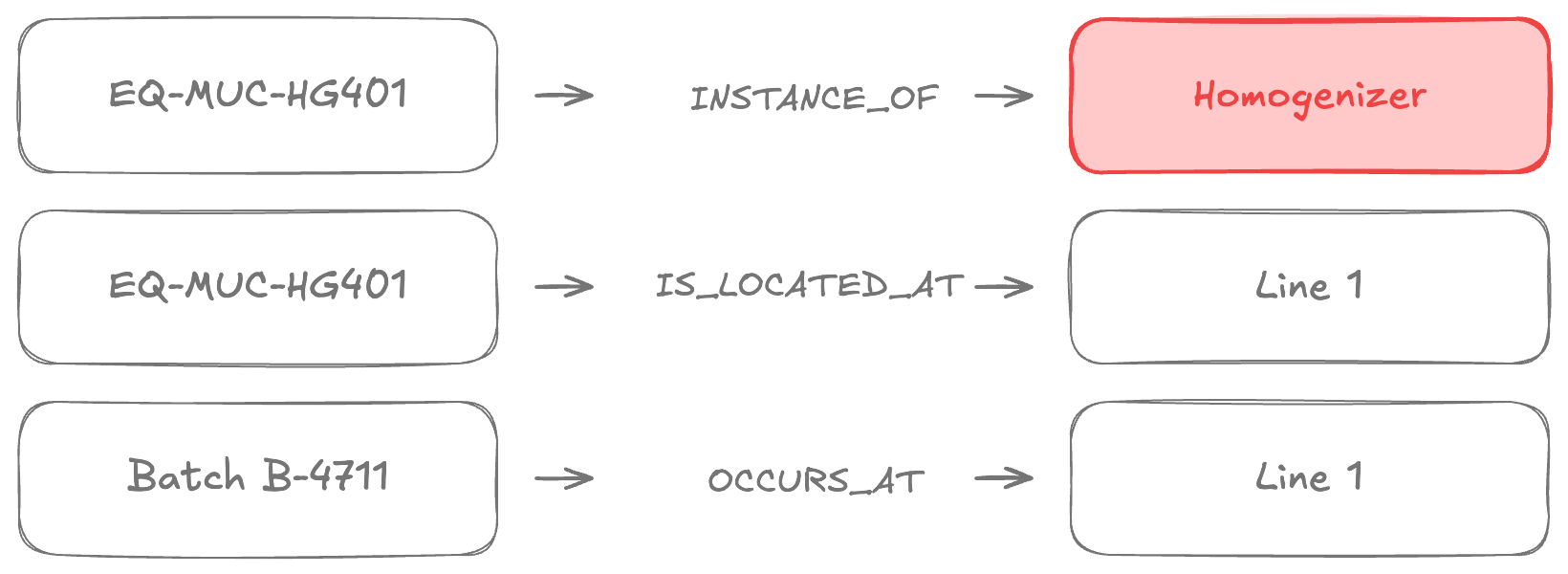
The agent can use the graph to discover that a faulted asset is part of a particular line, that a batch is currently running there, that a specific upstream pump feeds the process, or that the asset belongs to a class with known capabilities and failure modes.
A well-designed agent workflow typically moves from signal to context, then evidence, then recommendation or action.
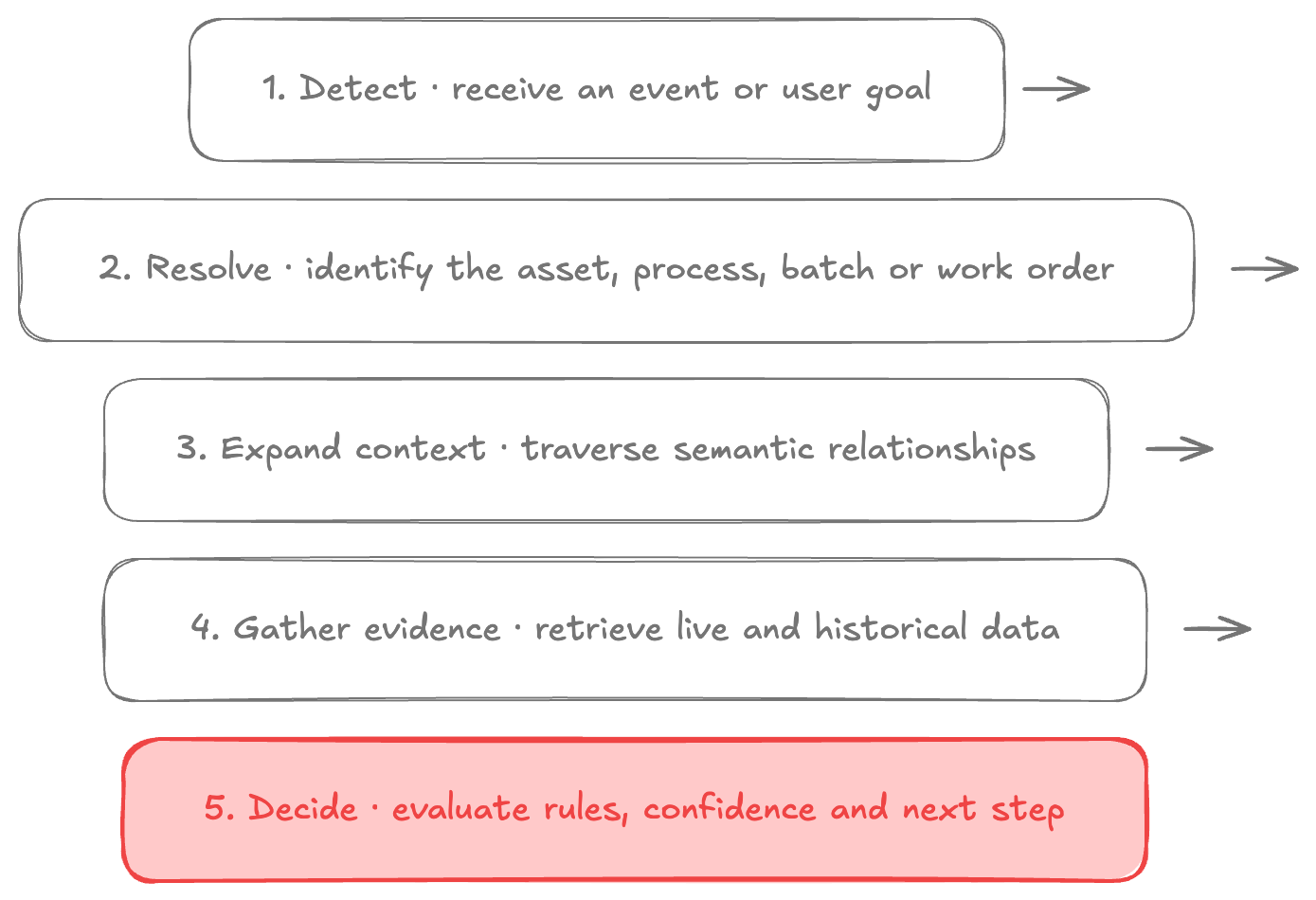
Goal:
Investigate why Homogenizer HG401 pressure increased.

Agent plan:
1. Resolve HG401 and current production context
2. Find active batch and recipe
3. Retrieve current equipment state
4. Query pressure trend for the batch
5. Compare with previous successful batches
6. Check recent maintenance or fault events
7. Identify upstream/downstream dependencies
8. Summarize likely causes and evidence
9. Recommend next inspection or workflow
The value of the agent is not that it knows the answer in advance. It is that it can decide which governed information sources to consult and assemble the result in context.
The quality of an industrial agent depends heavily on the tools it is given. Tool interfaces should expose operational capabilities with clear inputs, outputs and permissions.
Retrieve approved current state and KPIs for an equipment item or work center.
Retrieve validated time-series data for an entity and time window.
Traverse equipment, process, material, location and class relationships.
Resolve the current work order, batch, product and process context.
Retrieve recent work, failures and inspection records for an asset.
Create an approved downstream workflow rather than writing directly into plant control logic.
A good agent tool is narrow, observable and policy-aware. It should do one operationally meaningful thing with explicit boundaries rather than expose an unrestricted database connection or shell.
Agents may need short-term memory to track an investigation, remember intermediate results or continue a multi-step workflow. That memory is useful, but it should not become the authoritative source of manufacturing state.
| Type | Purpose | Authoritative source? |
|---|---|---|
| Conversation memory | Retain user context across the current interaction. | No |
| Workflow state | Track which investigation steps have completed and what remains. | No |
| Operational state | Current equipment, production and process condition. | Yes — live operational systems and the UNS |
| Historical evidence | Past measurements, events and records. | Yes — historian, datastore or system of record |
| Semantic truth | Definitions, classes and relationships. | Yes — the governed semantic layer |
An agentic application needs more than a prompt and a model. The orchestration layer manages tool selection, retries, context limits, workflow state, stopping conditions, approvals, routing between specialized agents and the transition from reasoning into downstream actions.
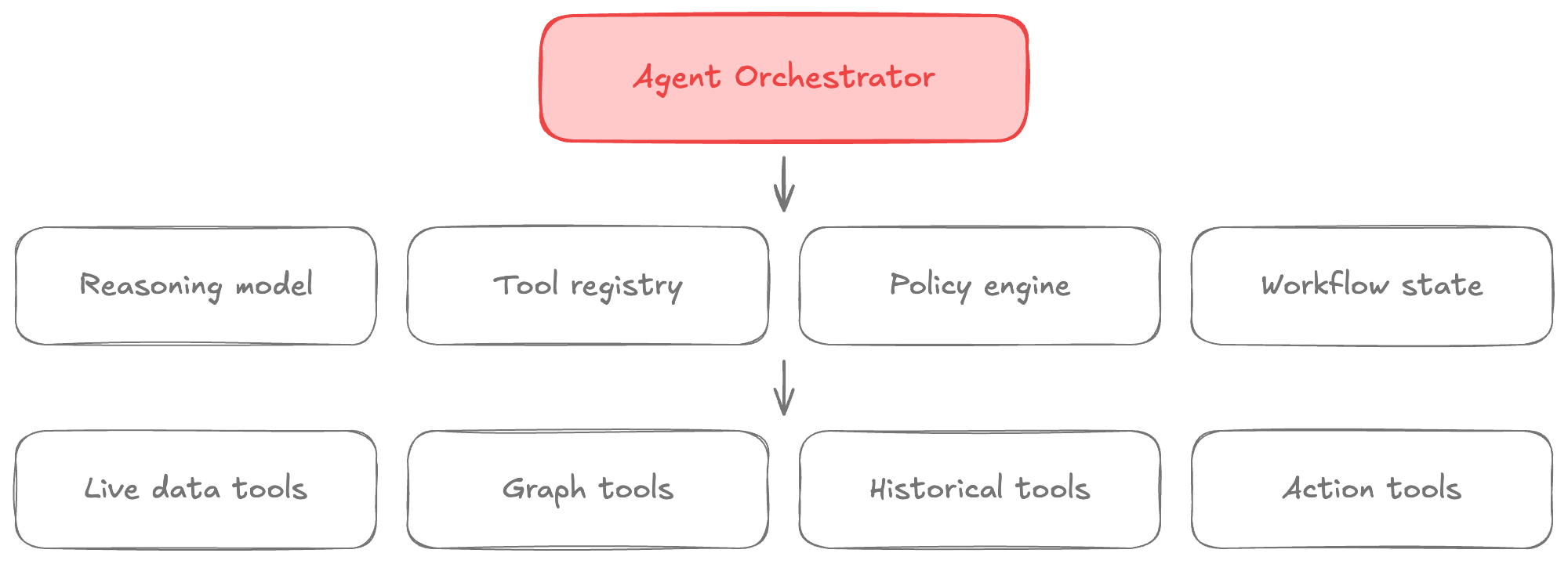
This is also where organizations can choose deterministic workflow steps around probabilistic reasoning. For example, an agent may decide which evidence to collect, while a fixed policy determines whether a maintenance request can actually be created.
Industrial environments have physical consequences. The safest architecture does not rely on a model remembering what it is allowed to do. Controls should exist outside the model and be enforced by the systems that expose data and actions.
Every agent and user context should have a verifiable identity before tools are exposed.
Permissions should determine which data, sites, assets and actions each identity can access.
Inputs, ranges, destinations and allowable operations should be enforced by the tool itself.
Ontology and business rules can limit which actions make sense for particular entity types or states.
Higher-risk actions should require deterministic checks or explicit human approval.
Record prompts, tool calls, data references, decisions, approvals and downstream actions.
Prompt instructions are not a substitute for authorization, safety interlocks, PLC logic, SIS functions, workflow permissions or human approval.
Many valuable industrial agent use cases do not require autonomous control. An agent can investigate a problem, gather evidence, rank likely causes and prepare a recommended action for an operator, engineer or maintenance planner.
Organizations can move along this spectrum gradually as confidence, observability and governance mature.
Most first-generation industrial agents should begin with read-heavy capabilities. Giving an agent broad write access to MES, CMMS, ERP or control systems before the data and policy foundation is mature creates unnecessary risk.
| Capability | Typical risk | Recommended control |
|---|---|---|
| Read live state | Low to moderate | Identity, site scoping, rate limits and audit. |
| Read history | Low to moderate | Query constraints, data classification and row or entity-level authorization. |
| Create investigation or work item | Moderate | Workflow validation and explicit user context. |
| Change production record | High | Deterministic validation and human approval. |
| Issue control command | Very high | Prefer existing control systems, safety interlocks and narrowly bounded execution services. |
Investigates throughput loss, downtime or abnormal conditions by combining live state, production context and historical evidence.
Combines sensor trends, equipment class, failure history, work orders and manuals to support troubleshooting.
Connects deviations to process conditions, material lots, equipment states, recipes and previous similar events.
Monitors work orders, material availability, equipment status and schedule constraints to surface emerging execution risks.
Correlates equipment state, production load and energy consumption to identify avoidable demand or scheduling opportunities.
Uses asset models, graph relationships, historical events and documents to answer context-specific engineering questions.
The most useful early agent is usually not the one with the most autonomy. It is the one that removes the largest amount of manual data gathering and context switching from an important operational workflow.
A single agent with a well-designed toolset is sufficient for many use cases. Multiple agents become useful when different domains require distinct tools, policies, models or responsibilities.
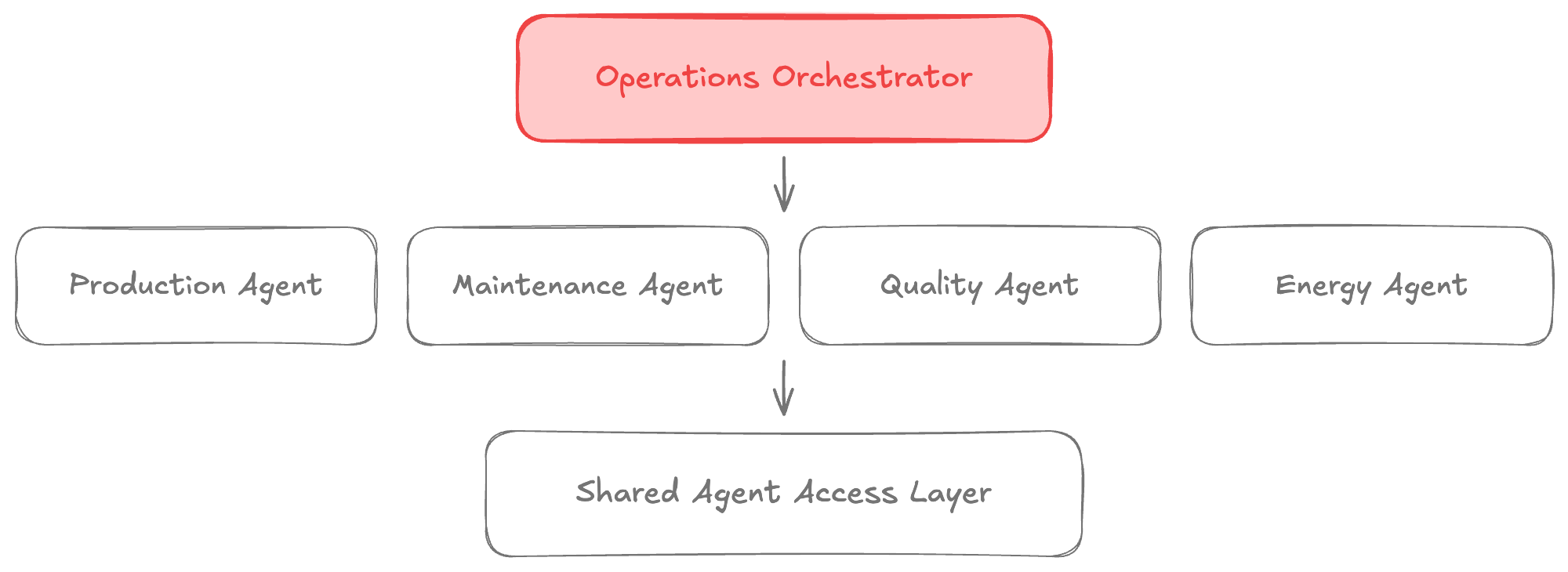
The architectural advantage is separation of responsibility: the quality agent may have access to quality records and hold workflows that the maintenance agent does not. The downside is additional coordination, latency and complexity. Multi-agent architecture should therefore solve a real organizational or technical boundary rather than become the default.
Once agents participate in operational workflows, teams need to know what they are doing, which data they used and where failures occur.
Traceability should make it possible to reconstruct an agent run: the triggering event or user request, the reasoning steps exposed by the orchestration layer, tool calls, records retrieved, policy checks, recommendations, approvals and final actions.
The use case should determine the context, tools and controls the agent needs, not the other way around.
Expose governed capabilities rather than unrestricted MQTT, database, shell or PLC access.
Procedures are valuable, but operational decisions also need current state, history and system-of-record data.
The agent cannot reliably reason about “Line 1”, “released” or “state” if those concepts mean different things across systems.
Agent memory can track a workflow; it should not be treated as the authoritative state of the plant.
Begin with recommendation and evidence gathering before expanding into higher-risk write capabilities.
Authorization, tool constraints and approval rules must be enforced outside the model.
Use multiple agents when boundaries or specialization require them, not because the architecture looks more sophisticated.
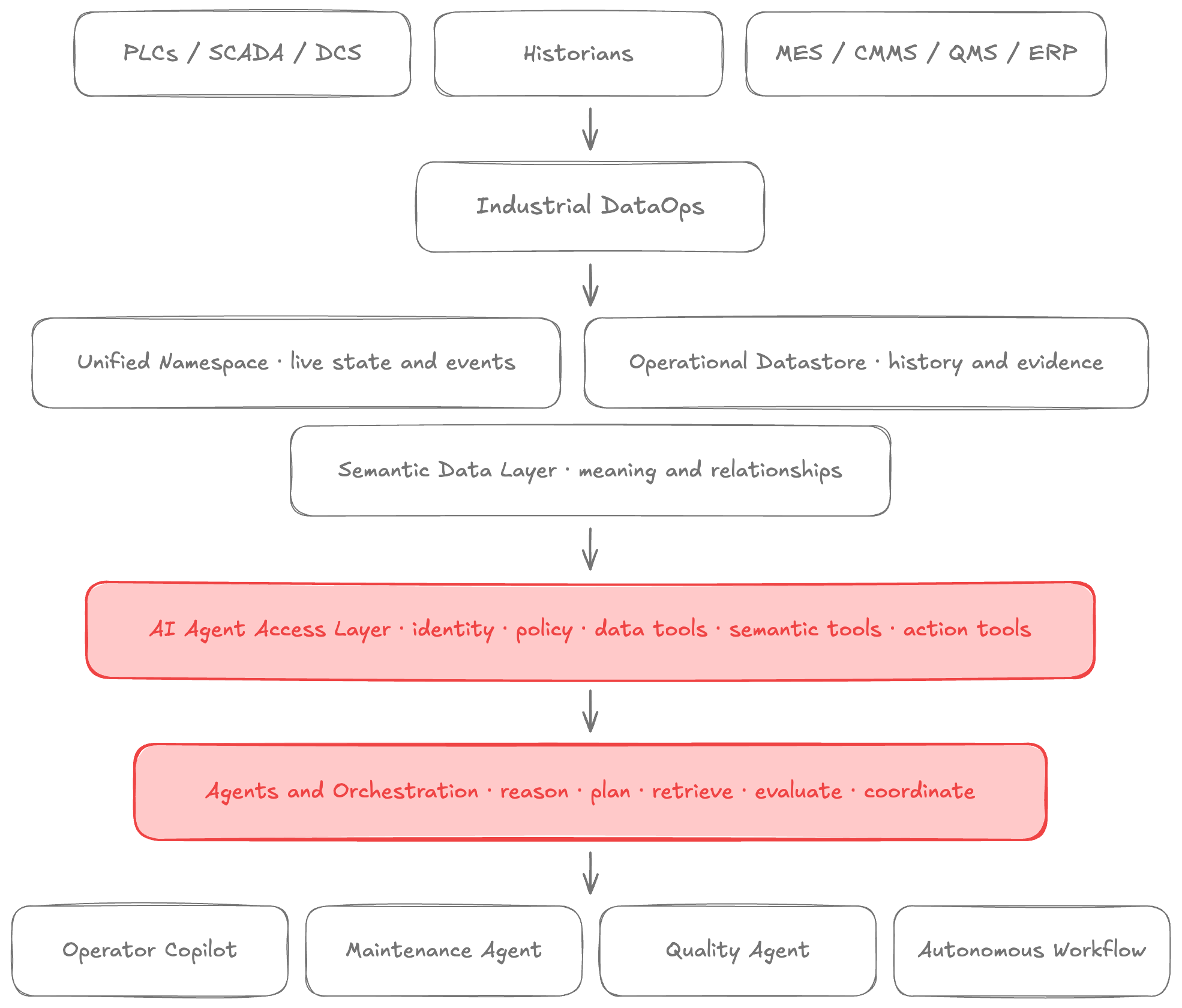
The key is separation of concerns. Operational systems remain the source of truth. The data layers make those systems usable. The semantic layer gives the information meaning. The access layer exposes approved capabilities. The agent reasons over those capabilities. Existing workflows, policies and control systems remain responsible for enforcing operational boundaries.
Start with a narrow operational workflow where people already spend significant time gathering context across systems. Build the first agent as an investigative assistant before expanding its authority.
For example: investigate unexpected downtime, diagnose a quality deviation or explain a throughput loss.
Identify which live, historical, semantic and transactional sources a human currently uses to answer the question.
Create governed functions for current state, history, production context, semantic lookup and relevant records.
Ensure the agent can resolve entities and relationships instead of relying on source-system naming conventions.
Define triggering conditions, stopping criteria, retries, context management and failure paths.
Measure evidence quality, usefulness, false conclusions, missed context and operator acceptance.
Begin with low-risk workflows such as creating an investigation or drafting a maintenance request.
Automate only where deterministic controls, audit and fallback behavior are strong enough for the operational risk.
Use this page as the architectural overview. The related pillar pages provide the data, real-time and semantic foundations that industrial agents depend on.

The leading IIoT & AI educational platform for digital manufacturing teams