
Why UNS Event-Driven Architecture Matters in Manufacturing
A practical look at how event-driven UNS architecture makes operational changes reusable across industrial data, analytics, and AI.

Manufacturing operations are constantly changing. Machines start and stop, orders move through production, materials are consumed, and equipment becomes unavailable.
Many of those changes affect what somebody or something elsewhere in the operation should do next.
Yet much of the industrial data architecture around those operations still works by periodically asking systems for an update. Applications query databases, integration services poll APIs, data pipelines extract information on a schedule, and reports refresh every few minutes or every few hours. People often fill the remaining gaps through emails, spreadsheets, phone calls, and shift meetings.
None of those approaches are inherently wrong. The limitation is that the consumer carries the burden of discovering that something has changed.
In the previous article, I described the Unified Namespace as a shared, contextualized, real-time representation of the current operational state of the business.
But there is another underlying architectural idea that is just as important: when something meaningful changes in the operation, the people, applications, and systems that care about it should be able to know when it happens.
That is the essence of event-driven architecture. And it is one of the most important architectural characteristics of the Unified Namespace that I think often gets far less attention than it deserves.
So, what does event-driven architecture actually mean in manufacturing, and why does it matter?
What Makes an Architecture Event-Driven in Manufacturing?
Event-driven processing is not new to manufacturing. Industrial control systems have always responded to events.
A sensor changes state, and a PLC reacts. A process value crosses a threshold and an alarm is raised. A batch phase completes and the control system advances to the next step. An MES receives confirmation that an operation has finished and updates the work order.
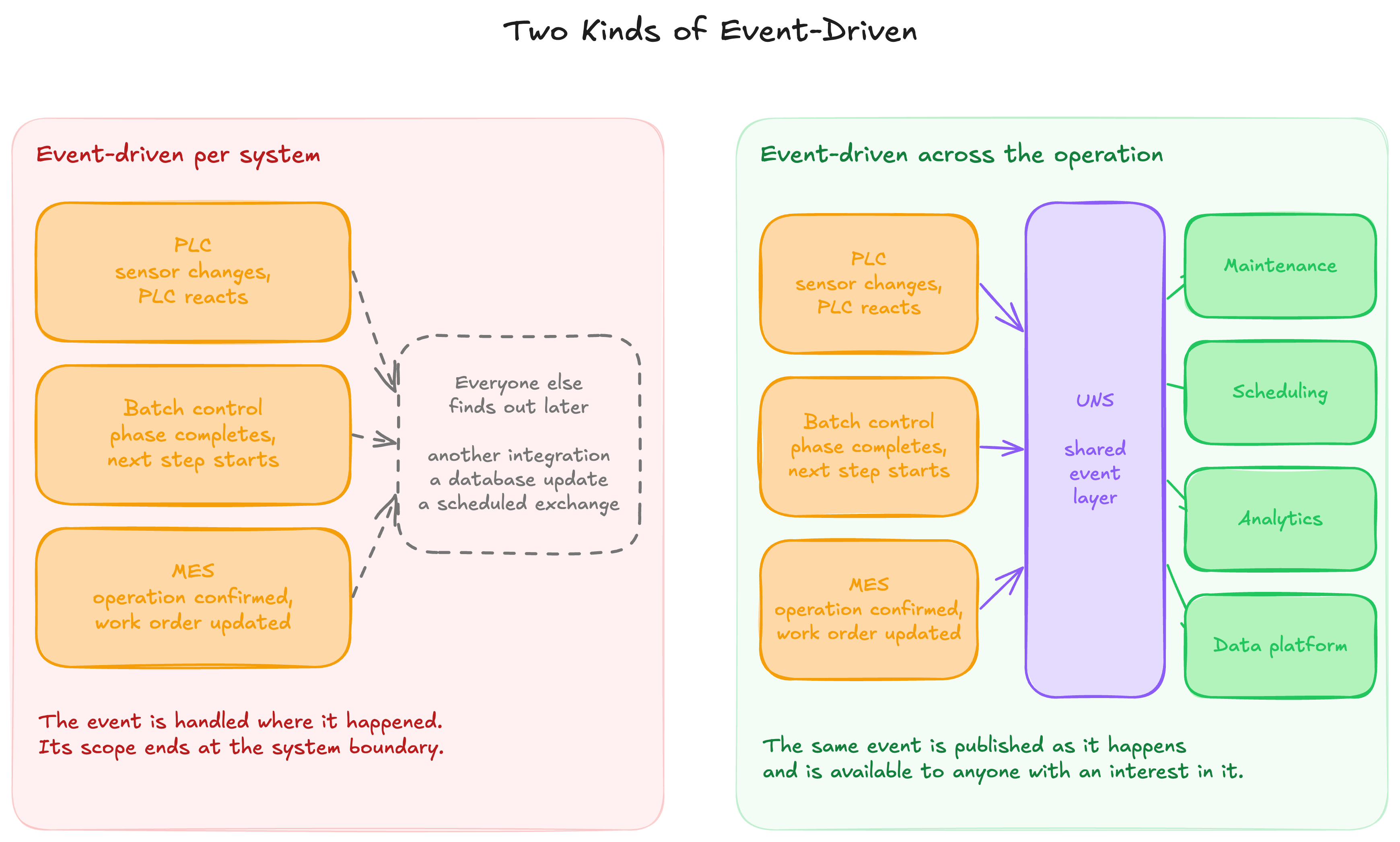
What is different is the scope. Historically, these events have usually been handled inside the system responsible for that part of the process. The PLC reacts to machine events, the MES reacts to production events, and other systems learn about the change later through another integration, a database update, or a periodic exchange of information.
An event-driven architecture extends that idea across the broader operational environment.
It helps to distinguish between telemetry, state, and events.
A temperature reading of 178.3°C is telemetry. It tells us the value of something at a particular moment. Filler 01 is Running describes state. It tells us what is currently true about that asset. Filler 01 Stopped is an event. It tells us that something changed.
Not every change in telemetry needs to become an event. A temperature moving from 178.2°C to 178.3°C may matter to a control loop, but there is probably no reason for an MES, maintenance application, production scheduler, or enterprise data platform to react to it.
The events that matter more broadly are changes with operational significance: an order was released, a batch started, equipment became unavailable, material was consumed, a quality inspection failed, or an order was completed. These are useful beyond the system where they originated because something elsewhere in the operation may need to respond.
This is where the Unified Namespace changes the architecture. Instead of those events remaining inside individual systems, they can be published into a shared infrastructure as they happen and made available to authorized consumers that have an interest in them.
That also changes the question we ask when deciding what belongs in a UNS. It is not simply:
What data can I get from this machine or system?
It is also:
What is happening here that somebody elsewhere in the operation needs to know about?
That shift moves the conversation beyond collecting industrial data toward representing meaningful changes in the operation.
In that sense, the UNS provides two complementary views of operational reality: state tells consumers what is true now; events tell them what changed.
How Pub-Sub Enables Event-Driven Architecture in Manufacturing
Once meaningful operational changes are treated as events, the next question is how they move through the architecture.
Many industrial integrations still rely on request-and-response. An application calls an API, queries a database, reads a tag, or runs a scheduled extraction. For many use cases, that is exactly the right approach.
The limitation appears when several consumers need to stay aware of changing operational conditions in close to real time.
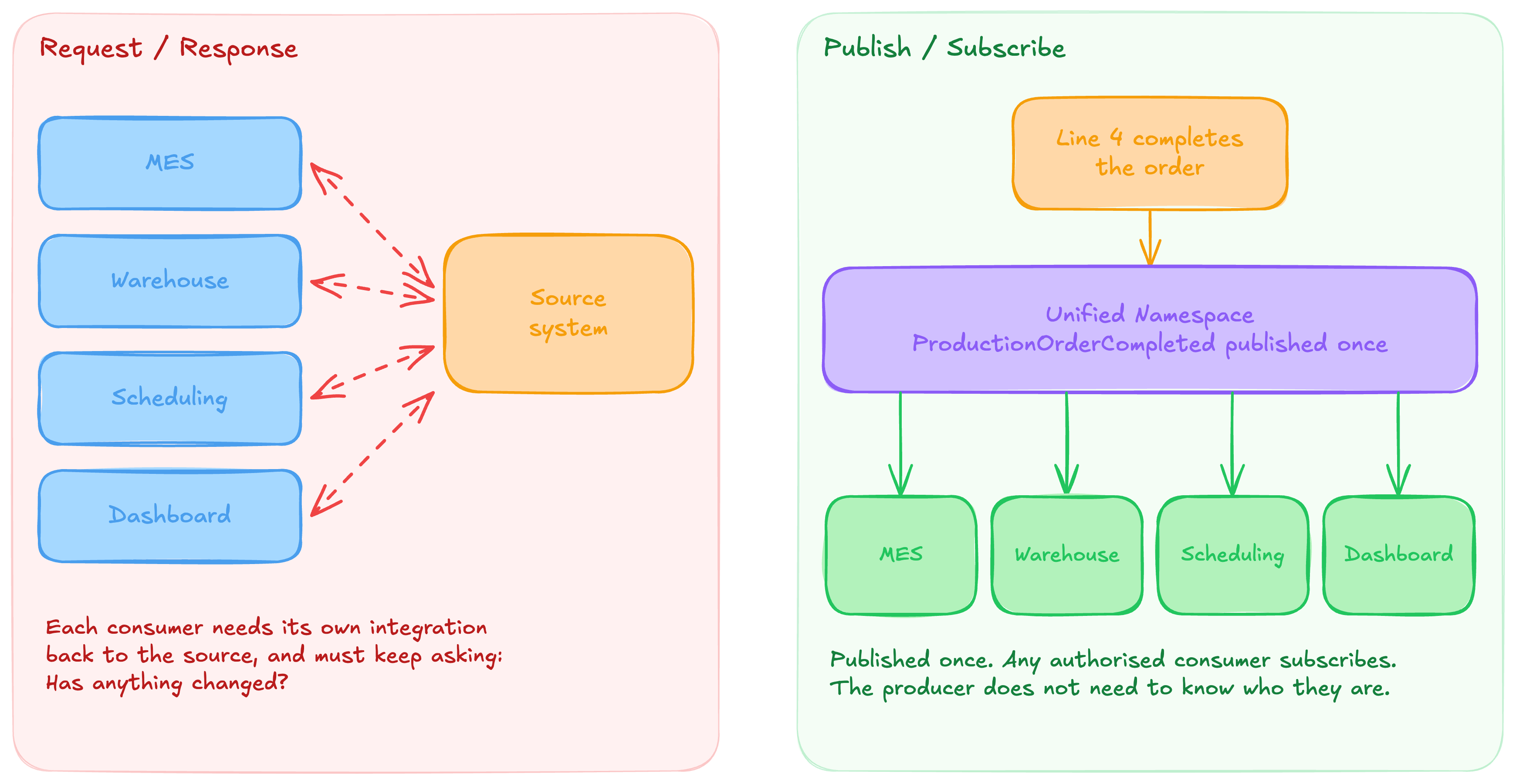
Imagine that Line 4 completes a production order. The MES may need to close the execution record, the warehouse may need to prepare for finished goods, a scheduling application may need to release the next order, and a dashboard needs to show that production has completed.
If each consumer has to discover that change independently, each needs its own way of going back to a source system and asking for an update. The dashboard needs to know where to retrieve the order status, the scheduling application needs an interface, and the warehouse application needs another integration. As more consumers are added, more dependencies accumulate around the systems producing the information.
Publish/subscribe turns that relationship around.
When the order completes, the event is published once. Any authorized consumer interested in it can receive it and decide what to do next. The producer does not need to know who those consumers are, and the consumers do not need to continuously interrogate the producer to discover whether something changed.
This is the practical meaning of decoupling producers and consumers.
It matters because new consumers can make use of information that is already being published instead of requiring another point-to-point connection back to the source. It also reduces the delay between something happening and the rest of the architecture becoming aware of it. The change can be distributed when it occurs rather than waiting for the next scheduled query, refresh, or extraction cycle.
That does not mean polling, APIs, databases, or scheduled pipelines disappear. They remain useful for retrieving information, performing transactions, and moving data where real-time notification is unnecessary.
The difference is that for meaningful operational changes, every consumer no longer has to keep asking:
Has anything changed?
The architecture can tell them when it has.
Benefits of Event-Driven Architecture for Industrial Data Use Cases
The real value begins to show when the same event can support more than one use case.
Take that production-order completion event. The MES can use it to close the execution record. The warehouse can prepare to receive finished goods. A dashboard can update immediately. A scheduling application can reconsider what should run next. The event can also be persisted into a data platform, where it becomes part of the historical record used for reporting and analysis.
The source system does not need to create a separate version of the event for each consumer.
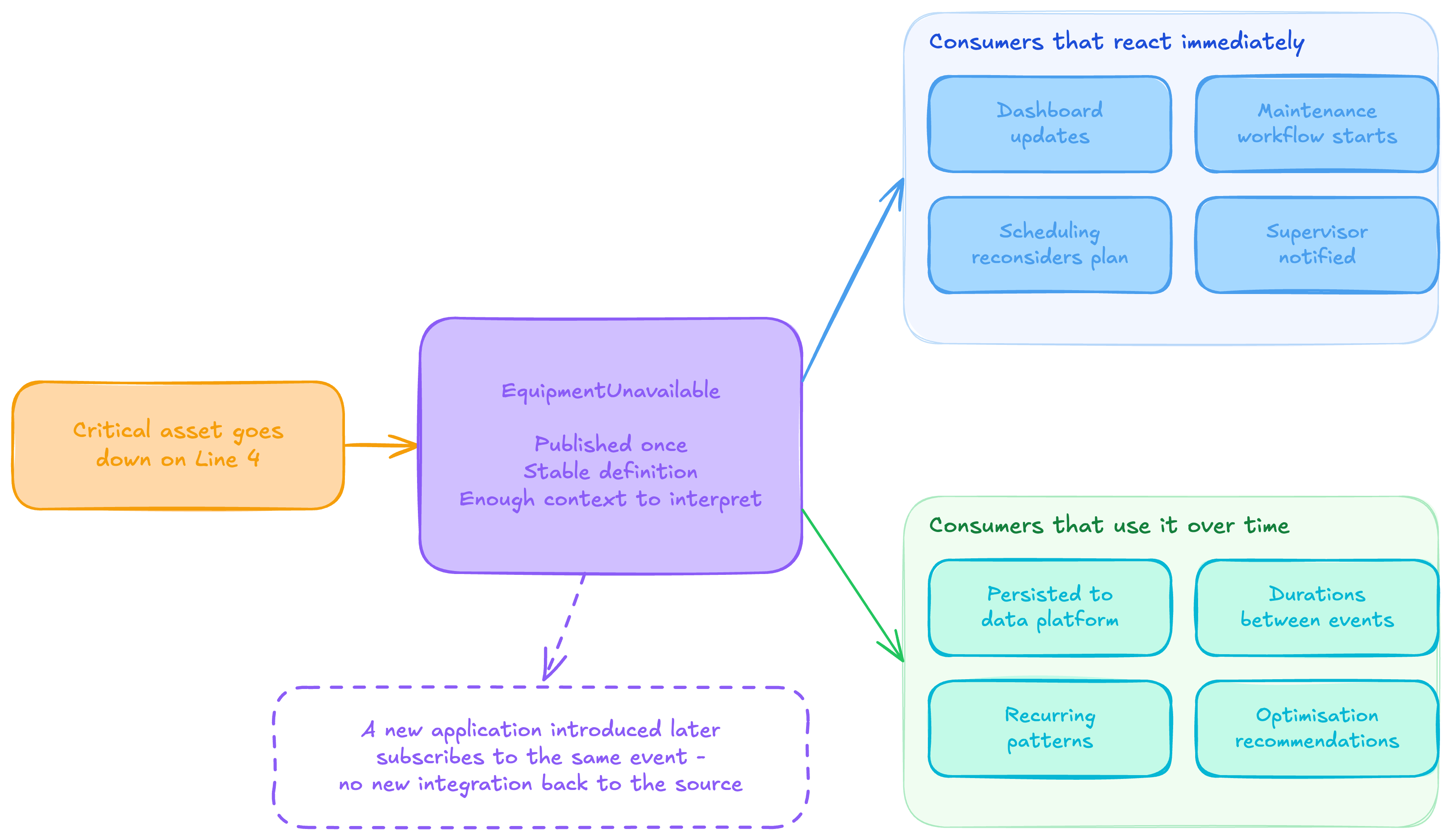
The same principle applies to events from the physical operation. If a critical asset becomes unavailable, maintenance may need to respond, but scheduling may also need to reconsider the production plan, a performance application may recalculate expected output, and the shift supervisor may need to be notified.
This is where an event-driven UNS becomes more than a mechanism for integrating one application with another. It becomes a common backbone for operational information that different use cases can share.
Some consumers react immediately. Dashboards update, workflows start, notifications are sent, and applications adjust to changing conditions. Others use those same events over longer periods. A data platform can persist them for historical analysis, analytics applications can calculate durations between events or identify recurring patterns, and optimization applications can use changes in equipment availability, production progress, material status, or quality conditions to update their recommendations.
That reuse also creates an incentive to define events properly. If an EquipmentUnavailable event is going to be consumed by maintenance, scheduling, analytics, and AI, its meaning cannot depend on somebody knowing how the original SCADA screen or source application works. The event needs a stable definition and enough context for different consumers to interpret it consistently.
This is an important part of scaling the architecture. Reuse only works when consumers can trust that the same event means the same thing wherever it appears. Event-driven architecture therefore pushes manufacturers toward better operational data contracts, clearer ownership, and more deliberate modelling of the information they expose.
Importantly, you do not need to know every future use case when an event is first defined.
If ProductionOrderCompleted, EquipmentUnavailable, or QualityInspectionFailed already exists as a well-defined, contextualized event in the UNS, a new application introduced later can subscribe to it without requiring another integration back into the original MES, PLC, or quality system.
That is where the value starts to compound. New use cases can build on operational information that already exists instead of beginning again with data extraction and contextualization.
The broader architectural principle is simple: publish meaningful operational changes once, and make them reusable wherever they are needed.
Why Event-Driven Industrial Data Architecture Matters for AI Agents
The same model becomes especially important as manufacturers introduce AI systems that are expected to do more than answer questions or generate reports.
An AI agent that is supposed to help manage operations cannot depend on somebody prompting it every time conditions change. It needs a way to know that something happened which may require attention.
Suppose a packaging line becomes unavailable while a priority order is running. A conventional workflow might create a maintenance ticket or alert the shift supervisor. An AI agent could use that same event as the starting point for a broader investigation.
It might determine how much of the order has already been completed, what is scheduled next, whether another line can run the same product, whether the necessary tooling and operators are available, and what effect a delay could have on customer commitments.
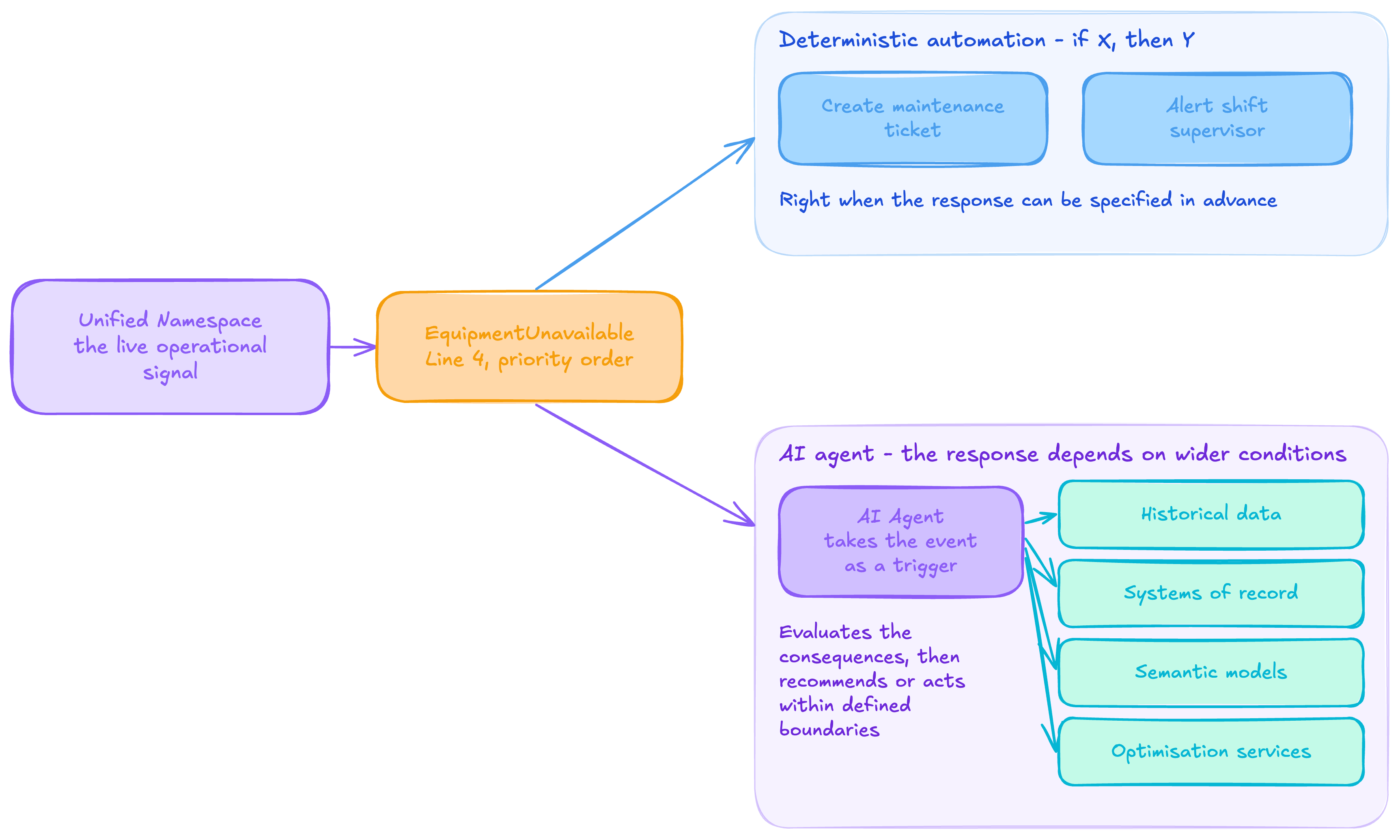
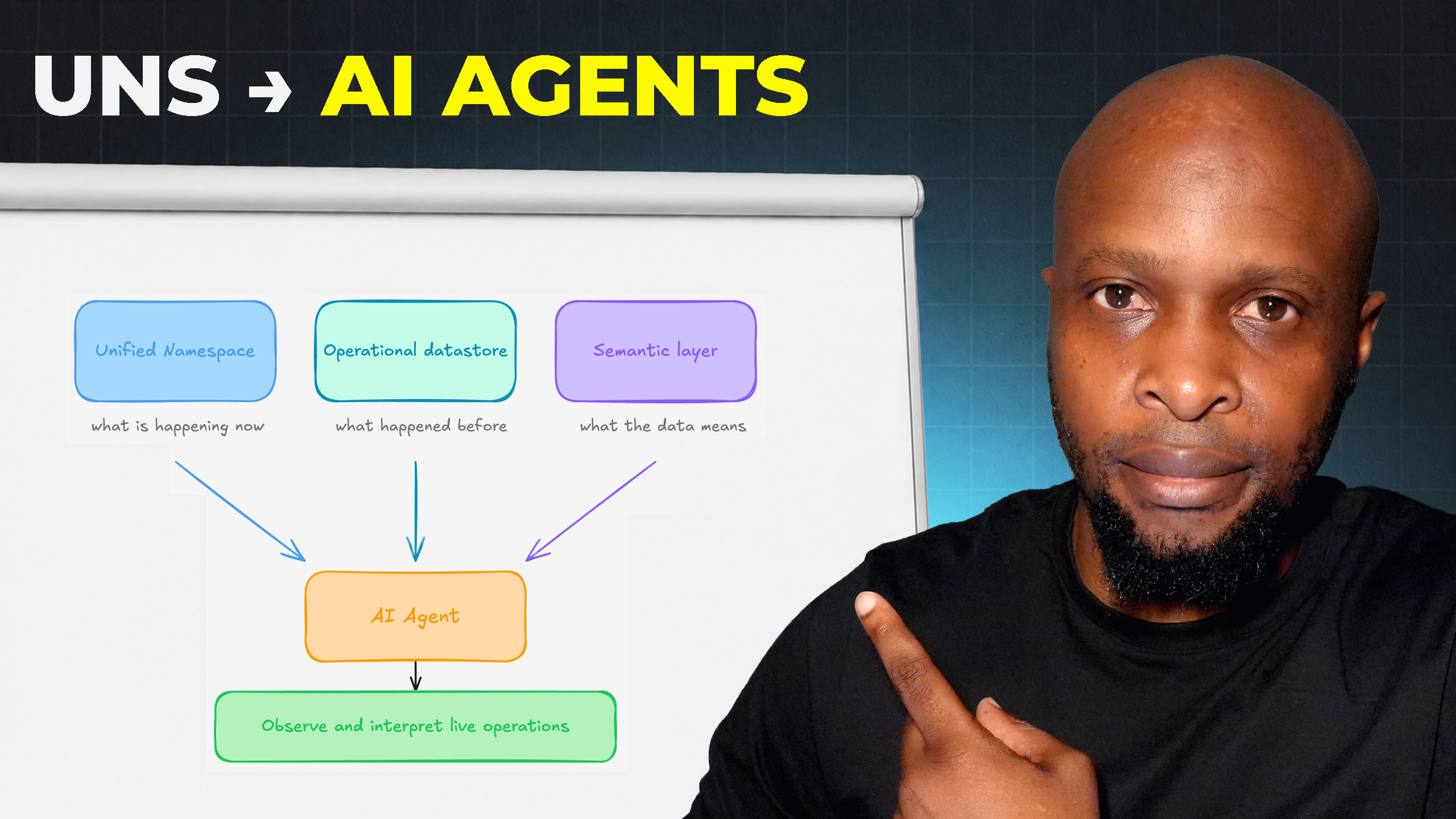
The event does not need to contain all of that information. Its role is to tell the agent that something significant changed and provide enough immediate context to begin investigating. The agent can then retrieve historical data, query systems of record, use semantic models to understand relationships, call optimization services, or invoke other tools as required.
This is why the UNS does not need to become the entire context layer for AI. Its role is more focused: it provides the live operational signal that tells the wider architecture where attention may be needed.
Traditional automation remains the right approach when the response to an event can be specified deterministically: if X happens, do Y. Manufacturing will continue to rely on that logic in control, safety, and well-understood workflows.
AI becomes useful where the appropriate response depends on a wider set of circumstances. If a machine stops, the best response may depend on the active order, downstream capacity, material availability, maintenance history, production priorities, quality requirements, and other conditions that cannot easily be reduced to a single rule.
An agent can take the event as the trigger, gather the context it needs, evaluate the consequences, and recommend or initiate a response within defined boundaries.
The important point is that this does not require a separate event architecture built specifically for AI. The same EquipmentUnavailable event that updates a dashboard or starts a maintenance workflow can also activate an AI agent. What changes is not the event, but what the consumer is capable of doing with it.
And that is perhaps the clearest expression of the value of an event-driven industrial architecture: the operation publishes what has changed, while consumers are free to decide how intelligently they respond.
Get the Next Guide
New architecture guides, implementation tutorials and use-case blueprints, delivered as they’re published.
More guides
All guides →

The leading IIoT & AI educational platform for digital manufacturing teams