
Back to Basics: What a Unified Namespace Is and What It is Not
A practical look at what the Unified Namespace is for, its role in the broader industrial data and AI architecture, and what it does not need to be.

Some concepts become less clear the more popular they become.
The Unified Namespace (UNS) is one of them.
Over the past several years, the term has moved from a relatively specific architectural concept into the mainstream of industrial digitalization. That popularity has been useful. More manufacturers are thinking seriously about how operational data should be structured, contextualized, and shared across the enterprise.
But as adoption has grown, so has the number of things people expect a UNS to be.
You will hear, for example, that a UNS must provide historical context, support transactional integration, offer flexible query capabilities, represent graph relationships, or enforce standardized data models.
None of those capabilities are unimportant. In fact, most of them are essential components of a modern industrial data architecture. But they are not what the Unified Namespace was originally designed to solve.
The boundary has become blurred for understandable reasons. Vendors describe the UNS through the capabilities of their platforms. Consultants and system integrators shape their approaches around the problems they encounter with customers. Standards organizations tend to frame it through the interoperability standards they maintain. Industrial use cases have evolved as well, and over time more responsibilities have been attached to the concept.
So does the boundary really matter? I think it does.
If the definition becomes too broad, manufacturers can end up with architectures that are more complicated than they need to be, harder to scale, and increasingly tied to proprietary ecosystems. It also creates unrealistic expectations and obscures the immediate value the UNS was created to provide:
A reliable, real-time representation of the current operational state of the business.
So rather than offering another interpretation of what the Unified Namespace should become, it is worth going back to the problem it was originally intended to solve.
What Problem Does a Unified Namespace Solve?
A production count of 7,450 may be useful to a control system, but on its own it tells you very little about the state of production. If I tell you that Line 4 has produced 7,450 units for Production Order 4711 against a target of 10,000, you immediately know that the order is 74.5% complete.
Add the planned completion time and current production rate, and you can determine whether the order is on schedule. Add equipment state, downtime events, and quality information, and you begin to build a useful picture of what is actually happening around that order.
And that kind of picture is still surprisingly difficult for many manufacturers to put together.
The data usually exists, but it is spread across PLCs, MES, ERP, quality systems, historians, scheduling applications, and other operational systems. As a result, getting a reliable answer to a simple operational question often still involves phone calls, radio messages, emails, spreadsheets, shift meetings, or simply walking across the plant to ask someone what is happening.
There is also a gap between what business systems think is happening and what is actually happening on the plant floor. An ERP system may release an order with a planned start time, quantity, and completion time, but as soon as production begins, reality starts to move. Equipment stops. Production rates change. Material arrives late. Quality issues occur. Orders run ahead or fall behind.
Those changes are continuous, while many business systems are updated through milestones: when an order starts, when a shift ends, when production is confirmed, or when the order is completed. Between those updates, the system's view of production can drift away from reality.
This is the problem the Unified Namespace was intended to address.
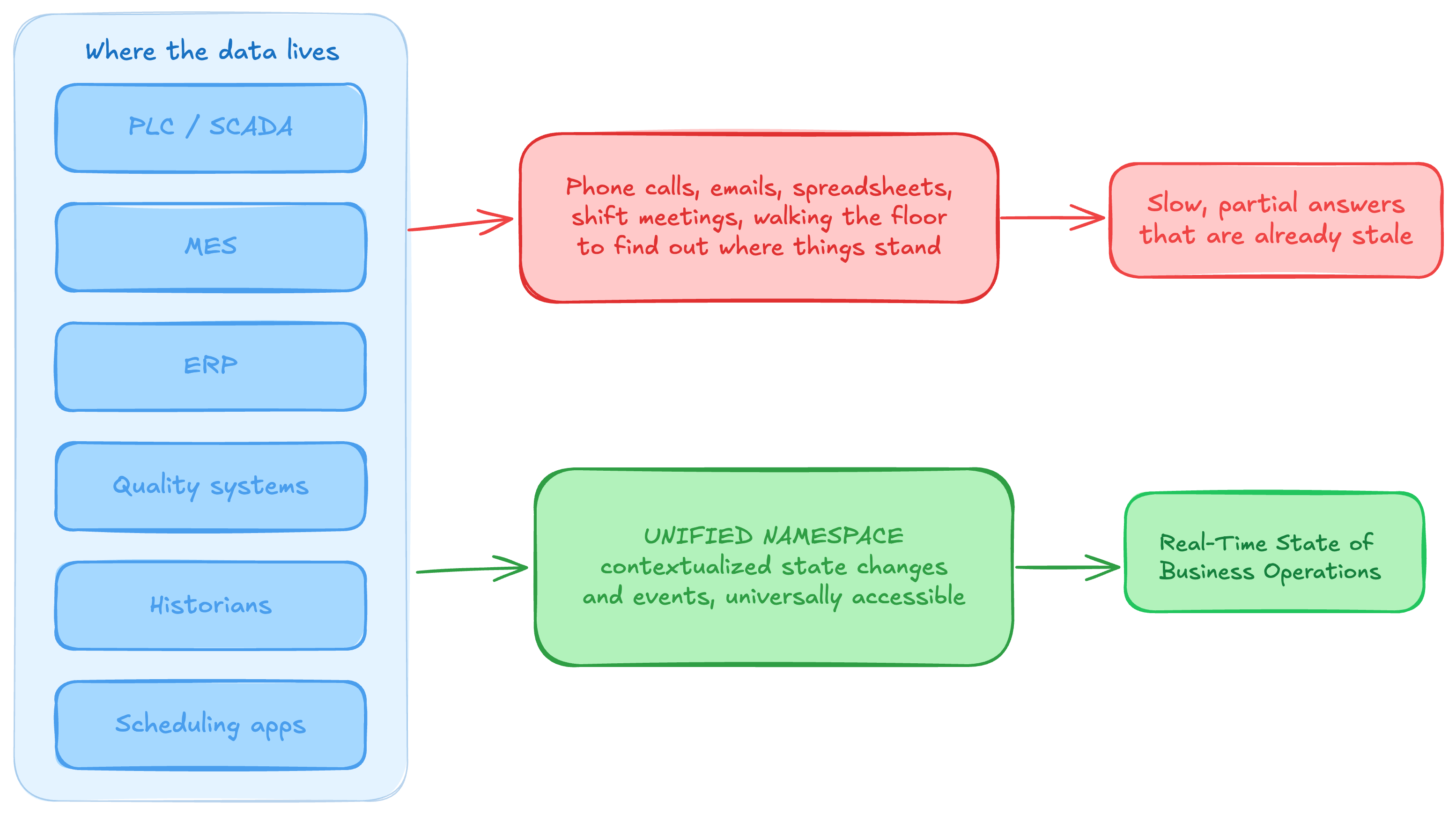
It should make it much easier to answer questions such as: Which lines are running behind schedule? Which orders are currently at risk? Which critical assets need attention right now? How is my area performing? Should we be trying to increase production rate, or is quality the bigger concern?
In other words, the kinds of questions required to run production minute by minute.
A UNS is therefore not simply a mechanism for transporting raw industrial data from one system to another. Its purpose is to take the operational data, state changes, and significant events distributed across otherwise disconnected systems, contextualize them, and make that information available through a common real-time infrastructure.
The result should be a shared and continuously updated picture of the operation as it actually exists now.
Why Does Real-Time Operational State Matter?
Maintaining an accurate picture of the current operational state may sound simple, particularly beside the more ambitious language now surrounding industrial AI. But manufacturing conditions are constantly changing. Orders take longer than expected, machines stop, material arrives late, batches require additional inspection, and cleaning cycles overrun. A schedule that looked perfectly reasonable at 8:00 can be wrong by 10:30.
If those changes are not reflected quickly across the organization, people and systems begin making decisions based on a version of the plant that no longer exists.
Suppose a support team is scheduled to arrive at a line at 2:00 PM for a changeover. If the current order is running an hour behind, knowing that early enough means the team can be redirected and return when the line is actually ready. Or consider a production manager trying to determine whether the shift will meet its target. If the progress of every active order is available in real time, attention can be directed to the lines falling behind while there is still time to intervene.
A UNS gives those consumers a shared operational picture to work from.
But there is another important benefit: once that information has been contextualized and published, it can be reused.
Traditional industrial integration tends to grow one use case at a time. A dashboard needs machine state, so a connection is built. Maintenance later needs the same information, so another interface appears. Then the enterprise data platform needs it, and another pipeline is created. Before long, several teams are extracting the same data from the same systems and recreating much of the same context for different purposes.
With a UNS, that operational information can be integrated and contextualized once, then made available as part of a shared data foundation. A process engineer might use it to build a real-time dashboard. An MES application might react to a production event and initiate a workflow. A data science team might persist the same contextualized information for model training and analysis. An AI agent might consume it as live operational context.
The source system does not need to know who all of those consumers will be, and every new use case does not need to begin by reconnecting to the PLC, MES, or other original systems.
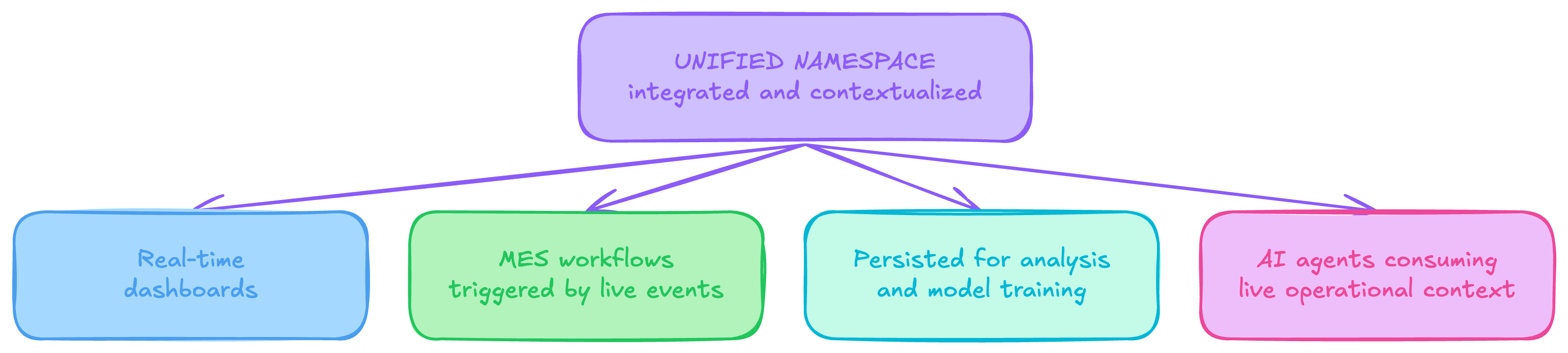
This is one of the most practical reasons to build a Unified Namespace. Instead of allowing the architecture to grow as an expanding collection of point-to-point integrations, it grows around reusable operational information.
Importantly, that does not mean modelling the entire enterprise before you can begin. Start with an operational problem, publish the information needed to solve it, and extend the namespace as new requirements emerge. Over time, the shared operational model becomes richer because it is being built around real use cases rather than an attempt to define everything in advance.
What Does a Unified Namespace Not Need to Do?
Once operational information is available through a shared foundation, it can support many different use cases. But that does not mean the Unified Namespace itself needs to take on every responsibility that follows.
Take historical analysis. If the UNS tells you that Line 4 is currently one hour behind schedule, that is useful operational information, but it does not necessarily tell you why. To understand what led to that condition, you may need to look back at equipment stops, changes in cycle time, material availability, or quality events over the previous several hours.
That requires historical data.
The states, events, and measurements published through the UNS can be persisted in a historian, time-series database, operational data store, lakehouse, or another platform designed for historical analysis. In fact, this is a natural extension of the architecture: the same contextualized information used in real time can also be stored for later analysis without making historical storage a defining responsibility of the UNS itself.
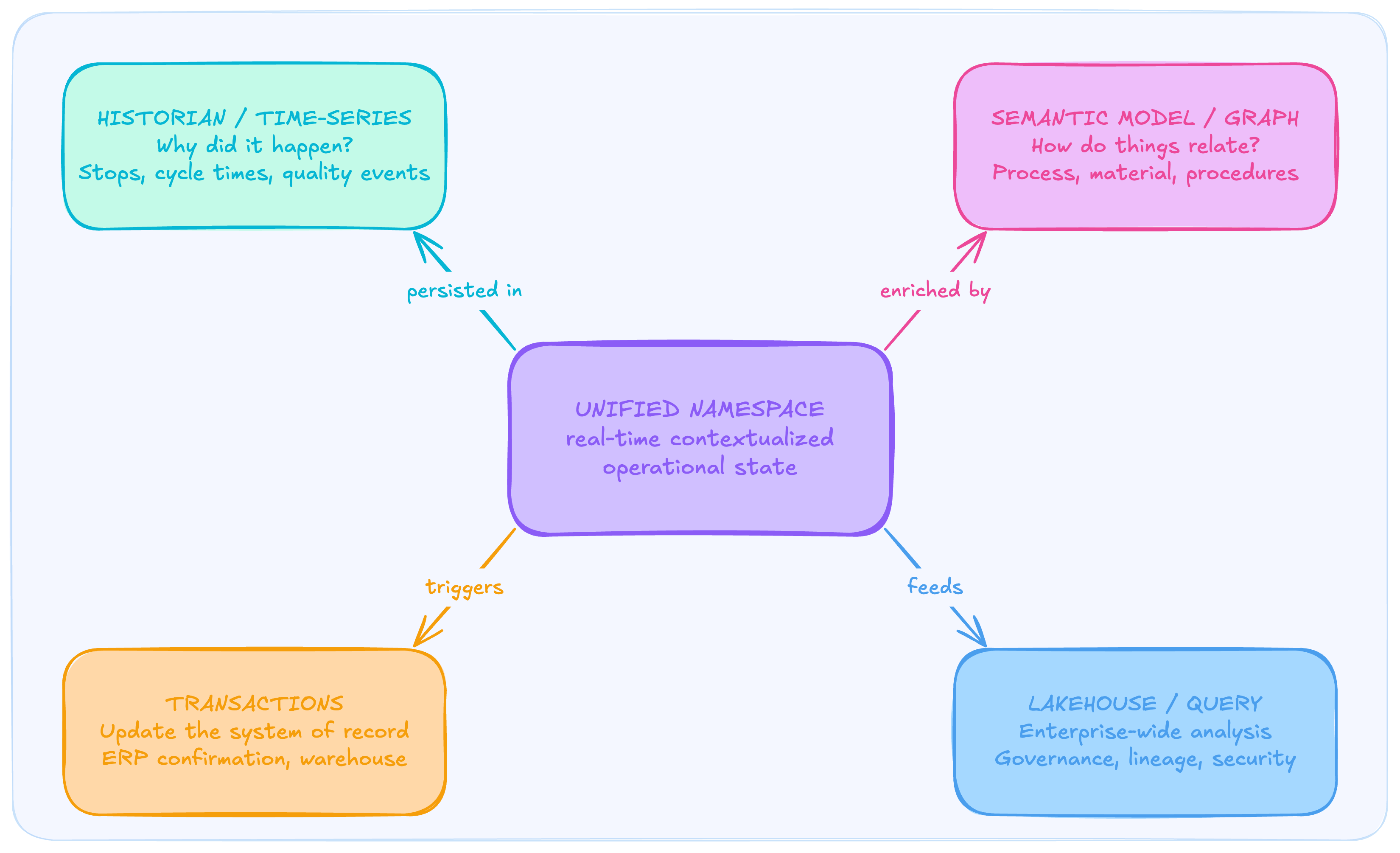
The same applies to transactions. A completed production order might be published as an event and used to initiate cleaning, notify the warehouse, or trigger an update in ERP. The UNS makes the event available; the appropriate application or integration service performs the transaction against the system of record.
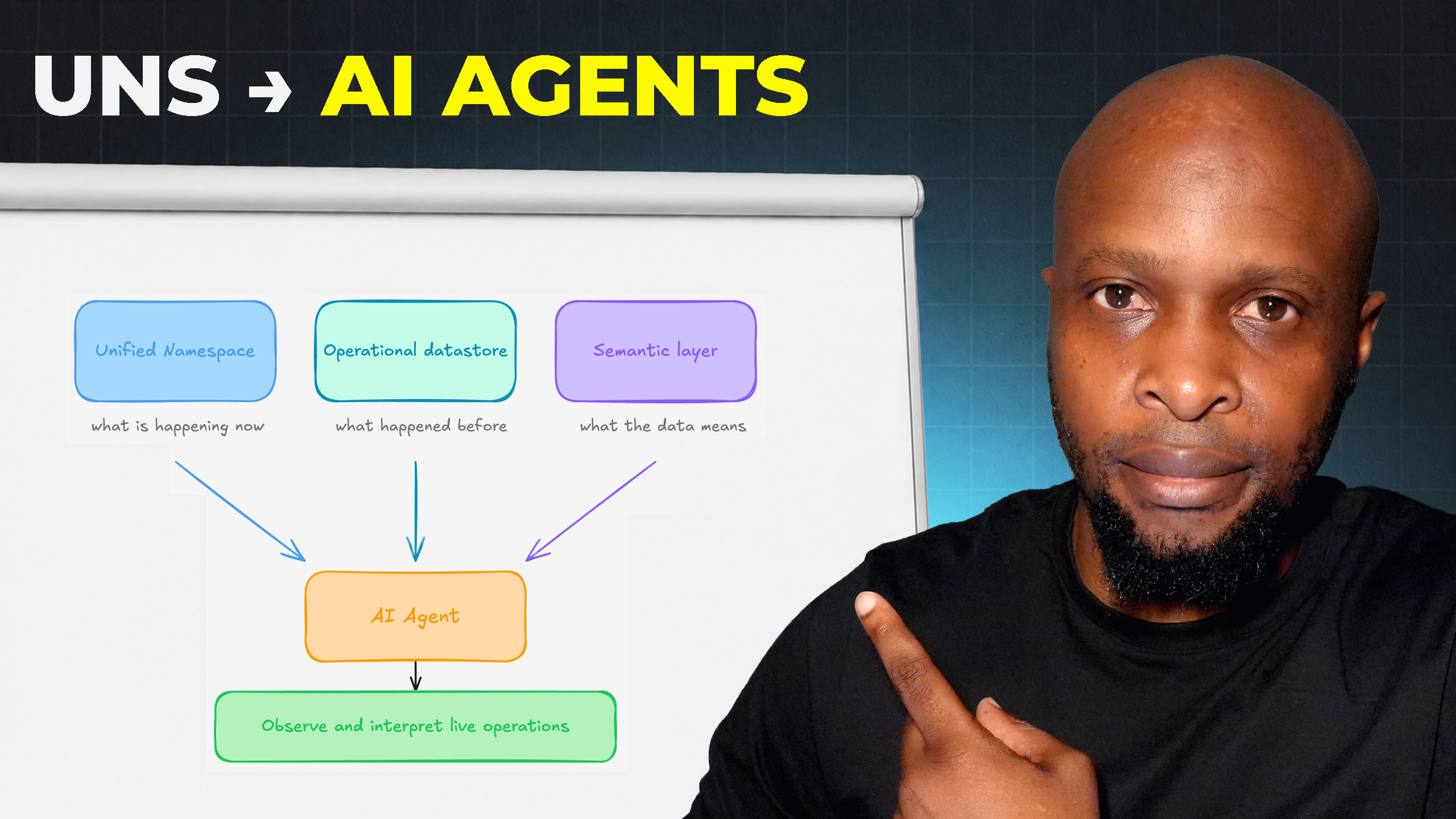
Semantic models and knowledge graphs serve another purpose again. The namespace may tell you that a pump belongs to Line 4 and expose its current state. A richer semantic layer can describe how that pump relates to a process, the material it handles, the capabilities it provides, or the maintenance procedures associated with it.
All of these capabilities can work with the Unified Namespace. They do not all need to become part of its definition.
That distinction matters because a broader industrial data architecture will naturally need history, transactions, richer semantics, governance, querying, and many other capabilities. The aim should be to let those components work together, rather than continually expanding the UNS until it becomes another name for the entire architecture.
Where Does UNS Fit in the Data and AI Architecture?
This separation becomes particularly useful when operational data starts being used beyond the plant floor, whether for analytics, enterprise applications, or AI.
This is where the value of the UNS extends well beyond real-time dashboards. A well-designed UNS gives IT, analytics, and AI teams something that has traditionally been difficult to obtain from industrial systems: operational information that already carries useful context.
That context is often best created close to the source. The engineers and operators who understand the equipment and process know what constitutes downtime, which state changes matter, whether a measurement is valid, and how a production rate should be calculated. If that knowledge is captured when the data is contextualized and published, downstream teams do not have to reconstruct the same meaning every time they want to use it.
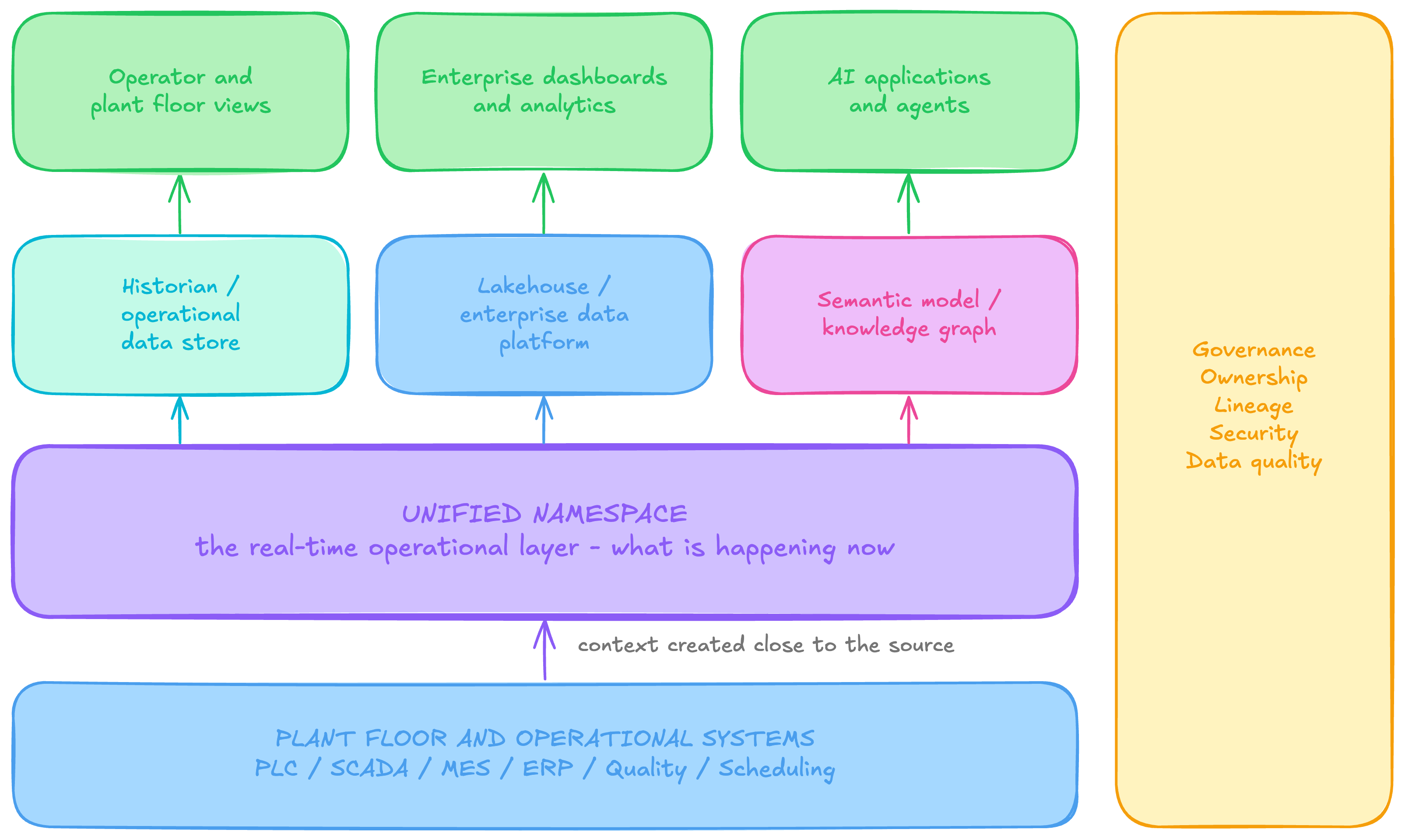
The production metric displayed to an operator, persisted for historical analysis, shown in an enterprise dashboard, and consumed by an AI application can therefore originate from the same operational definition.
As that information is used more broadly, capabilities such as governance, ownership, lineage, security, and data quality become increasingly important. But these strengthen the data architecture around the UNS. They do not require us to keep expanding the definition of the UNS itself.
This is ultimately where the Unified Namespace fits: as the real-time operational layer within a broader data architecture, providing a consistent view of what is happening now that other systems can store, enrich, analyze, and act upon.
What Is the Core Purpose of a Unified Namespace?
The Unified Namespace is powerful because the idea is simple: take the operational information that matters, contextualize it, and make it available through a shared real-time infrastructure so the rest of the business can understand what is happening.
That is already a significant problem to solve.
The UNS does not need to become your historian, lakehouse, knowledge graph, transactional integration platform, or another name for the entire industrial data architecture. Those capabilities can sit around it and build on the information it provides.
Its role is narrower, but foundational:
Create a unified, contextualized, real-time representation of the operational state of the business.
Once that exists, the same information can be persisted for historical analysis, used to trigger workflows, fed into enterprise data platforms, enriched through semantic models, and consumed by AI applications and agents.
But those are things you can do with the Unified Namespace. They do not need to become part of what the Unified Namespace is.
That distinction is worth preserving.
For manufacturers trying to decide where to begin, I would start with the question the UNS was designed to answer:
What is happening in my operation right now, and can the people and systems that need to know reliably understand it?
Get the Next Guide
New architecture guides, implementation tutorials and use-case blueprints, delivered as they’re published.
More guides
All guides →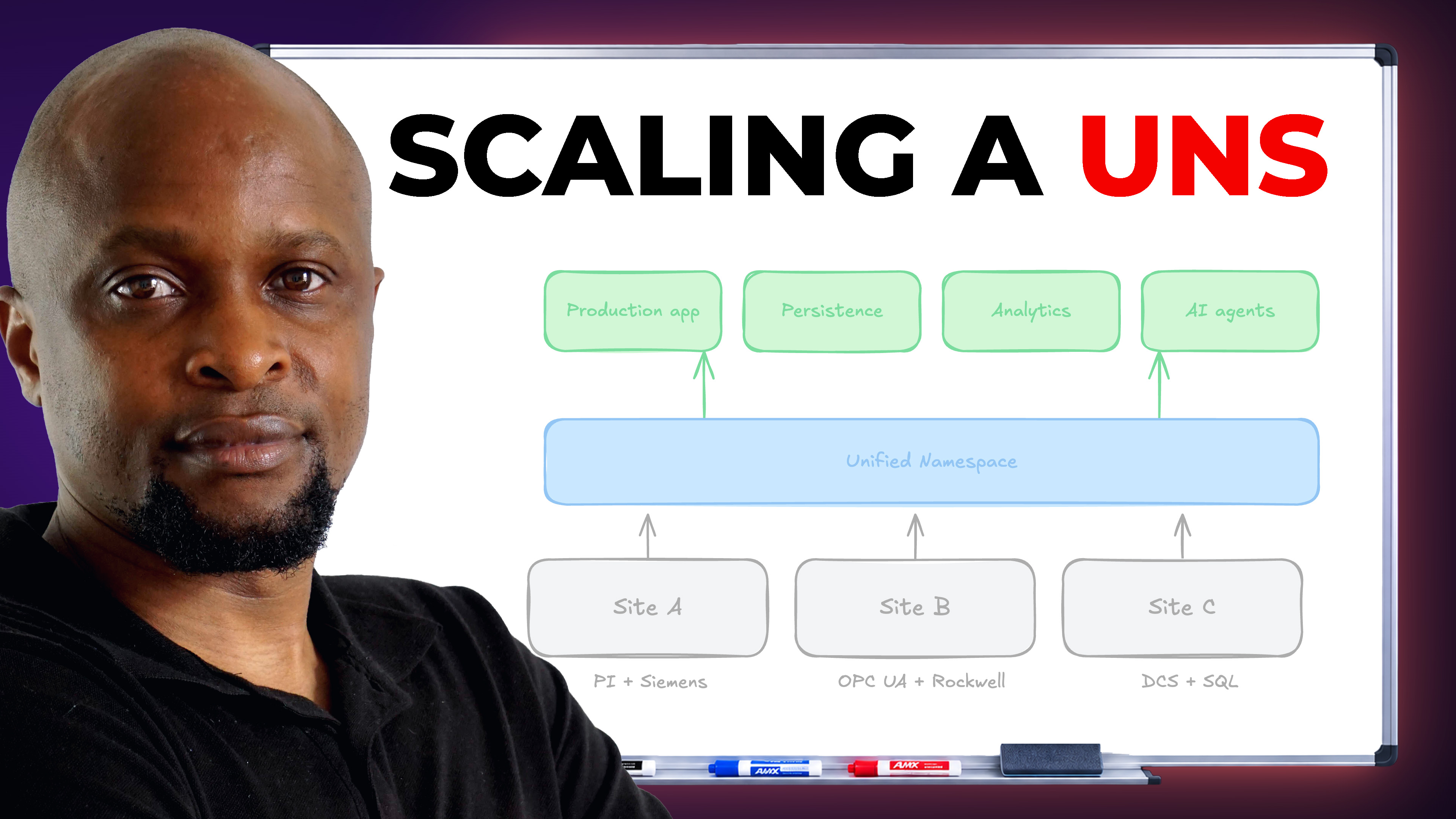


The leading IIoT & AI educational platform for digital manufacturing teams