
Industrial DataOps: What It Is, Why It Matters, and Where It Fits
A practical introduction to Industrial DataOps, how it turns complex industrial data into trusted information, and where it fits in the architecture.

Manufacturers are connecting more operational data than ever before. Data is being collected from PLCs, SCADA systems, DCS platforms, historians, MES applications, databases, and many other sources across the plant.
At the same time, many manufacturers are building real-time data backbones such as the Unified Namespace to make this information more widely available across plants and the enterprise.
But connecting these systems does not automatically make their data ready for broader consumption.
Before operational data can reliably be delivered to a Unified Namespace, data platform, analytics application, or AI system, it often needs to be extracted, cleaned, contextualized, transformed, validated, structured, and governed.
Industrial DataOps provides the engineering discipline needed to bridge this gap.
It sits between heterogeneous industrial systems and the applications that need trusted, usable operational data. Its role is to acquire information from industrial sources, add the context required to understand it, transform it into consistent structures, apply information models and data-quality rules, and deliver it in the form required by downstream systems.
For many manufacturers, this is becoming an essential layer of the industrial data architecture, particularly as operational data is expected to support a growing range of real-time applications, enterprise analytics, and AI use cases.
What Is Industrial DataOps?
The term DataOps emerged from enterprise data engineering as a way of applying many of the principles associated with DevOps to data pipelines, including automation, repeatability, testing, collaboration, observability, and continuous improvement.
Industrial DataOps applies these principles to operational technology data, but within an environment that introduces a different set of challenges.
Manufacturing data originates from PLCs and industrial controllers, OPC UA servers, SCADA and DCS platforms, Historians, industrial databases, MES and batch systems, files, APIs, and increasingly IIoT devices.
The data coming from these systems is rarely consistent. Different plants may use different tag structures and naming conventions. Equipment vendors may represent identical measurements differently. Some information arrives continuously as time-series data, some is generated as events, and other information has to be retrieved from databases or transactional systems. The operational context required to interpret that data may also be spread across several systems.
Industrial DataOps addresses these interoperability and usability gaps by systematically preparing operational data for broader use.
A useful way of thinking about the distinction is this:
Industrial connectivity gets data out of industrial systems. Industrial DataOps makes that data usable beyond the system that produced it.
Where Industrial DataOps Fits in the Architecture
Industrial DataOps does not occupy a single fixed position in the architecture. Its capabilities can be deployed wherever operational data needs to be acquired, contextualized, transformed, validated, governed, or moved between systems.
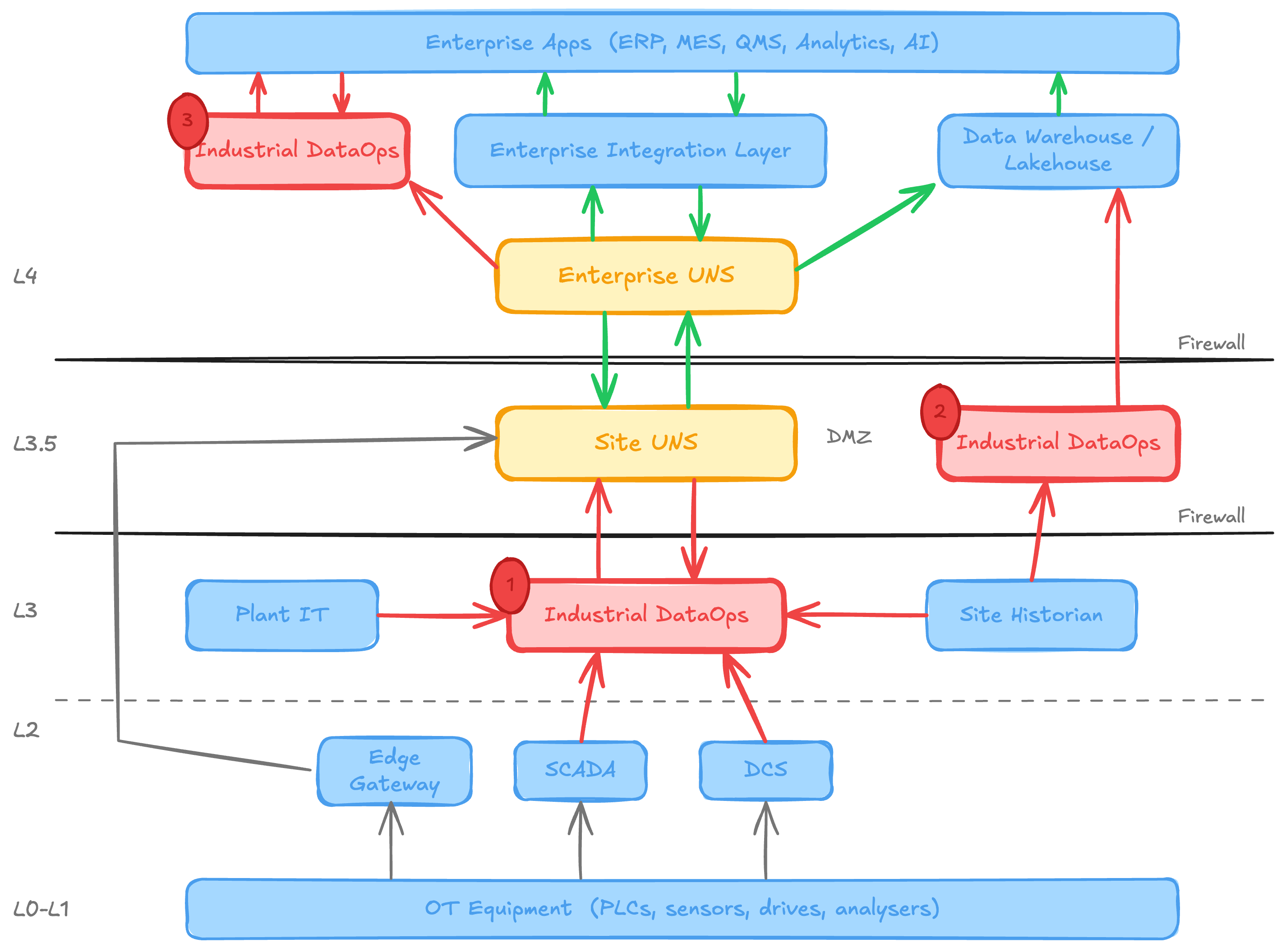
At the plant level, DataOps may connect directly to SCADA, DCS, historians, databases, edge systems, and other sources. This is often where source-specific data is normalized, enriched with context, mapped into agreed information models, and prepared for broader consumption.
The resulting information might be published into a Unified Namespace, persisted in an operational datastore, sent to another plant application, or delivered directly to a central data platform.
DataOps can also govern the movement of historical information north. A manufacturer may already have years of process data stored in site historians and want selected information replicated into a central warehouse or lakehouse for enterprise analytics, machine learning, or long-term retention. A DataOps pipeline can extract the appropriate data, apply transformations and context, and deliver it into the central platform using an agreed structure.
Further north, DataOps can act as a translation layer between operational and enterprise information models. Production data may be represented around concepts such as equipment, work orders, batches, states, events, and materials, while an ERP, MES, QMS, or other enterprise system expects a very different schema.
DataOps maps between those representations so that neither side has to adopt the internal structure of the other.
These flows are also not necessarily one-way. Production orders, schedules, product definitions, quality information, or other business context may move from enterprise or plant IT systems back toward the operational environment.
The exact deployment varies between manufacturers. What remains consistent is the function: Industrial DataOps prepares and moves information across architectural boundaries while preserving its context, quality, structure, and meaning.
The Core Responsibilities of Industrial DataOps
Although different products implement these capabilities in different ways, the underlying responsibilities of Industrial DataOps are relatively consistent.
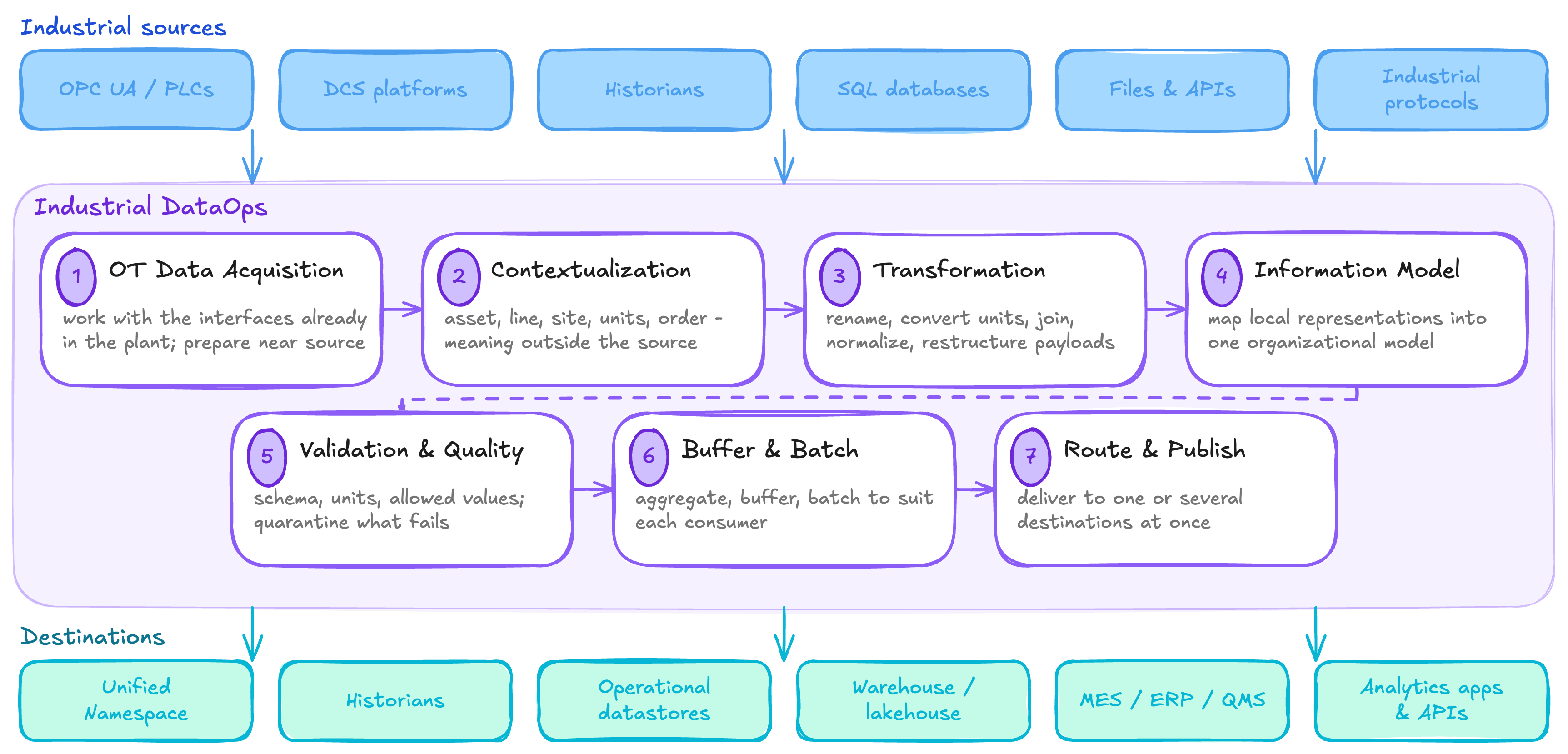
OT Data Acquisition
Everything begins with gaining access to the data.
A single site may need to collect information from OPC UA, PLCs, DCS platforms, historians, SQL databases, industrial protocols, files, and APIs. Industrial DataOps therefore needs to work with the interfaces already present in the plant rather than assuming that every source exposes data in the same way.
Much of this acquisition can happen close to the source. Rather than sending large volumes of unprocessed data into a central environment and attempting to interpret it there, manufacturers can select and prepare the relevant information before it leaves the site.
This also reduces the need for every downstream application to establish its own direct connection to industrial systems.
Contextualization
Acquiring a value does not necessarily mean that anyone outside the source system can understand it.
Consider:
FIC101.PV
Speed_04
MTR7_Current
These names might be obvious to the controls engineer responsible for the equipment. Outside that environment, much of their meaning is implicit.
A downstream application may instead need to know that MTR7_Current represents the motor current of ConveyorMotor07, installed on Line04 in the packaging area of a particular site, measured in amperes and associated with a specific work order or product.
Some of that context may come from the source system. Other information may come from engineering databases, MES applications, historians, asset models, or centrally managed definitions.
Industrial DataOps brings these pieces together.
Without contextualization, manufacturers can centralize enormous quantities of data while simply creating a larger collection of difficult-to-understand tags.
Transformation
Operational data often needs to be reshaped before it can be used elsewhere.
Simple transformations may include renaming fields, converting engineering units, normalizing timestamps, filtering unnecessary signals, mapping values, or restructuring payloads.
Other transformations are considerably more involved.
The information required to construct a production event, for example, may be distributed across several MES or database tables. A pipeline may need to retrieve the production record, join it with equipment and product information, map local identifiers to enterprise identifiers, calculate additional values, and then construct the required event structure.
This is why Industrial DataOps is more than protocol conversion. The task is not merely to move data between systems, but to transform source-specific data into information that can be consistently understood and reused.
Information Model Handling
Transformation defines how the source data changes. Information modelling defines what the resulting information should look like.
An organization might establish a common representation for an industrial motor containing an asset identifier, manufacturer, model, operational state, speed, current, and temperature.
A Siemens PLC, Rockwell PLC, DCS database, and historian may all describe that motor differently at source. Industrial DataOps provides the mapping layer that allows those local representations to produce the same organizational model.
This creates a valuable separation between the technology producing the data and the information contract exposed to the rest of the architecture.
At scale, that consistency becomes extremely important.
Validation and Data Quality
Producing a standardized payload is not enough. Manufacturers also need confidence that the resulting information conforms to agreed rules.
A DataOps pipeline can validate required properties, data types, engineering units, allowed values, schemas, topic structures, or other organizational conventions before the information is released downstream.
A message missing an asset identifier or containing an unsupported state can therefore be detected before it enters shared infrastructure.
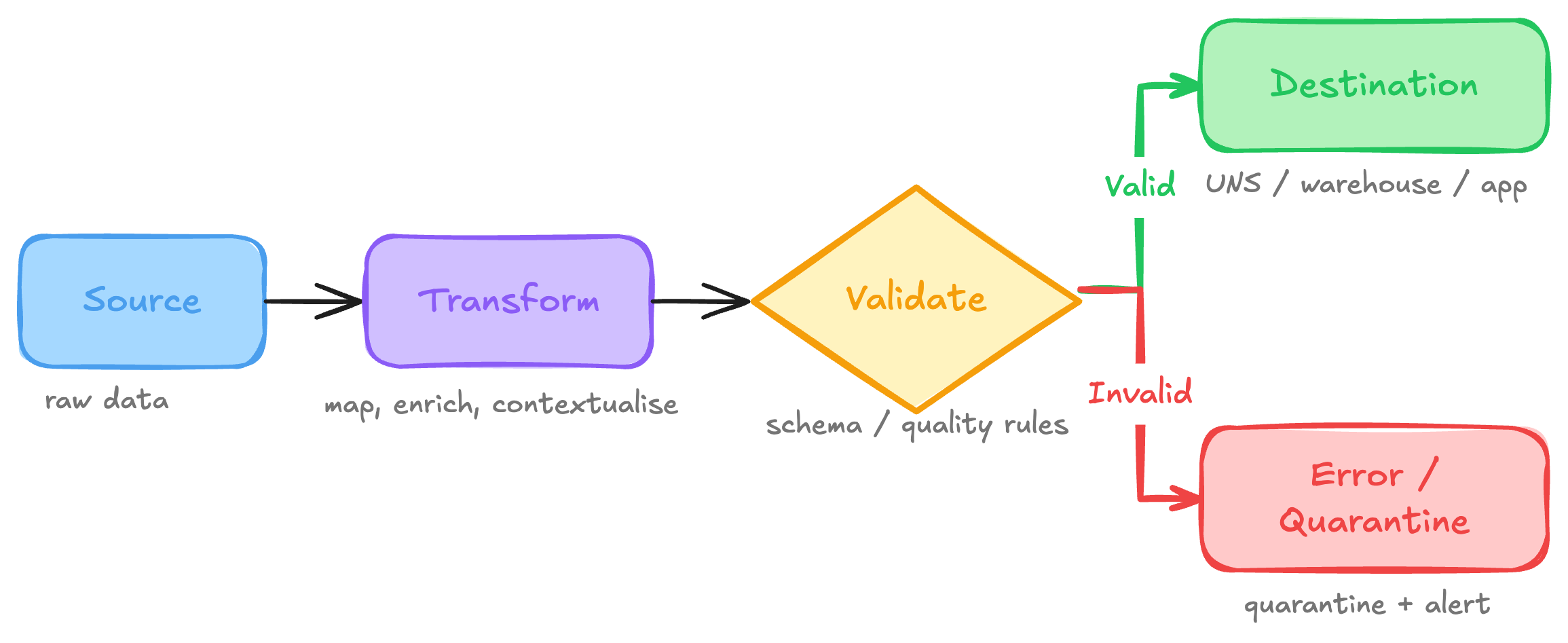
Invalid information can be logged, quarantined, or routed for investigation rather than silently propagated.
This pushes data-quality enforcement upstream. Once inconsistent data enters shared infrastructure, every downstream consumer otherwise inherits the problem.
Aggregation, Buffering, and Batching
Different destinations also have different requirements.
A real-time monitoring application may need an equipment-state change immediately. A historian may require high-frequency process values. A central data platform may work more efficiently with records delivered periodically in larger batches, while another application may only need five-minute aggregates.
Industrial DataOps adapts the delivery pattern to suit the consumer.
The PLC does not need to understand how a cloud lakehouse wants records to be batched, and a historian does not need to implement the payload structure required by an analytics application. The DataOps layer absorbs that integration complexity.
Routing and Publishing
Finally, the prepared information needs to reach the appropriate destination.
That might be a Unified Namespace, historian, operational datastore, warehouse, lakehouse, MES, ERP, QMS, API, analytics application, or several destinations at the same time.
By the time information reaches this stage, several DataOps responsibilities may already have been applied. A raw value may have been acquired, associated with the correct asset, normalized, contextualized, mapped into an agreed model, validated, and then routed according to the needs of the architecture.
The destination is important, but the core principle remains the same: downstream systems should not have to understand the complexity of every industrial source that produced their data.
Industrial DataOps Is Also About Managing Change
Industrial data architectures are not static.
Equipment is replaced, tags are renamed, new production lines are commissioned, models evolve, and new consumers begin using the data. A pipeline that was correct today may need to change when the organizational information model changes tomorrow.
For this reason, Industrial DataOps is also concerned with the lifecycle of the models, mappings, transformations, and configurations used across the architecture.
Consider a manufacturer operating twenty factories. A central architecture team introduces a new standard model for industrial motors. Defining the model is only the beginning. The organization also needs to understand which sites are still using the previous version, which pipelines differ from the agreed standard, and how changes can be deployed without disrupting production.
Not every local difference is necessarily wrong. One plant may require a different mapping because of its DCS, while another may retain an additional property required by a local application.
The objective is therefore not to make every plant identical. It is to make differences visible, deliberate, and manageable.
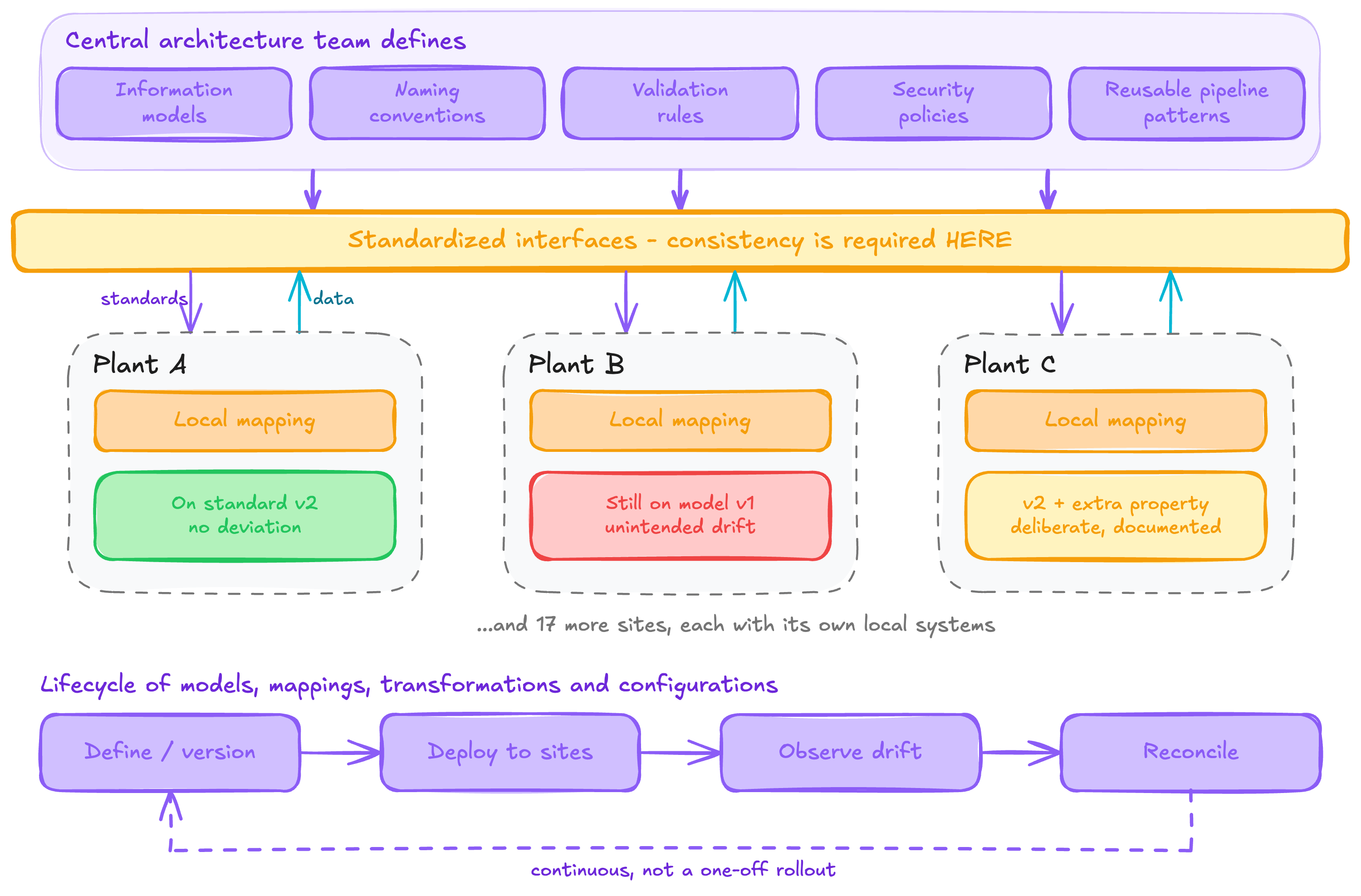
This introduces an important organizational role for Industrial DataOps: it helps manufacturers operationalize and maintain data standards across sites.
Central teams can define information models, naming conventions, validation rules, security policies, and reusable pipeline patterns, while individual plants retain control over how their local systems are mapped into those standards.
The goal is not uniformity at the source.
It is consistency at the interfaces where information is shared.
Why Industrial DataOps Matters for AI
The growing use of analytics and AI makes this foundation even more important.
An AI agent investigating poor production performance should not first have to determine whether P101_SPD means pump speed, production speed, or something else entirely.
People who work closely with a plant can often interpret such tags from experience. They understand naming conventions and know where to look for additional information. Software does not have that implicit knowledge.
For operational data to be used reliably by analytics and AI, identity, context, structure, meaning, quality, and provenance need to become increasingly explicit.
Industrial DataOps does not solve the entire industrial AI problem. It does not replace an ontology, knowledge graph, analytics platform, or AI system.
What it does is remove much of the basic data engineering those higher layers would otherwise have to repeat.
Without DataOps, those responsibilities do not disappear. They simply move further up the architecture, often into every application that needs the data.
What Industrial DataOps Is Not
Industrial DataOps is easier to understand when separated from several adjacent technologies.
It is more than industrial connectivity. Connecting to an OPC UA server, historian, database, or PLC provides access to data, but does not automatically make that data contextualized, standardized, modelled, or fit for broader use.
It is also distinct from the Unified Namespace. A UNS provides a shared real-time environment for publishing and consuming operational information. DataOps performs much of the engineering required to prepare that information and can also move and transform data between the UNS and other systems.
There is significant overlap with ETL and data integration, but Industrial DataOps has to operate within the realities of industrial environments: OT protocols, equipment models, high-frequency data, intermittent connectivity, plant autonomy, industrial deployment constraints, and real-time requirements.
And it does not replace MES, SCADA, DCS platforms, historians, or other operational systems. Those systems continue to perform the functions for which they were designed.
Industrial DataOps works across them.
A Useful Mental Model
A useful way to think about Industrial DataOps is as the engineering layer that turns heterogeneous industrial data into standardized operational information.
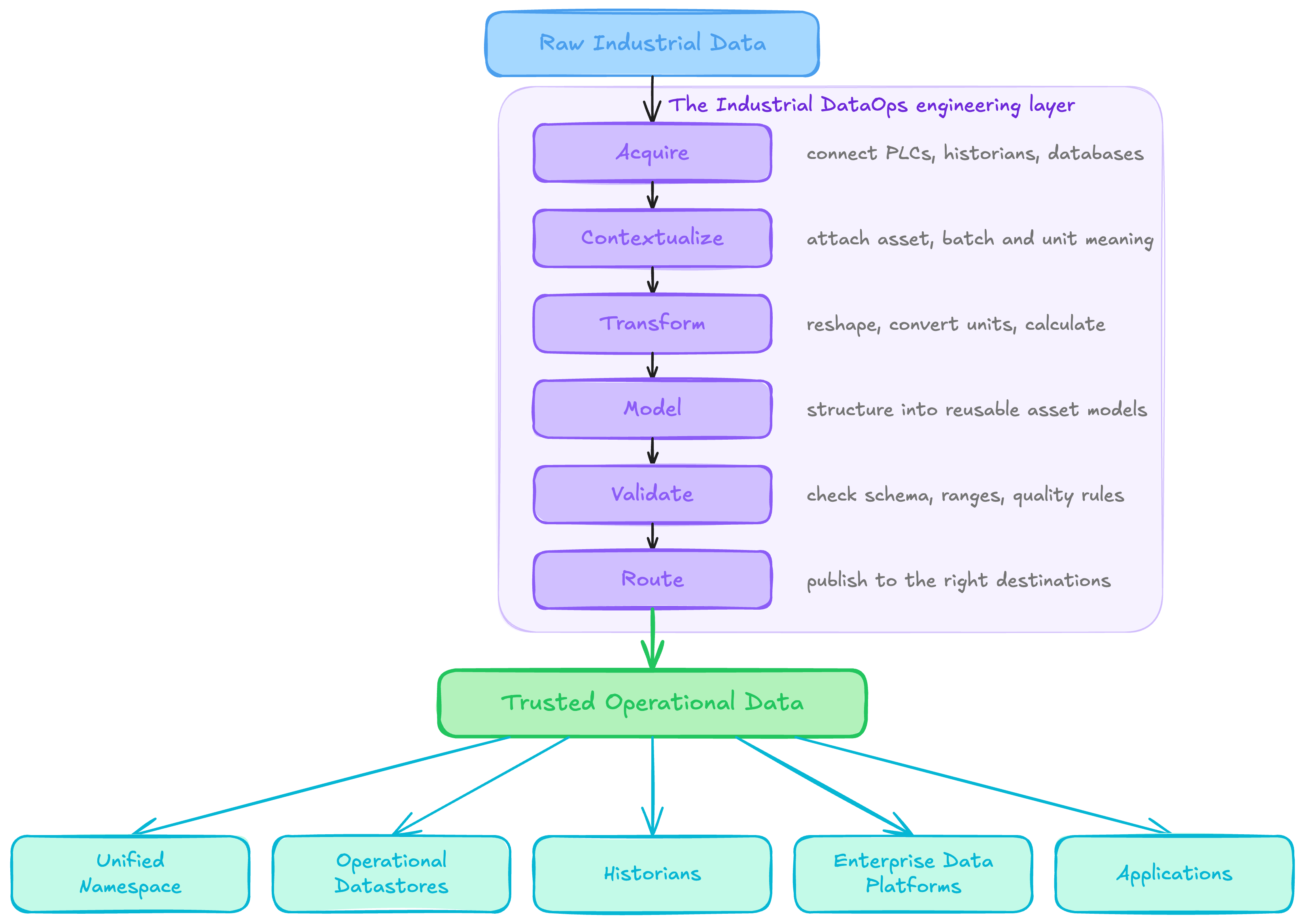
Not every pipeline will perform every step, and the sequence will not always be identical. A historian extraction may already contain substantial context, while a database integration may require several joins before a useful model can be constructed.
The common purpose is what matters.
Industrial DataOps provides the data engineering discipline for turning heterogeneous industrial data into trusted, contextualized, and standardized information that can be reliably used across the wider industrial data architecture.
In the next article, we discuss the role of Industrial DataOps in a Unified namespace architecture.
Get the Next Guide
New architecture guides, implementation tutorials and use-case blueprints, delivered as they’re published.
More guides
All guides →

The leading IIoT & AI educational platform for digital manufacturing teams