
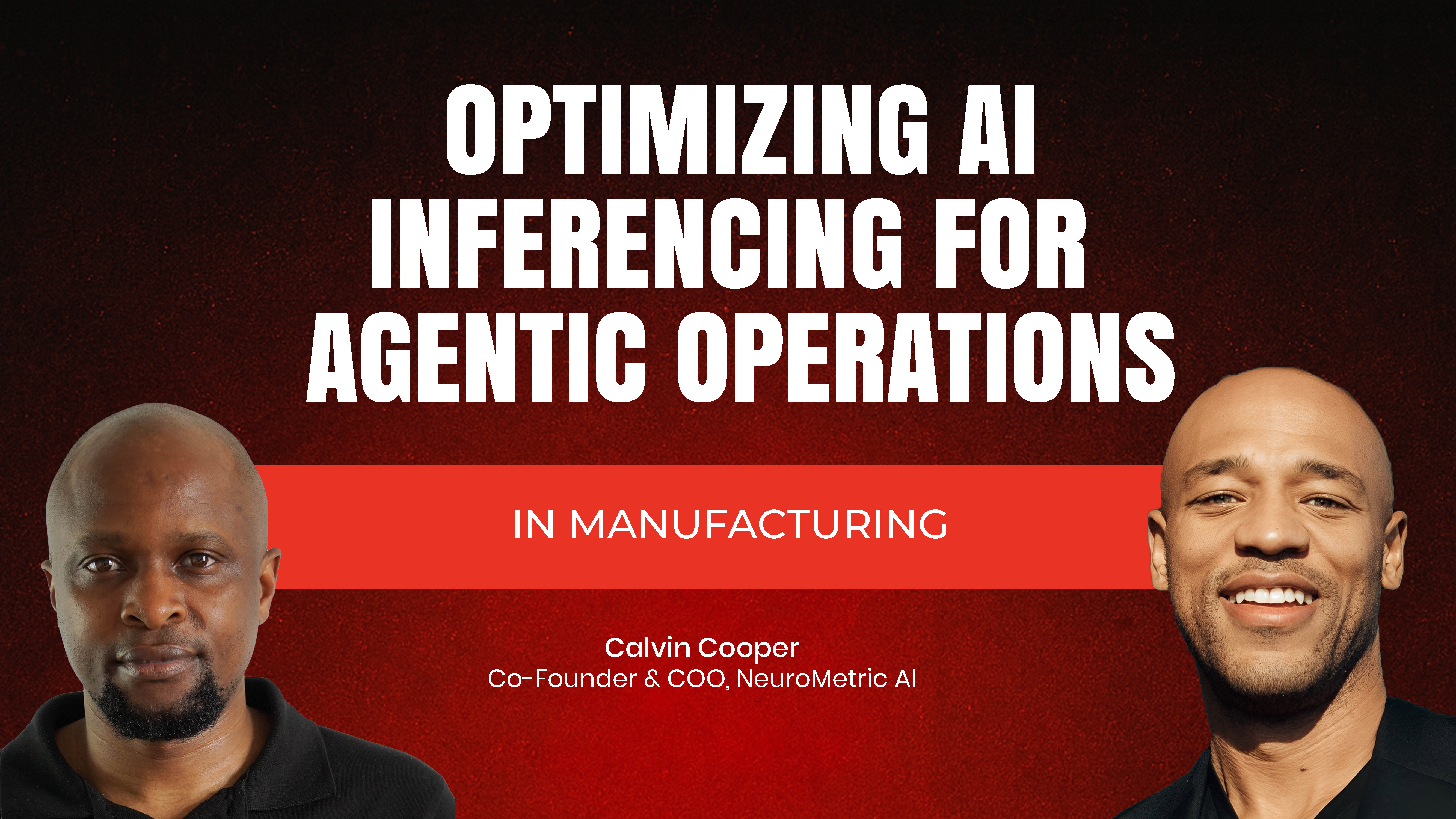
Optimizing AI Inferencing for Agentic Operations in Manufacturing
Why running every task through one large language model drives runaway cost and latency, and how coordinated small models change the economics of scaling.

The biggest bottleneck to scaling AI in manufacturing is the assumption that a single large language model can handle every task across your operations. That assumption, reasonable twelve months ago, is now the primary driver of runaway costs, latency problems, and stalled deployments.
In my conversation with Calvin Cooper, co-founder and COO of Neurometric.ai, on the AI in Manufacturing podcast, we dug into why the smartest enterprises are abandoning the one-model-fits-all approach and moving toward coordinated systems of specialized small language models. Cooper, who also serves as a director at Pilot Wave Holdings—a private equity firm doing AI rollups in the industrial economy—brings a rare vantage point that spans venture capital, AI research at the Milken Institute, and hands-on operational transformation.
Why Do 95% of Manufacturing AI Pilots Never Reach Production?
The conventional explanation points to technical complexity or data readiness. Cooper sees something more fundamental: organizations are building the wrong thing. They think the pilot is the product. It's not. The pilot is the team and the feedback loop.
"The problem is that you think the pilot is what you're building," Cooper said bluntly. What you're actually building is a pod—a small group of technologists and a product manager—whose real KPI is shipping something complete as fast as possible, assuming it will fail, and then learning from that failure. The flywheel of build, ship, interact, learn, adjust is the actual deliverable. The specific use case is almost secondary.
This runs counter to how most manufacturing organizations approach AI adoption. The typical playbook involves months of use case evaluation, committee-based decision making, and elaborate success criteria before anything ships. Cooper argues this instinct to over-mitigate risk is itself the biggest risk. Most doors are two-way doors. You can ship something and scale it back. But the time you spend analyzing and debating is time the market is moving without you.
What Changed About AI Economics That Invalidates the Single-Model Approach?
A year ago, the market narrative was straightforward: bigger models, more compute, better results. Every company started the same way—route everything to Anthropic or OpenAI, leverage the most capable frontier model, and iterate from there. That approach made sense when the priority was simply getting something to work.
But scaling changes the math entirely. Cooper pointed to AT&T's CDO publicly discussing how, at 8 billion tokens per day, costs forced a complete rethink of their AI architecture. They built an orchestration layer with task-specific models and a multi-agent stack. As they scaled to 27 billion tokens per day, they cut costs by 90 percent.
The pattern is consistent: capability first, then latency becomes the bottleneck, then cost becomes prohibitive. Every organization that successfully scales AI inference hits this sequence. The difference is whether you planned for it or whether it blindsides you at the worst possible moment.
What Is the Real Cost of Vendor Lock-In with Frontier AI Models?
The hidden tax of defaulting to a single model provider goes beyond the invoice. It creates architectural rigidity at exactly the moment you need flexibility. Cooper was direct about this: "It's important to start to build from day one with the perspective that you need to build an AI system that doesn't have vendor lock-in."
When your entire agentic operation depends on one provider's API, you inherit their pricing decisions, their latency characteristics, and their reliability constraints—across every use case, regardless of whether that model is the right fit. Different tasks have fundamentally different requirements. Production scheduling demands different capabilities than supply chain optimization. A purchase order automation workflow has nothing in common with a quality inspection system. Yet companies routinely route all of these through the same frontier model, paying premium prices for capabilities they don't need on most tasks.
Cooper described what his team calls "the jagged frontier"—the reality that different models perform better or worse at the task level, and even how you use inference-time compute around the model can have a bigger impact than selecting the model itself. Within a single model, on a given task, there's significant variance in output because these aren't deterministic systems. Treating them as interchangeable black boxes is an expensive fiction.
How Does a Coordinated System of Small Language Models Actually Work?
The alternative isn't just swapping one model for another. It's a fundamentally different architecture where intelligence is distributed across specialized models, each optimized for specific tasks, with an orchestration layer that routes queries to the right model based on cost, latency, or accuracy requirements.
Cooper described the end state simply: "You're going to be abstracted away from caring about whether you're leveraging Anthropic or OpenAI. You're going to have an AI system that automatically selects the right model for the right tasks." Frontier models still play a role, but only when necessary—handling the genuinely complex queries that smaller models can't address. For the vast majority of repetitive, well-defined tasks, a fine-tuned small language model with fewer parameters delivers faster, cheaper, and more accurate results.
The logic is intuitive once you hear it. You don't need a model that knows world history to handle repetitive manufacturing tasks. Specialization beats generalization for any workflow with high repetition and clear evaluation criteria. And the system improves over time—production data feeds back into fine-tuning, creating a self-improving loop that gets better the more you use it.
One of Neurometric's customers saw a 10x improvement in both cost and latency simply by shifting from GPT-4o to Llama Maverick for specific tasks. That's not a hypothetical. That's a real result from running an analysis across dozens of models and identifying where the mismatch between capability and need was costing the most.
How Fast Can Manufacturers Implement AI Inference Orchestration?
The shift is more accessible than most leaders assume. Cooper described implementations where the initial step was as simple as analyzing current model usage, recommending alternatives, and making the switch. No massive infrastructure overhaul. No eighteen-month integration project.
For organizations earlier in their AI maturity—those still trying to get something to work—the advice is even more direct. Don't spend three months evaluating use cases. Pick something, ship it, and learn. The accounting system, purchase orders, bidding optimization—anything involving a human sitting in front of a computer is a legitimate target. The value isn't in selecting the perfect first use case. The value is in building a team within your organization that can execute, build, interact with the market, and learn quickly. That team, that capability, is the real asset.
For organizations already running production AI systems and hitting scaling bottlenecks, Neurometric's SLM marketplace offers task-specific small language models that can be downloaded or accessed via API, along with analysis tools that benchmark current model usage against alternatives. The self-improving system that auto-distills task-specific SLMs from production traffic is coming next.
Why Should Manufacturing Leaders Stop Asking "Which AI Model Should We Use?"
The question itself is wrong. It assumes a static answer to a dynamic problem. Which model you should use depends on the task, the performance requirement, the cost constraint, and the current state of a rapidly evolving market. The right question is: "How do we build an AI system that automatically makes that choice for every task, every time, and gets better at it continuously?"
Cooper framed the broader strategic context starkly. Hundred-billion-dollar buyout funds are forming to do AI rollups in manufacturing. Private equity firms like Pilot Wave are acquiring industrial businesses specifically to lead AI transformation. The capital entering this space is not patient and it is not theoretical. Meanwhile, researchers tracking the top 70 critical technology areas report that the US, which used to dominate 60 of them, now leads in only a few. China dominates. Europe is far behind.
The manufacturers who will thrive aren't the ones who picked the right model. They're the ones who built the organizational muscle to adopt, iterate, and improve AI systems continuously. As Cooper put it, "The future is now, just not evenly distributed." The factories running coordinated systems of specialized models, self-optimizing their inference costs, and shipping AI improvements weekly already exist. The question is whether yours will be among them.
Get the next episode
New AI in Manufacturing episodes, expert perspectives and, delivered as they’re published.
More episodes
All episodes →

The leading IIoT & AI educational platform for digital manufacturing teams