
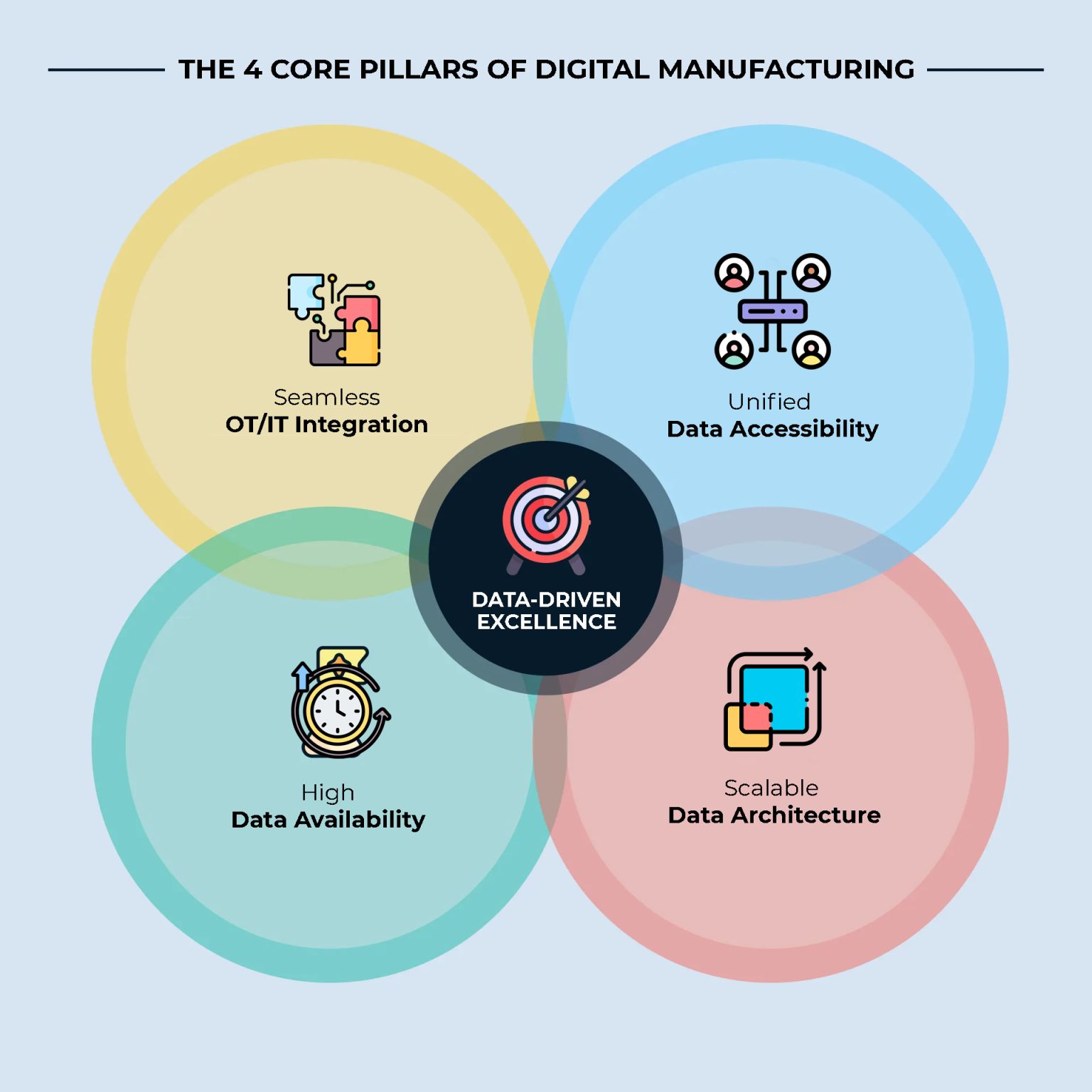
4 Core Pillars of Digital Manufacturing Architecture

If you’re leading digital transformation or part of an OT/IT integration team, then there are four core pillars you likely (should) care about.
→ Seamless OT/IT Integration
→ Unified Data Accessibility
→ Scalable Data Architecture
→ High Data Availability
Let’s break down what these mean and why they are hard to realize in most traditional manufacturing environments.
1. 𝐒𝐞𝐚𝐦𝐥𝐞𝐬𝐬 𝐎𝐓/𝐈𝐓 𝐈𝐧𝐭𝐞𝐠𝐫𝐚𝐭𝐢𝐨𝐧
You aspire to bring legacy equipment into your digital ecosystem and deploy new tools without weeks of custom engineering every time something changes.
But in reality?
→ Every new integration turns into a project.
→ Every change adds complexity.
→ And every delay slows down innovation.
If adding a new sensor or machine requires weeks of effort, you’re not accelerating value, you’re adding friction. And I’d bet your team doesn’t have the time (or budget) for that.
2. 𝐔𝐧𝐢𝐟𝐢𝐞𝐝 𝐃𝐚𝐭𝐚 𝐀𝐜𝐜𝐞𝐬𝐬𝐢𝐛𝐢𝐥𝐢𝐭𝐲
You wish to collect, standardize, and contextualize data from across your OT and IT systems, and make it accessible in real-time to your operations, analytics, and AI teams.
But what you’re facing instead:
→ Data silos
→ Inconsistent formats
→ Lack of context
Without unified, accessible data, you’re not building smart operations, you’re building isolated islands of insight.
3. 𝐒𝐜𝐚𝐥𝐚𝐛𝐥𝐞 𝐃𝐚𝐭𝐚 𝐀𝐫𝐜𝐡𝐢𝐭𝐞𝐜𝐭𝐮𝐫𝐞
You need to rapidly scale innovative capabilities from one line to another, or from one site to many with minimal effort.
But with rigid, inflexible systems:
→ Even your best pilot projects stall out.
→ Rolling out a digital solution on one line doesn’t guarantee it’ll work on the next.
→ Every scale-up takes too much effort and time
True scalability isn’t just about adding more tech, it’s about having an architecture that adapts as fast as your needs evolve.
4. 𝐇𝐢𝐠𝐡 𝐃𝐚𝐭𝐚 𝐀𝐯𝐚𝐢𝐥𝐚𝐛𝐢𝐥𝐢𝐭𝐲
Your teams rely on live data to run operations, make decisions, and stay compliant. So, when data pipelines go down, visibility vanishes.
But what you are facing instead:
→ Data Loss
→ High Latency.
→ Connectivity Issues
Get the next guide
Industrial data & AI architecture guides, implementation tutorials and use-case blueprints, delivered as they’re published.
More insights
All insights →
The leading IIoT & AI educational platform for digital manufacturing teams