
Data-Driven Process Optimization: Moving from Reactive to Proactive Manufacturing Operations

Most manufacturing organizations collect enormous amounts of data. They have historians, control systems, quality databases, and various other sources capturing what happens in their facilities. Yet when problems occur, teams still scramble to figure out what went wrong. The data exists, but companies use it primarily to investigate failures rather than prevent them.
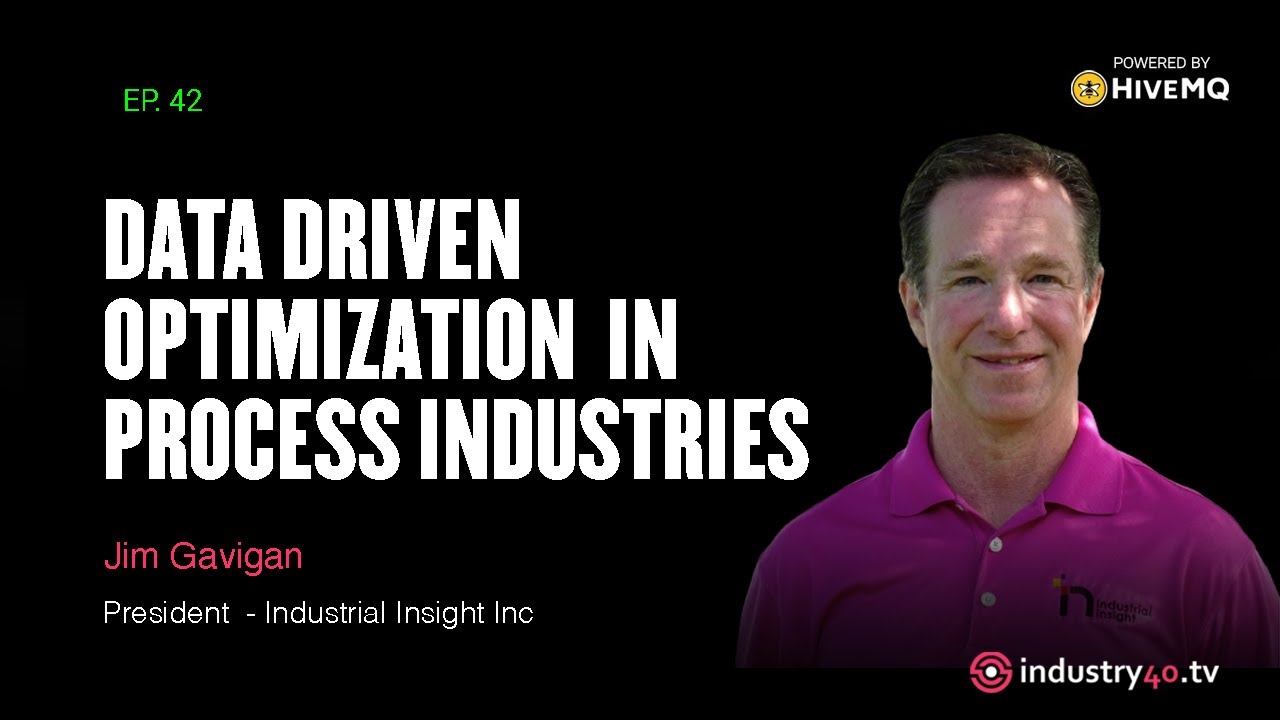
Jim Gavigan, President of Industrial Insight, spent his career working in process industries - starting as a vibration analyst, working as a controls engineer, selling automation systems for Rockwell, and eventually specializing in helping manufacturers use data proactively. His experience spans food processing, paper mills, chemical plants, and power generation, giving him perspective on what actually works across different industries.
Proactive Data Monitoring versus Reactive Troubleshooting
The fundamental problem with how most manufacturers use data comes down to timing. They look backward at what already happened rather than forward at what's about to happen.
Think about driving. You glance at the rearview mirror occasionally, but you focus attention on the windshield. It's larger, shows you where you're going, and helps you avoid problems ahead. Yet manufacturers typically do the opposite with their data. They focus on the rearview mirror - analyzing what went wrong after equipment breaks or quality goes off specification.
This reactive approach costs money. Downtime that could have been prevented. Quality issues that required rework or scrap. Efficiency losses from running processes outside optimal conditions. The data to prevent these problems often exists in real time, but nobody looks at it until after something breaks.
Proactive data use means building systems that show you when problems are developing, not just what caused them after the fact. A dashboard that alerts operators when quality parameters are trending toward specification limits. Email notifications when equipment shows early warning signs of failure. Models that predict when processes are about to become unstable.
Requirements Discovery for Manufacturing Data Solutions
A common pattern emerges when manufacturers try to implement data solutions. They know they have problems. They know they have data. They have no clear idea how to connect the two.
Many integrators and solution providers want clearly defined scopes of work. Tell us exactly what you need built, and we'll build it. But customers often can't articulate what they need because they don't know what's possible. They understand their process problems but not how data tools can solve them.
This creates an opportunity for a different approach. Instead of waiting for customers to define requirements, spend time understanding their actual operations. Sit through morning production meetings. Watch how people currently access and use information. Ask what keeps them up at night or what they check first thing each morning.
One paper mill manager described checking mill balance every morning by looking at three different screens, mentally processing multiple numbers to determine whether everything ran in sync. The obvious solution was a single screen showing balance status with clear indicators of what's running too fast or too slow. But nobody had asked him to walk through his morning routine before, so nobody knew to build this simple tool.
Simplifying Complex Information Displays
Process industries often create dashboards with hundreds of data points displayed simultaneously. Graphics, trends, tables, calculated values - everything crammed onto one screen. The assumption is that more information means better decisions.
The reality is different. When operators need to scan 200 numbers to find the few that matter for their current situation, they work too hard to get critical information. When managers visit multiple screens and manually synthesize information in their heads, they waste time on data gathering rather than decision making.
Better approaches focus on simplicity and context. What are the three to five key metrics that tell you whether operations are normal or require attention? Show those prominently. Everything else can be one click away for when detailed investigation is needed.
This doesn't mean eliminating detailed views. It means creating appropriate entry points. A mill dashboard shows overall status at a glance. Click on any area showing problems and drill into detailed diagnostics. Start broad and simple. Provide depth when needed.
The same principle applies to how information is calculated and displayed. If a manager manually checks four different values to determine one condition, build a calculation that does this automatically and displays the result. Don't make people do math in their heads when computers can do it instantly.
Working with Historian Data and Legacy Systems
The PI System and similar historians have been collecting process data for decades in many facilities. This historical data becomes valuable when training predictive models or understanding long-term patterns.
When building optimization solutions, start with data that already exists. Don't wait to deploy new sensors or upgrade systems before beginning. Use the historian data you have to prove concepts and deliver initial value. Add new data sources as specific use cases require them.
Each historian system has its own interface and data model. PI System, Wonderware, GE, Aspen IP21 - they all work differently. Understanding these differences matters when building solutions that need to work across multiple sites or integrate data from various sources.
The challenge is that people who built these systems years ago often didn't organize data with today's use cases in mind. Tag naming conventions made sense for control engineers but not for analytics. Structures optimized for real-time control don't always work well for historical analysis. Working effectively with historians means understanding both what's possible and what requires workarounds.
Capturing Knowledge from Retiring Experts
Manufacturing faces a demographic challenge. Experienced process engineers and operators who deeply understand how facilities actually run are retiring. Their knowledge often exists primarily in their heads rather than in documented systems.
This creates urgency around knowledge capture. When an experienced engineer can look at a dashboard and immediately identify subtle problems that others miss, that expertise needs to be preserved. When operators know from experience which combinations of conditions cause quality issues, that understanding should be embedded in systems that help less experienced workers.
Several approaches help with knowledge capture:
Document decision rules. When experts explain why they take certain actions based on specific data patterns, turn those explanations into automated alerts or recommendations.
Build tools that reflect expert workflows. Watch how experienced people use existing systems. What do they look at? In what order? What comparisons do they make? Build new tools that match these proven workflows.
Create structured handoff processes. Before experienced people retire, have them work directly with the teams building optimization tools. Their involvement ensures critical nuances get captured.
Some companies hire recently retired experts as consultants specifically for knowledge transfer. They don't need full-time work, but spending a few hours weekly helping document their expertise makes that knowledge available to current staff.
The Role of Process Understanding in Data Solutions
Technical expertise in data tools matters, but process expertise matters more. You can hire data scientists who understand machine learning algorithms. You can find software engineers who build excellent dashboards. But if they don't understand the manufacturing process, they'll build solutions that technically work but don't solve real problems.
This is why teams building optimization solutions need people with process backgrounds. Former controls engineers, operations managers, or process engineers who understand the physics and chemistry of manufacturing processes. They know what's physically possible, what constraints exist, and what operators actually need.
The ideal approach combines process expertise with data expertise. Process people identify what problems need solving and what information matters. Data people figure out how to extract, analyze, and present that information effectively. Neither group succeeds without the other.
Business Intelligence Tools for Manufacturing
Business intelligence platforms like Power BI and Tableau have become important parts of manufacturing data strategies. They connect to historians and other systems, create visualizations, and enable people to build their own reports without programming.
These tools work well for certain use cases. Management dashboards showing production metrics across multiple facilities. Quality trend analysis combining data from multiple sources. Performance reporting that used to require manual spreadsheet work.
However, they're not always the right choice. Real-time operational displays often work better in systems designed for process control. Complex calculations sometimes perform better in historian calculation engines than in BI tools. Knowing when to use BI platforms versus other tools requires understanding the specific requirements.
The trend is toward using multiple tools for different purposes. Historians for real-time data collection and basic calculations. BI platforms for reporting and analysis. Specialized tools for advanced analytics like multivariate analysis or machine learning. The challenge is integrating these tools so users get seamless access to information regardless of where it originates.
Building Partnerships for Specialized Capabilities
No single company has expertise in every type of analysis or every tool. This makes partnerships important for delivering complete solutions.
When a customer needs capabilities outside your core expertise, you have choices. Try to build that expertise internally, which takes time and may not succeed. Turn away the work, which limits your ability to help customers. Or partner with specialists who handle the parts outside your core capabilities.
Effective partnerships mean finding companies with complementary strengths. If you excel at process understanding and system integration but don't specialize in advanced analytics, partner with analytics experts. If you focus on specific industries, partner with tool specialists who work across industries.
The key is being honest about your capabilities and limitations. Don't oversell what you can deliver. Customers benefit more from partnerships that bring genuine expertise than from trying to do everything yourself with mediocre results.
Starting Small and Proving Value
Manufacturing organizations are often skeptical of new approaches. They've seen technology projects that promised big benefits but delivered little. They've invested in systems that looked good in demonstrations but proved impractical in production.
This skepticism is healthy. It means organizations won't waste money on unproven concepts. But it also means you need to prove value quickly with small, focused projects before attempting enterprise-wide deployments.
Pick one problem at one facility. Something important enough that solving it matters but small enough to deliver results quickly. Build a solution. Prove it works. Measure the impact. Use that success to justify the next project.
This incremental approach also provides learning. You discover what data actually exists versus what you thought existed. You find out which types of solutions operators find useful versus which they ignore. You identify integration challenges and data quality issues. Each small project teaches lessons that make the next one better.
Implementing Continuous Process Optimization Programs
The manufacturers succeeding with data-driven optimization share common characteristics. They focus on proactive rather than reactive data use. They invest time understanding operations before building solutions. They keep information displays simple and focused. They combine process expertise with data expertise.
Success doesn't require the most advanced technology or the biggest budget. It requires understanding manufacturing operations, identifying problems that matter, and building solutions that actually get used. Start with clear problems, use data you already have, prove value quickly, then expand based on what works.
Get the next guide
Industrial data & AI architecture guides, implementation tutorials and use-case blueprints, delivered as they’re published.
More episodes
All episodes →

The leading IIoT & AI educational platform for digital manufacturing teams