
Why Quality & Inspection Is the Sweet Spot for Industrial AI Right Now

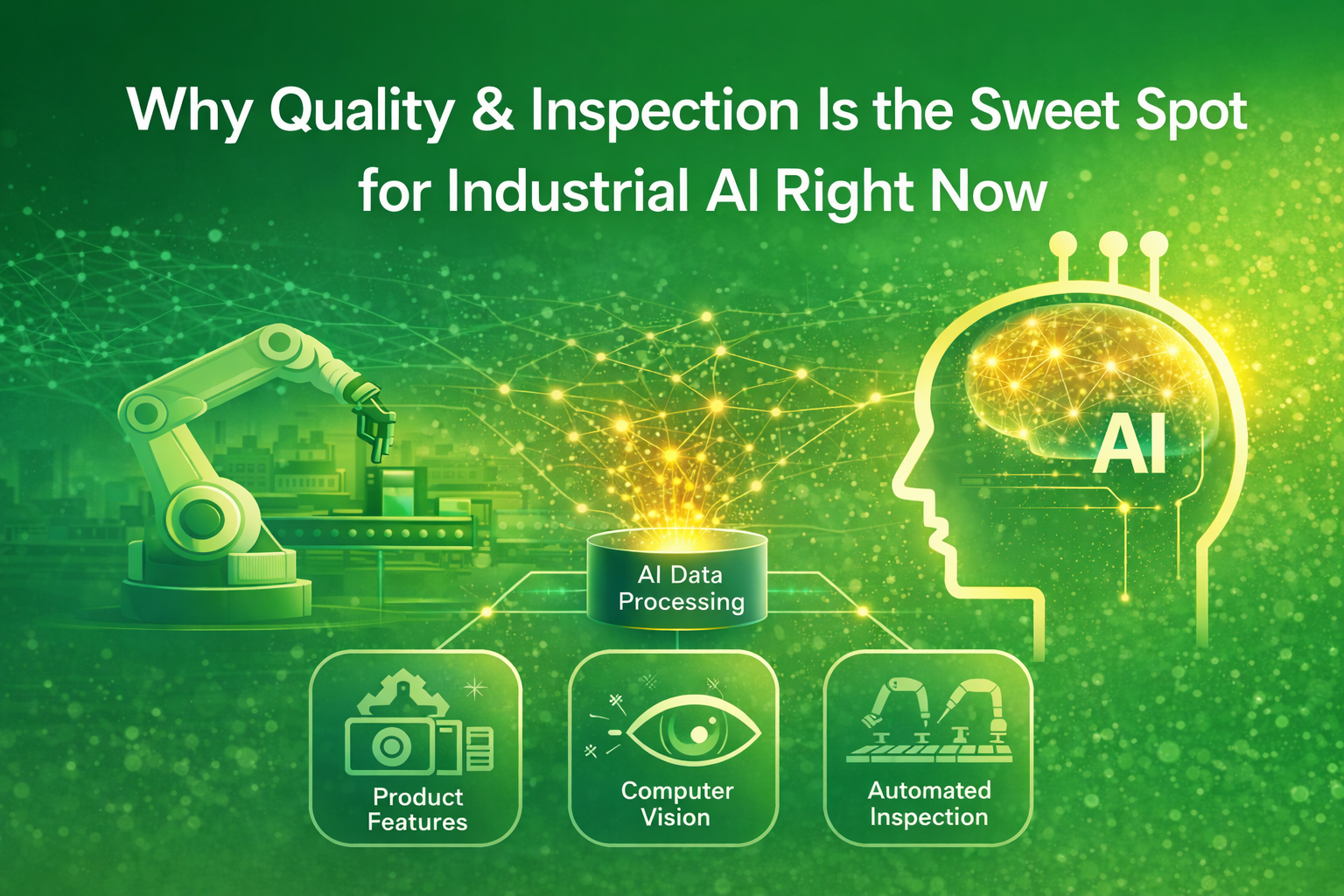
If you're looking for the best place to start, or scale, your industrial AI journey, the data points to a clear answer: quality and inspection. Not predictive maintenance, despite its popularity in conference presentations. Not autonomous control, despite its impressive demonstrations. Quality and inspection sits at the intersection of mature technology, clear business value, and universal applicability that makes it the most actionable opportunity in industrial AI today.
The use case works across virtually every manufacturing sector, from food processing to semiconductors, from pharmaceuticals to plywood. And the technology stack is mature enough that implementations can move from concept to production in months, not years.
This article examines why quality and inspection has become the sweet spot for industrial AI, what makes implementations successful, and how organizations can capture this opportunity.
Why Industrial AI for Quality & Inspection Works
1. The Problem is Well-Defined
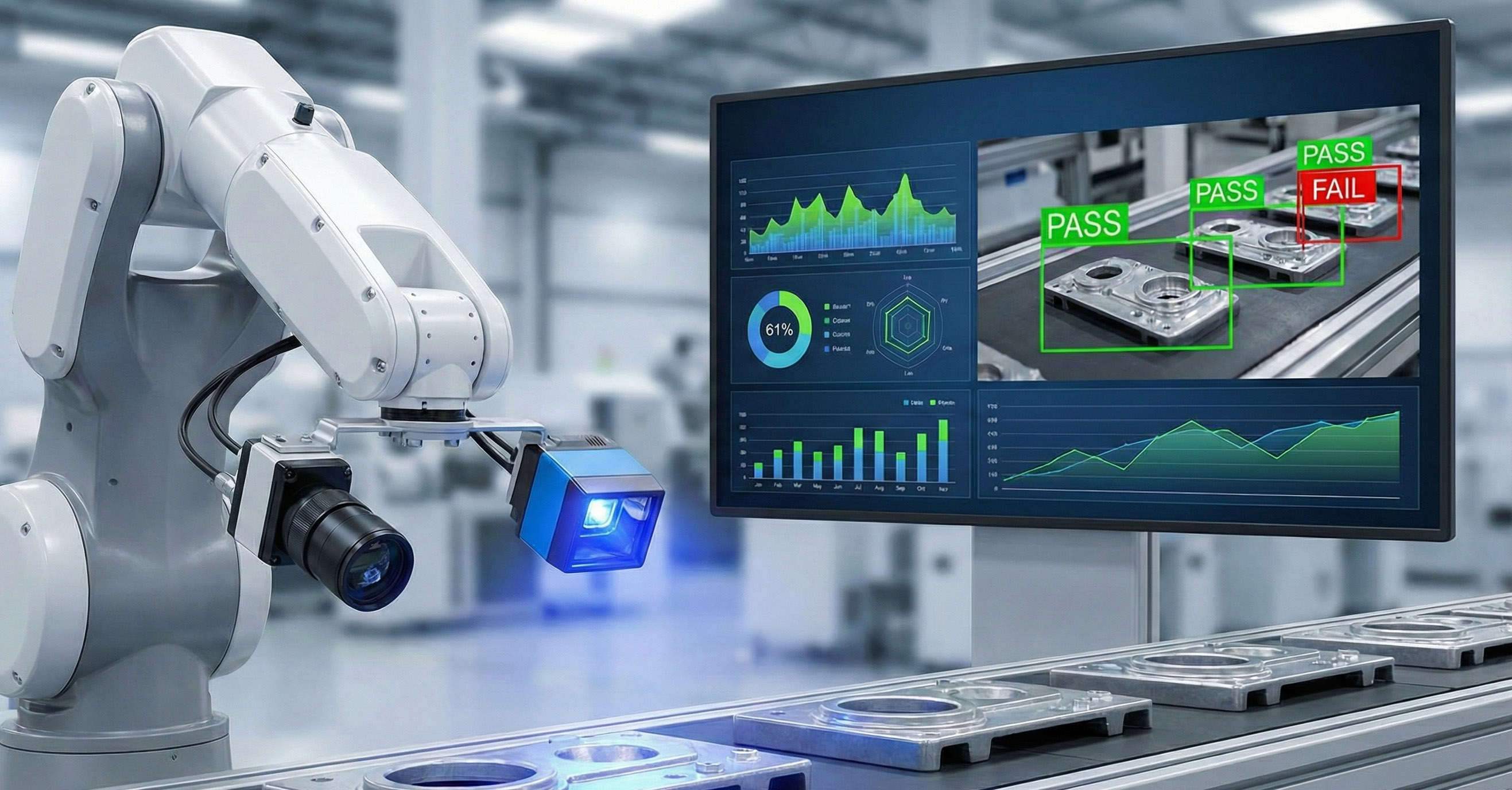
Quality inspection is fundamentally a classification problem: is this product good or defective? Does this component meet specification? Is there an anomaly in this data stream? These well-defined problems are exactly what machine learning excels at. Unlike open-ended optimization problems or complex control challenges, inspection problems have clear success criteria that can be measured and validated.
For example, when electronics manufacturers deploy AI for circuit board inspection, the objective is unambiguous: detect defects that human inspectors or rule-based systems might miss, while reducing false positives. When food processors implement optical sorting, the goal is clear: identify and remove defective products. This problem clarity makes it easier to define success, measure progress, and demonstrate value.
2. The Training Data Already Exists
One of the biggest barriers to industrial AI adoption is data: most manufacturing AI requires labeled historical data that many organizations don't have. Quality inspection is different. Years of quality records, rejected parts, defect classifications, and inspection logs create natural training datasets. The data infrastructure for quality already exists, it just needs to be connected to ML models.
Steel producers' quality prediction systems leverage years of process data to detect quality deviations early. Pharmaceutical manufacturers' drug inspection platforms harmonize product genealogy, process parameters, and quality records from existing manufacturing systems. The data is already being collected; the AI layer adds intelligence to what was previously just archival storage.
3. The Technology Stack is Mature
Most quality and inspection implementations use classical machine learning and advanced analytics, not deep learning, not reinforcement learning, not generative AI. This matters enormously for implementation success. Classical ML has decades of refinement, mature tooling, established best practices, and a broad talent pool that can develop and maintain systems.
When deep learning is used, it's for specific perception challenges where classical methods fall short, complex visual defects, highly variable appearances, or unstructured inspection environments. Aerospace manufacturers use deep learning for aircraft assembly inspection where the visual complexity demands it. But this is the exception, not the rule.
The mature technology stack means faster implementation, lower risk, and easier maintenance. You don't need a team of PhD researchers; you need competent ML engineers with good manufacturing domain knowledge.
4. The ROI Case is Straightforward
Quality costs are among the most measurable in manufacturing. Scrap rates, rework percentages, customer returns, warranty claims, these metrics are already tracked, already reported to leadership, and already have dollar values attached. When an AI system reduces defect escape rates or catches issues earlier in production, the financial impact is immediately quantifiable.
This makes building the business case straightforward. Unlike predictive maintenance (where you're preventing hypothetical future failures) or process optimization (where benefits may be distributed across multiple factors), quality improvement shows up directly in metrics everyone already watches.
5. It Works Across Every Industry
Quality and inspection implementations span virtually every manufacturing sector: food processing (grain sorting), semiconductors (photolithography quality), pharmaceuticals (drug inspection), chemicals (leak detection, color production), electronics (PCB inspection), steel production, plastics manufacturing, wood products (plywood), and more.
This universality means that solution patterns developed in one industry can transfer to others. The fundamental techniques of visual inspection, anomaly detection, and quality prediction apply regardless of whether you're inspecting rice grains or circuit boards. This cross-industry applicability accelerates learning and reduces implementation risk.
The Implementation Spectrum
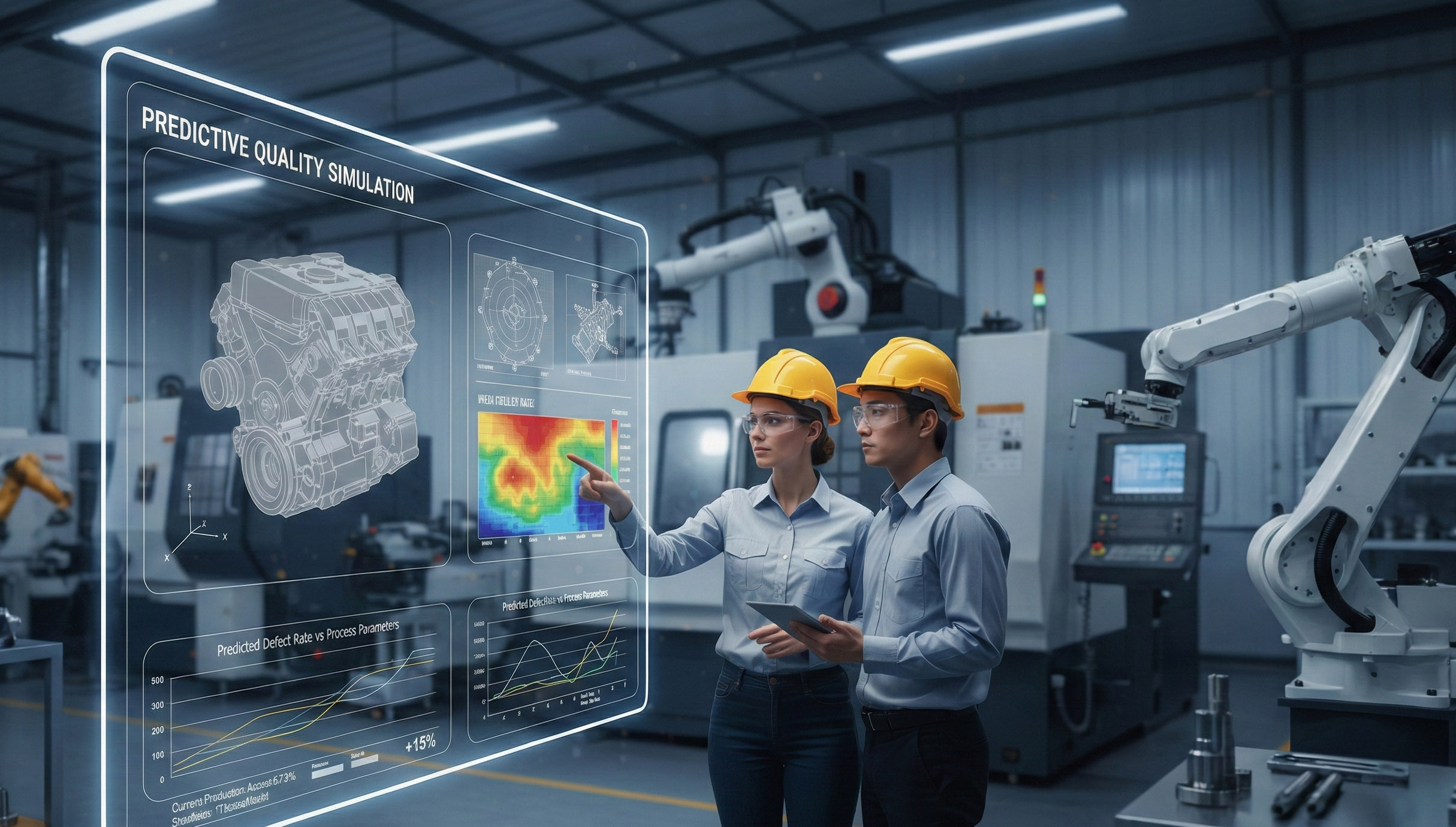
Quality and inspection AI spans a range of approaches, from simple visual inspection to sophisticated predictive quality systems. Understanding this spectrum helps identify the right starting point for your organization.
Automated Optical Inspection (AOI)
The most common approach, representing half of all quality and inspection implementations. AI-powered cameras examine products, components, or processes in real-time, identifying defects that human inspectors might miss or rule-based systems can't recognize.
PCB Inspection at Scale
Electronics manufacturers use GPU-accelerated AI platforms for circuit board inspection, deploying AI that can recognize complex defect patterns across production lines. These systems also use synthetic data generation, creating artificial defect images to train models, reducing the need for large historical defect datasets. This addresses one of the key challenges in AOI: defects are (hopefully) rare, which means limited training data.
Beyond Products to Processes
Chemical manufacturers have deployed video analytics systems to monitor for containment issues in real-time. This extends the AOI concept from product inspection to process monitoring, using AI vision to continuously watch for problems that might otherwise go unnoticed until they become incidents. These systems support zero safety incident goals while also preventing production losses.
Non-Optical Fault Detection
Not all inspections are visual. Acoustic analysis, vibration monitoring, and sensor-based anomaly detection extend quality AI beyond what cameras can see.
Acoustic Quality Assurance
Manufacturers use AI-powered acoustic analysis to inspect units. These systems identify sound irregularities with over 96% accuracy, detecting problems that would be invisible to cameras but audible to trained technicians. This approach captures the expertise of experienced inspectors in AI form, making it scalable across production lines.
Infrastructure Anomaly Detection
Utilities and infrastructure operators use AI with IoT sensors to detect pipeline anomalies, problems that can't be seen but can be inferred from flow patterns, pressure readings, and other sensor data. These systems identify and classify anomalies before they become visible leaks, enabling proactive maintenance and reducing resource waste.
Predictive Quality Simulation
The most sophisticated quality AI doesn't just detect defects, it predicts them before they occur by modeling the relationship between process parameters and product quality.
Predicting Steel Quality
Steel producers use AI to analyze process data and detect quality deviations early, before steel becomes scrap. By predicting quality outcomes from process parameters, these systems enable operators to adjust processes before defects occur, rather than catching them after the fact.
Drilling Tool Quality Prediction
Mining equipment manufacturers use cloud machine learning platforms to predict steel density, hardness, and flexibility in drilling products. ML models ensure consistent steel grades and optimal tolerance levels, reducing variability that would otherwise appear as quality issues in finished products. This is quality engineering, not just quality inspection.
Getting Started with Quality and Inspection Industrial AI
Start with What You Measure
The most successful quality AI implementations build on existing quality infrastructure. Where do you already have cameras? What defects do you already track? Which quality metrics already have visibility with leadership? Start where data exists, measurements are established, and organizational attention is already focused.
Choose Battles You Can Win
Not every quality problem is a good AI problem. Look for challenges where human inspection is slow, inconsistent, or unable to keep pace with production. Look for defects that are visually identifiable but occur in high volumes. Avoid problems that require understanding context humans struggle to articulate, or where defect appearance varies dramatically.
Leverage the Vendor Ecosystem
A mature vendor ecosystem serves quality and inspection: Microsoft and AWS for cloud ML infrastructure, NVIDIA for edge AI and computer vision, Solomon for vision systems, Siemens for industrial integration, and specialized vendors like Bühler for food processing. You don't need to build from scratch; proven solutions exist across the technology stack.
Plan for Scale from Day One
If quality AI works on one line, you'll want it on every line. Design initial implementations with scale in mind: containerized models that deploy easily, data pipelines that extend to additional equipment, and integration patterns that replicate across facilities. The marginal cost of scaling should decrease dramatically after the first deployment.
Conclusion
Industrial AI can seem overwhelming: reinforcement learning, digital twins, autonomous systems, generative AI. The technology landscape shifts constantly, and it's easy to feel behind regardless of where you start. Quality and inspection cuts through this complexity. The technology works. The ROI is clear. The implementations deploy successfully. And the patterns transfer across industries.
For manufacturing leaders looking to build AI capabilities, quality and inspection offers the best combination of low risk and high reward. Success here builds the organizational muscle, the data infrastructure, the ML engineering skills, the deployment practices, that enables more ambitious AI applications later. Start where you can win, then expand from a position of demonstrated value.
The sweet spot isn't where the technology is most exciting. It's where the technology is most ready to deliver value. Right now, for most manufacturers, that sweet spot is quality and inspection.
Get the newsletter
Industrial data & AI architecture guides, implementation tutorials and use-case blueprints, delivered as they’re published.
More articles
All articles →

The leading IIoT & AI educational platform for digital manufacturing teams