
The Industrial AI Implementation Framework: From Problem to Outcome

Every successful industrial AI implementation follows the same fundamental pattern: a business problem drives data collection, data enables an AI method, and the method produces a measurable outcome. Understanding this pattern, and where each component sits in the modern industrial data stack, is essential for manufacturing leaders planning AI investments.
This article maps the complete flow from problem to outcome, illustrates it with concrete implementations, and shows how the pieces fit together in a modern industrial data architecture.
The Core Industrial AI Framework

Every industrial AI project can be decomposed into four elements:
Problem: The business challenge driving the initiative, unplanned downtime, quality defects, inefficient processes, safety incidents
Data: The information required to address the problem, sensor streams, images, service records, process data
Method: The AI technique applied to the data, machine learning, deep learning, generative AI, reinforcement learning
Outcome: The measurable result, cost reduction, quality improvement, safety enhancement, efficiency gain
These elements are not independent, they form a causal chain. The problem defines what data is needed. The data determines which methods are applicable. The method produces the outcome. Get any link wrong, and the chain breaks.
The Framework in Practice: 4 Industrial AI Patterns with Proven Outcomes
Pattern 1: Predictive Maintenance
Problem: Unplanned equipment failures causing production disruption
Data: Real-time sensor streams from manufacturing equipment (via cloud IoT platforms)
Method: Machine learning anomaly detection (cloud ML services)
Outcome: Eliminated unplanned outages through early anomaly detection
Pattern 2: Quality Inspection
Problem: Product inspection requiring consistent, high-accuracy defect detection
Data: Product genealogy + process data + quality data + real-time inspection images
Method: Deep learning classification (cloud ML platforms)
Outcome: Automated product inspection with improved defect detection
Pattern 3: Production Optimization
Problem: Energy inefficiency in industrial plant operations
Data: Plant operational data, energy consumption, process parameters
Method: Reinforcement learning for autonomous production control
Outcome: Optimized plant operations with reduced energy consumption
Pattern 4: Knowledge & Assistance
Problem: Operator errors from difficulty accessing procedures during production
Data: 200+ SOPs, quality procedures, maintenance instructions, case sheets
Method: Generative AI co-pilot interfacing with SOP documents
Outcome: Reduced defects, improved productivity in capsule manufacturing
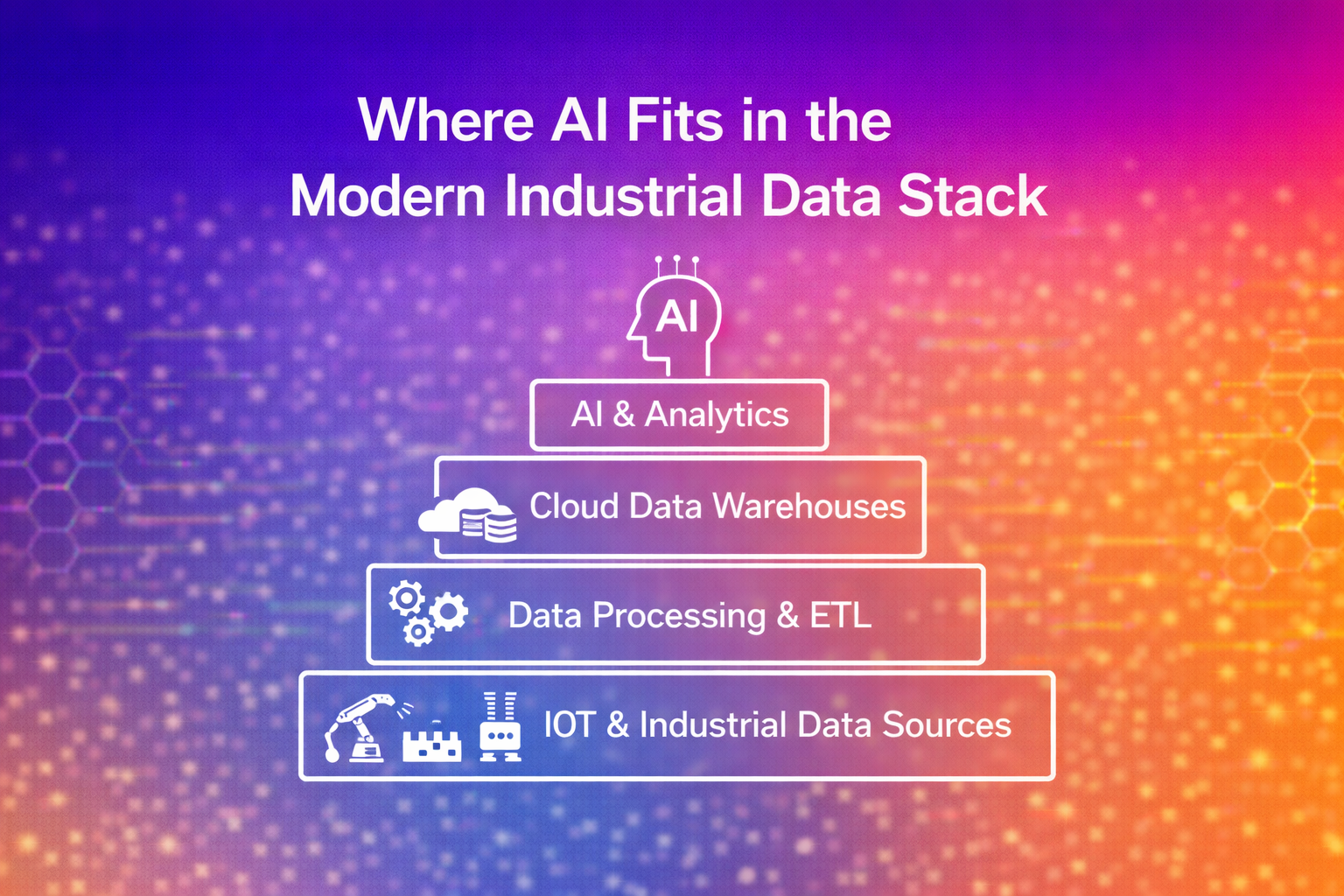
The 5-Layer Industrial Data Stack: Where AI Fits in Your Architecture
Understanding where AI fits requires understanding the modern industrial data stack, the layered architecture that moves data from physical equipment to business outcomes. The stack has five essential layers:
Layer 1: Edge & OT Systems
The foundation: physical equipment and operational technology that generates data.
Sensors & PLCs: Temperature, pressure, vibration, flow sensors connected to programmable logic controllers.
Vision Systems: Cameras, 3D scanners, thermal imaging.
Industrial Controllers: SCADA, DCS, automation platforms.
Edge AI Devices: NVIDIA Jetson, Invisible AI edge devices, processing at the source
Real-time inference at the edge for latency-critical applications. AGVs use GPU edge platforms for autonomous navigation. Vision AI systems use multiple edge devices per site for real-time production monitoring.
Layer 2: Data Ingestion & Connectivity
Moving data from OT systems to IT infrastructure, bridging the OT/IT divide.
IoT Gateways: Protocol translation (OPC UA, MQTT, Modbus to cloud-native)
Streaming Platforms: AWS Kinesis, Azure Event Hubs, Kafka for real-time data movement.
Industrial IoT Platforms: Cloud IoT services for industrial applications
Manufacturers partner with data quality specialists for sensor data assessment before feeding AI/ML applications and they use streaming services for real-time inspection data ingestion.
Layer 3: Data Platform & Storage
Storing, organizing, and preparing data for analysis, the data foundation.
Data Lakes: Raw data storage (S3, Azure Data Lake, Google Cloud Storage)
Data Warehouses: Structured analytics (Redshift, Synapse, BigQuery)
Data Transformation: AWS Glue, Azure Data Factory, Databricks
Unified Data Platforms: Manufacturing-specific platforms for data contextualization.
Manufacturers built unified data foundations to track OEE across plants and they consolidate fragmented operational data into single systems of record before AI deployment.
Layer 4: AI/ML Platform
The intelligence layer, where models are trained, managed, and served.
ML Development: Amazon SageMaker, Vertex AI
Specialized Industrial AI: Industry-specific AI platforms for reliability and operations
LLM/GenAI: Cloud AI services powering integrated copilots
Edge Inference: TensorRT, ONNX Runtime for production deployment
This is where the AI lives. Manufacturers build AI/ML platforms on cloud services, and they use cloud ML and analytics platforms for predictive quality models.
Layer 5: Application & Action
Delivering insights and enabling action, where AI meets users and systems.
Dashboards & Visualization: Power BI, Grafana, custom industrial UIs.
Alerting & Notification: Mobile notification platforms, CMMS integration
Closed-Loop Control: AI outputs feeding back to PLCs, setpoint optimization
Copilots & Assistants: Natural language interfaces for factory data access
Translating AI outputs into human decisions or machine actions. Chemical manufacturers achieved one year of autonomous plant control with RL feeding back to process control. Manufacturers use mobile platforms for automated alerts from AI insights.
Choosing Between Cloud, Edge, Hybrid, and Platform Approaches
Cloud-Centric ML
Data flows from OT to cloud for processing, training, and inference. Best for: batch analytics, historical pattern learning, centralized model management.
Edge-First Processing
AI inference at the edge for real-time response, with cloud for training and coordination. Best for: latency-sensitive applications, robotics, real-time quality.
Hybrid Edge-Cloud
Edge for real-time inference, cloud for heavy training and analytics. Best for: most industrial AI deployments requiring both speed and scale.
Platform-Mediated
Industrial data platform contextualizes and harmonizes data before AI consumption. Best for: multi-plant deployments, complex data integration, manufacturing-specific AI.
Get the newsletter
Industrial data & AI architecture guides, implementation tutorials and use-case blueprints, delivered as they’re published.
More articles
All articles →

The leading IIoT & AI educational platform for digital manufacturing teams