
Smart Maintenance vs Condition Monitoring vs Predictive Maintenance

The terms get thrown around interchangeably: smart maintenance, condition monitoring, predictive maintenance, prescriptive maintenance, AI-driven maintenance. Vendors use whatever sounds most impressive. And manufacturing leaders trying to build a maintenance AI strategy are left confused about what they actually need.
The confusion isn't just semantic, it affects investment decisions. Different approaches serve different problems, require different infrastructure, and deliver different benefits. A manufacturer who needs condition monitoring but buys a predictive maintenance solution (or vice versa) will struggle to show ROI. Understanding the distinctions is essential for matching solutions to actual needs.
This article cuts through the terminology confusion by examining how maintenance AI actually gets deployed. We'll define each approach, show real implementations of each, and map the benefit profiles that make each approach valuable for different contexts.
The Terminology Problem
Before diving into definitions, it's worth acknowledging why this confusion exists. The maintenance AI market has evolved rapidly, with vendors positioning and repositioning their solutions as buyer preferences shift. "Predictive maintenance" became a buzzword, so every monitoring solution added "predictive" to its marketing. "Smart maintenance" emerged as an even broader umbrella term that could mean almost anything.
Adding to the confusion: what vendors call "predictive maintenance" often includes condition monitoring capabilities, and what they call "smart maintenance" often includes predictive features. The categories overlap in practice, even if they're conceptually distinct.
For clarity, let's define these terms by what they actually do, not how vendors market them:
The Three Approaches Defined
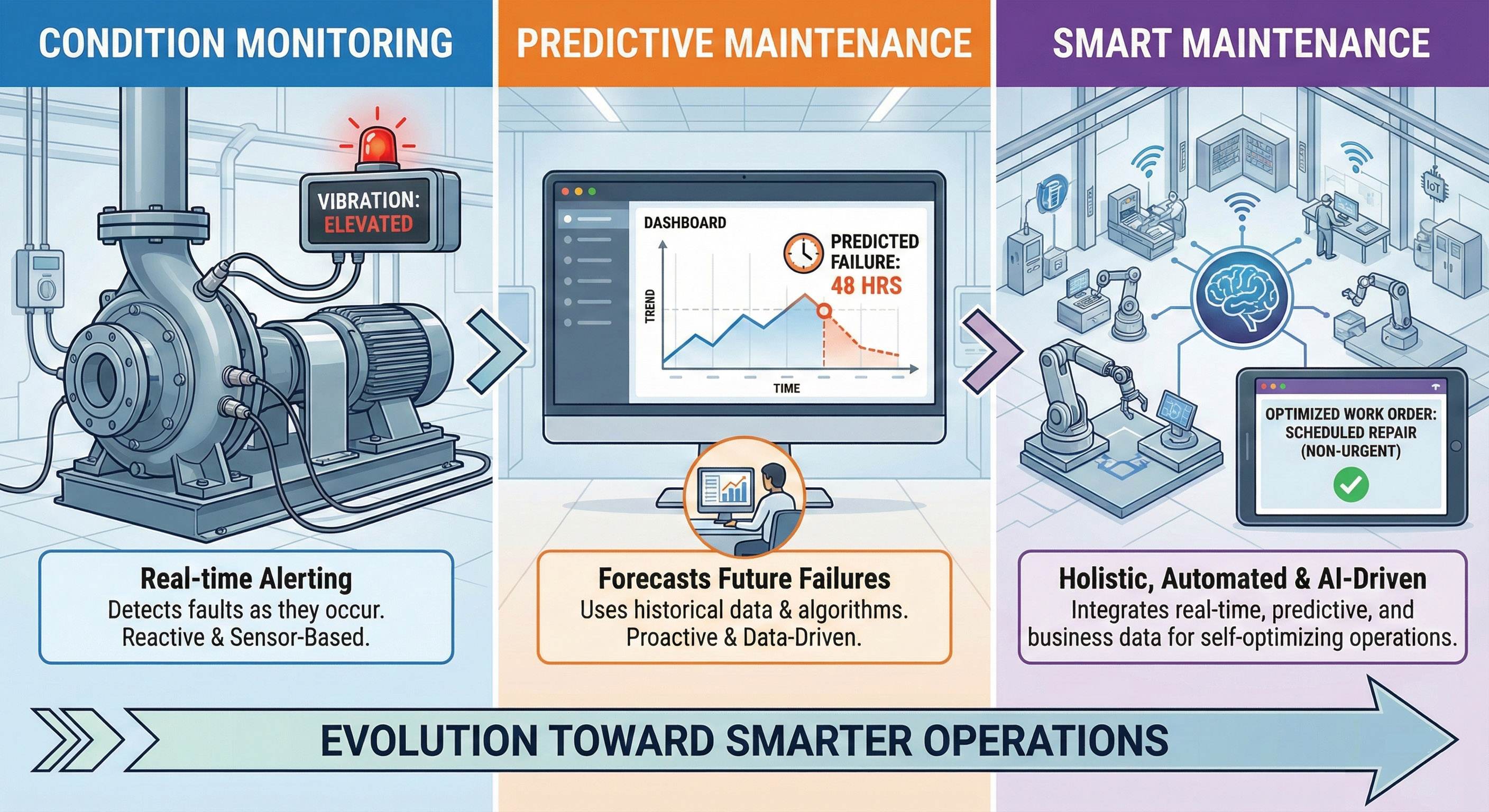
Condition Monitoring: Real-Time Awareness
What it does: Continuously monitors equipment parameters (vibration, temperature, pressure, acoustic signatures, etc.) and alerts when values exceed thresholds or exhibit anomalous patterns.
The question it answers: "Is something wrong right now?"
Technology foundation: IoT sensors, threshold-based alerts, basic anomaly detection algorithms. Can use machine learning for pattern recognition, but the core value is awareness, not prediction.
Value proposition: Faster response to developing problems. Instead of waiting for failure, operators see degradation in real-time and can respond before catastrophic breakdown. Reduces mean time to repair (MTTR) by enabling faster diagnosis.
Predictive Maintenance: Forecasting Failure
What it does: Uses machine learning models trained on historical failure data to predict when equipment will fail, typically providing days or weeks of advance warning.
The question it answers: "When will this equipment fail?"
Technology foundation: Machine learning models (classification, regression, time-series analysis) trained on sensor data correlated with historical failures. Requires both condition data AND failure history.
Value proposition: Converts unplanned downtime to planned maintenance. With advance warning, maintenance can be scheduled during planned production gaps, parts can be pre-ordered, and crews can be allocated efficiently. Reduces mean time between failures (MTBF) by catching issues before they become failures.
Smart Maintenance: Orchestrated Operations
What it does: Encompasses the broader ecosystem of AI-enabled maintenance capabilities: not just monitoring or prediction, but work order optimization, technician scheduling, parts inventory management, knowledge capture, and service delivery.
The question it answers: "How do we optimize our entire maintenance operation?"
Technology foundation: Often combines condition monitoring and predictive maintenance with additional capabilities: GenAI assistants for maintenance knowledge, scheduling optimization algorithms, integration with ERP and CMMS systems.
Value proposition: End-to-end maintenance optimization. Not just knowing what's wrong or when it will fail, but ensuring the right response happens efficiently. Encompasses cost, uptime, AND organizational capability.
Real-World Implementation Examples
Condition Monitoring in Action
HVAC Health Monitoring
Manufacturing facilities facing frequent HVAC failures are deploying performance monitoring platforms that consolidate fragmented operational data into single systems and monitor equipment continuously for anomalies. These systems don't predict when the HVAC will fail next month, they tell operators when something is wrong right now, enabling rapid response before small issues become major failures.
Real-Time Equipment Monitoring
Manufacturers are implementing IoT sensors with cloud analytics to enable real-time condition monitoring across manufacturing plants. These systems monitor equipment health continuously, alerting operators to developing issues. The focus is on "reducing unplanned downtime" through faster awareness, not through predicting failures weeks in advance.
Predictive Maintenance in Action
Hydraulic Leak Prediction
Steel producers, for example, are deploying predictive maintenance technology on metal coating lines. These systems detect developing hydraulic leaks before they cause failure, avoiding at least 24 hours of unplanned downtime. This is true prediction: the system identifies a future failure from current condition data, providing time to schedule repair.
Offshore Oil Platforms Prediction
Predictive analytics implementations for offshore oil platforms have predicted 75% of historical failures with nine days' advance warning. Nine days is enough time to schedule maintenance crews, transport parts to offshore locations, and coordinate with production schedules, transforming emergency responses into planned maintenance events.
Cloud-Powered Predictive Maintenance
Manufacturers are deploying cloud IoT platforms with equipment anomaly detection to identify equipment issues early. These systems enable "data-driven decisions on when to schedule repairs", the signature capability of predictive maintenance. Rather than time-based maintenance schedules or reactive repair, manufacturers use ML predictions to optimize maintenance timing.
Smart Maintenance in Action
Reliability Optimization
Manufacturers are implementing AI reliability platforms that go beyond prediction. These systems analyze data from multiple sources, predict failures, and enable proactive maintenance planning, but also target improvement in Overall Equipment Effectiveness (OEE), a metric that encompasses availability, performance, and quality. A 5% OEE improvement represents a holistic maintenance optimization, not just failure prevention.
Enterprise-Wide Maintenance Platform
Manufacturers are deploying full-stack machine health platforms across manufacturing sites globally. These implementations include IoT sensors, AI diagnostics, vibration and temperature monitoring, but the value is in the enterprise-wide view of equipment health. This is maintenance as a strategic capability, not just failure prevention.
AI-Optimized Field Service
Industrial machinery companies are deploying AI recommendation engines to automate technician assignment. These systems use NLP to understand job requirements, GPS for routing, and learning-to-rank algorithms for skill matching. This isn't about predicting equipment failure, it's about optimizing the maintenance response. Smart maintenance encompasses the entire service delivery chain.
Service Assistants: Knowledge at the Point of Need
Multiple manufacturers are deploying GenAI assistants for maintenance support across various industries: commercial vehicles, aerospace, industrial equipment, and consumer electronics. These systems make maintenance knowledge accessible, helping technicians diagnose issues, find documentation, and execute repairs correctly. This is the "smart" in smart maintenance: augmented human capability.
Benefits Mapping: Cost vs Uptime vs Safety
Different maintenance approaches emphasize different benefits. Understanding these patterns helps match approaches to organizational priorities.
Cost Reduction: The Universal Driver
Cost reduction is the most consistent benefit across all approaches. But the cost savings manifest differently:
Condition monitoring reduces cost by catching problems earlier, reducing repair scope and preventing secondary damage.
Predictive maintenance reduces cost by converting emergency repairs to scheduled maintenance and eliminating unnecessary time-based maintenance.
Smart maintenance reduces cost through workforce optimization, parts inventory reduction, and improved first-time-fix rates.
Uptime/Availability: The Operations Priority
While cost reduction is about dollars saved, uptime is about production protection. The approaches differ in how they protect uptime:
Condition monitoring improves uptime by reducing mean time to repair (MTTR) — problems are detected faster, so repairs begin sooner.
Predictive maintenance improves uptime by increasing mean time between failures (MTBF), failures are prevented entirely, and planned maintenance can be scheduled during production gaps.
Smart maintenance improves uptime through both mechanisms plus faster execution when maintenance is needed.
Safety: The Non-Negotiable
Safety benefits are concentrated in industries where equipment failure creates hazards: oil and gas (offshore platforms), heavy manufacturing (steel production), and logistics (cranes and material handling).
For safety-critical applications, the benefit calculation isn't just ROI, it's risk reduction. A single prevented incident can justify entire maintenance AI programs.
Choosing Your Approach
Start with Condition Monitoring When...
- You lack historical failure data to train predictive models
- Equipment failures are currently detected late (after symptoms become obvious)
- You need quick wins to build organizational support for maintenance AI
- Budget is limited and you need the simplest viable solution
Invest in Predictive Maintenance When...
- You have historical failure data that can be correlated with sensor readings
- Unplanned downtime costs are significant (high production value, long repair times)
- You need advance warning to coordinate maintenance with production schedules
- Parts or service availability requires lead time to arrange
Build Smart Maintenance When...
- You've already implemented condition monitoring and/or predictive maintenance
- Maintenance is a strategic capability, not just a cost center
- You need to optimize the entire maintenance value chain (not just failure detection)
- Knowledge management and workforce enablement are priorities
Conclusion
The maintenance AI landscape isn't one-size-fits-all. Condition monitoring, predictive maintenance, and smart maintenance represent different points on a capability spectrum, each valuable for different contexts, each requiring different prerequisites, each delivering different benefit profiles.
The manufacturers succeeding with maintenance AI aren't necessarily using the most sophisticated approaches, they're using the right approach for their situation. An organization without failure history shouldn't buy predictive maintenance; they need condition monitoring first. An organization with mature prediction capabilities shouldn't stop there; smart maintenance offers additional optimization opportunities.
Get the newsletter
Industrial data & AI architecture guides, implementation tutorials and use-case blueprints, delivered as they’re published.
More articles
All articles →

The leading IIoT & AI educational platform for digital manufacturing teams