
Industrial AI Maturity Curve: From Advanced Analytics to Reinforcement Learning

There’s a compelling, but misleading, narrative in industrial AI: that the future belongs to cutting-edge techniques like reinforcement learning, that staying competitive requires jumping to the most advanced methods, and that traditional machine learning is outdated. This mindset is flawed, and it risks leading manufacturers down the wrong path.
The reality of industrial AI in 2025 is far more pragmatic. The vast majority of successful, deployed industrial AI systems run on what might be called "classic" machine learning and advanced analytics, techniques that have been refined over decades and are now mature, reliable, and well-understood. Reinforcement learning, while genuinely impressive in a handful of implementations, represents the bleeding edge, not the standard practice.
This article maps the actual maturity curve of industrial AI methods, from the foundational analytics that power most deployments to the advanced techniques that remain experimental for most organizations. The goal isn't to discourage ambition, it's to help manufacturing leaders understand where they actually are on this curve, and what they should focus on next.
The Reality: Where Industrial AI Actually Stands
When you look at industrial AI implementations in production today, not press releases, not proofs of concept, but systems actually running in factories, a clear picture emerges of which methods dominate:
Classic Machine Learning and Advanced Analytics: ~72% of implementations
Generative AI: ~15% of implementations (mostly assistants and chatbots)
Deep Learning: ~8% of implementations (specialized vision and sensing applications)
Reinforcement Learning: ~3% of implementations (edge-of-practice autonomous control)
This distribution isn't a failure of ambition, it's a reflection of maturity. Classic ML techniques have had decades to be refined, tooled, and battle-tested. They work reliably in industrial environments. They can be maintained by teams without PhDs. They fail gracefully. The more advanced techniques are powerful but require more expertise, more data, and more infrastructure to deploy successfully.
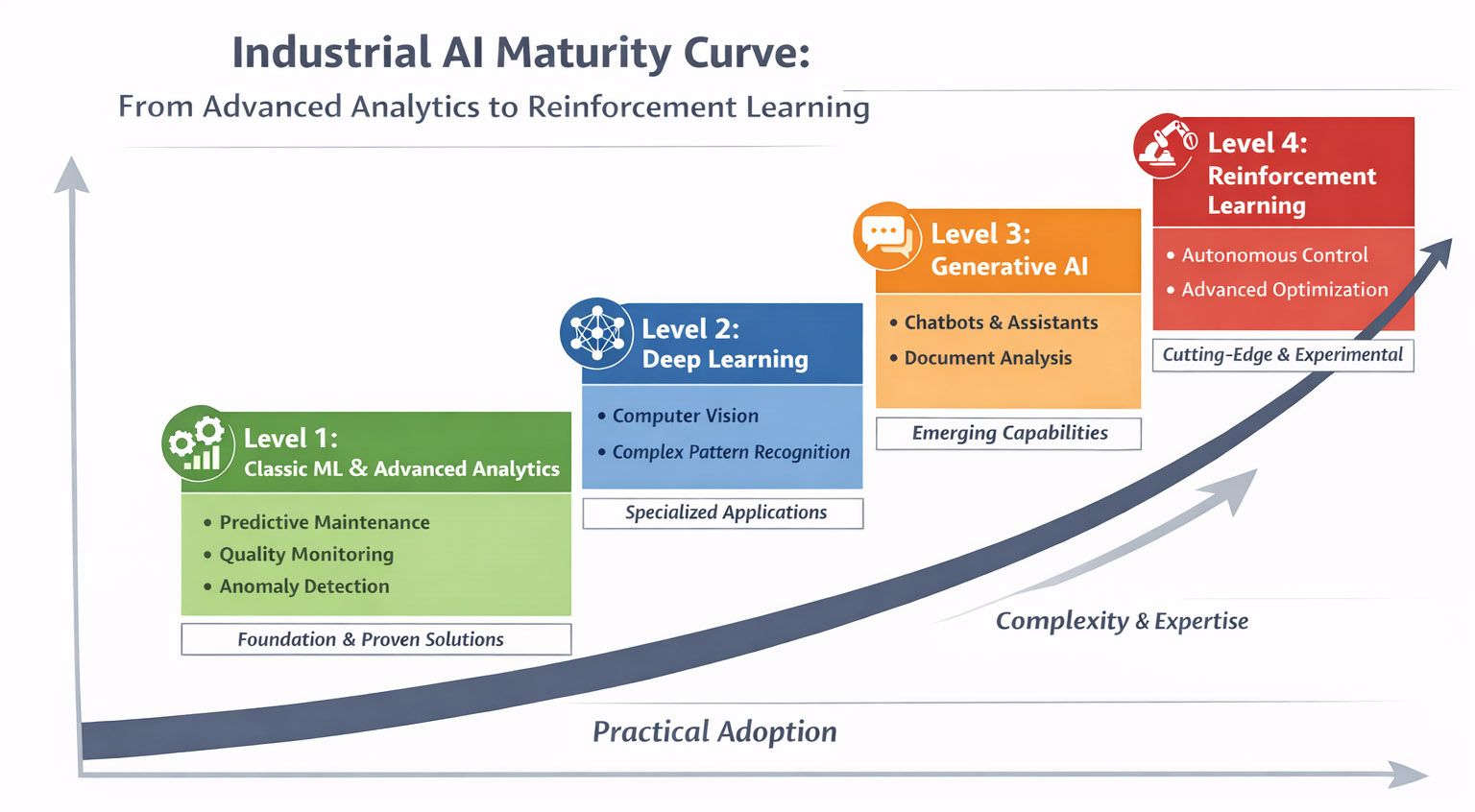
Level 1: Classic ML and Advanced Analytics
Classic machine learning, supervised learning algorithms like random forests, gradient boosting, support vector machines, and traditional neural networks, along with advanced analytics techniques like time-series analysis and anomaly detection, power the overwhelming majority of industrial AI. These methods aren't glamorous, but they're remarkably effective for the problems manufacturers actually face.
What Classic ML Excels At
Predictive maintenance: Predicting equipment failures from sensor data using classification and regression models.
Quality prediction: Forecasting product quality based on process parameters
Anomaly detection: Identifying unusual patterns in process data, network traffic, or equipment behavior
Demand forecasting: Predicting inventory needs and production requirements
Process optimization: Identifying optimal setpoints from historical production data
Why Classic ML Dominates in Industrial AI
Classic ML dominates industrial AI for practical reasons:
Interpretability: You can explain why a random forest model made a prediction. In regulated industries, this matters enormously.
Data efficiency: Classic ML often works well with hundreds or thousands of examples, not millions.
Maintainability: Models can be understood, debugged, and updated by engineers without deep AI expertise.
Mature tooling: Libraries, platforms, and deployment patterns are well-established and battle-tested.
Level 2: Deep Learning
Deep learning excels at perception tasks: recognizing objects in images, understanding speech, processing unstructured data. In industrial settings, deep learning has found its niche primarily in computer vision applications where the complexity of visual patterns exceeds what traditional image processing can handle.
Where Deep Learning Adds Value
Complex visual inspection: Defect detection where defects are visually subtle or highly variable
Autonomous vehicle navigation: AGVs and mobile robots navigating dynamic environments
Unstructured data processing: Understanding maintenance logs, engineering documents, or operator notes
The Deep Learning Trade-off
Deep learning's power comes with costs: it requires more data (typically thousands of labeled examples), more compute (GPU infrastructure), and more expertise to tune effectively. Notice that only about 8% of industrial AI implementations use deep learning , and nearly half remain in proof-of-concept or pilot stages. This isn't failure; it's appropriate restraint. Deep learning should be used when simpler methods are insufficient, not as a default choice.
Level 3: Generative AI
Generative AI, large language models and their variants, represents a genuinely new capability in industrial AI. Unlike classical ML (which predicts) or deep learning (which perceives), GenAI generates: text, code, analysis, responses. In industrial settings, GenAI has found traction primarily as an interface layer, making existing data and systems more accessible to human users.
Where GenAI Is Working in Industry
Chatbots and assistants: Natural language interfaces to maintenance systems, SOPs, and enterprise data.
Document analysis: Extracting information from maintenance logs, technical documents, and reports.
Code generation: Assisting with PLC programming, automation scripting, and report generation
The GenAI Reality Check
GenAI is an interface layer, not a control system. GenAI excels at making information accessible and generating content that humans then review. It's not (yet) making autonomous operational decisions in industrial settings.
Level 4: Reinforcement Learning
Reinforcement learning, where AI systems learn optimal behavior through trial and error, represents the genuine frontier of industrial AI. Only a few industrial AI implementations use RL, and the implementations that do exist are remarkable achievements that required significant expertise, investment, and careful engineering.
What Makes RL Different
Classical ML predicts outcomes; RL optimizes sequences of decisions over time. This is fundamentally harder. An RL system must explore different actions, learn from consequences that may be delayed, and balance exploration (trying new things) with exploitation (using what it knows works). In industrial settings, where wrong actions can damage equipment or compromise safety, this exploration phase is particularly challenging.
Why RL Remains Rare
Reinforcement learning is rare in industrial settings for good reasons:
Exploration risk: RL systems need to try different actions to learn. In a chemical plant, "trying things" can be dangerous or expensive.
Simulation requirements: Safe RL typically requires high-fidelity simulators for initial training, which themselves require significant investment.
Expertise scarcity: Designing reward functions, ensuring safe exploration, and debugging RL systems requires specialized skills that most manufacturers lack.
Interpretability challenges: Understanding why an RL system made a particular decision is harder than explaining a random forest's logic.
The Strategic Message: Industrialize What Works
Here's the message that may be counterintuitive but is critical for manufacturing leaders:
You probably don't need reinforcement learning. You probably need to industrialize the machine learning patterns you already know work.
The gap between knowing that predictive maintenance works and having predictive maintenance deployed across every critical asset is enormous. The gap between understanding that visual inspection AI can improve quality and having it running on every production line is equally large. Most manufacturers have significant value to capture from mature, proven techniques before they need to consider bleeding-edge methods.
When to Consider Advanced Industrial AI Methods
Advanced techniques have their place, but the prerequisites are demanding:
Consider Deep Learning When.
- You have complex perception challenges that classical computer vision can't solve
- You can generate thousands of labeled training examples
- You have GPU infrastructure and expertise to train and maintain models
Consider GenAI When
- You have valuable unstructured information (SOPs, logs, documents) that needs to be more accessible
- You need natural language interfaces to existing systems
- Human judgment will still validate AI outputs
Consider Reinforcement Learning When
- You have continuous control problems that require optimizing sequences of decisions over time
- You can build or access high-fidelity simulators for initial training
- You have access to specialized RL expertise (internal or through partnerships)
- The potential value justifies multi-year development timelines
Conclusion
The maturity curve of industrial AI isn't a ladder you must climb. Classical ML isn't a stepping stone to reinforcement learning, it's the destination for most use cases. The manufacturers capturing the most value from AI aren't the ones with the most sophisticated algorithms; they're the ones who have industrialized proven patterns across their operations.
If you're early in your industrial AI journey, focus on the fundamentals: data infrastructure, predictive maintenance, quality prediction, anomaly detection. If you've mastered the basics, focus on scale: deploying across plants, building MLOps capabilities, integrating with operational systems. Only if you've achieved scale with classical methods, and you face problems that genuinely require advanced techniques, should you consider deep learning, GenAI, or reinforcement learning.
Get the newsletter
Industrial data & AI architecture guides, implementation tutorials and use-case blueprints, delivered as they’re published.
More articles
All articles →

The leading IIoT & AI educational platform for digital manufacturing teams