
How Manufacturers Really Get ROI from Industrial AI

The Four Value Drivers Behind Successful AI Implementations
The question manufacturing leaders ask most often about industrial AI isn't "what can it do?", it's "what's the ROI?" And that's exactly the right question. Despite the hype around artificial intelligence, the path to value remains grounded in fundamental business benefits that manufacturing executives understand: reducing costs, improving quality, ensuring safety, and maintaining compliance.
Looking at how leading manufacturers are actually deploying AI, from steel producers and pharmaceutical companies to automotive giants and food processors, clear patterns emerge in where and how industrial AI delivers measurable returns.
This article breaks down the four primary value drivers of industrial AI and illustrates each with real implementations from companies that have moved beyond pilots to production deployment.
The Industrial AI Value Hierarchy
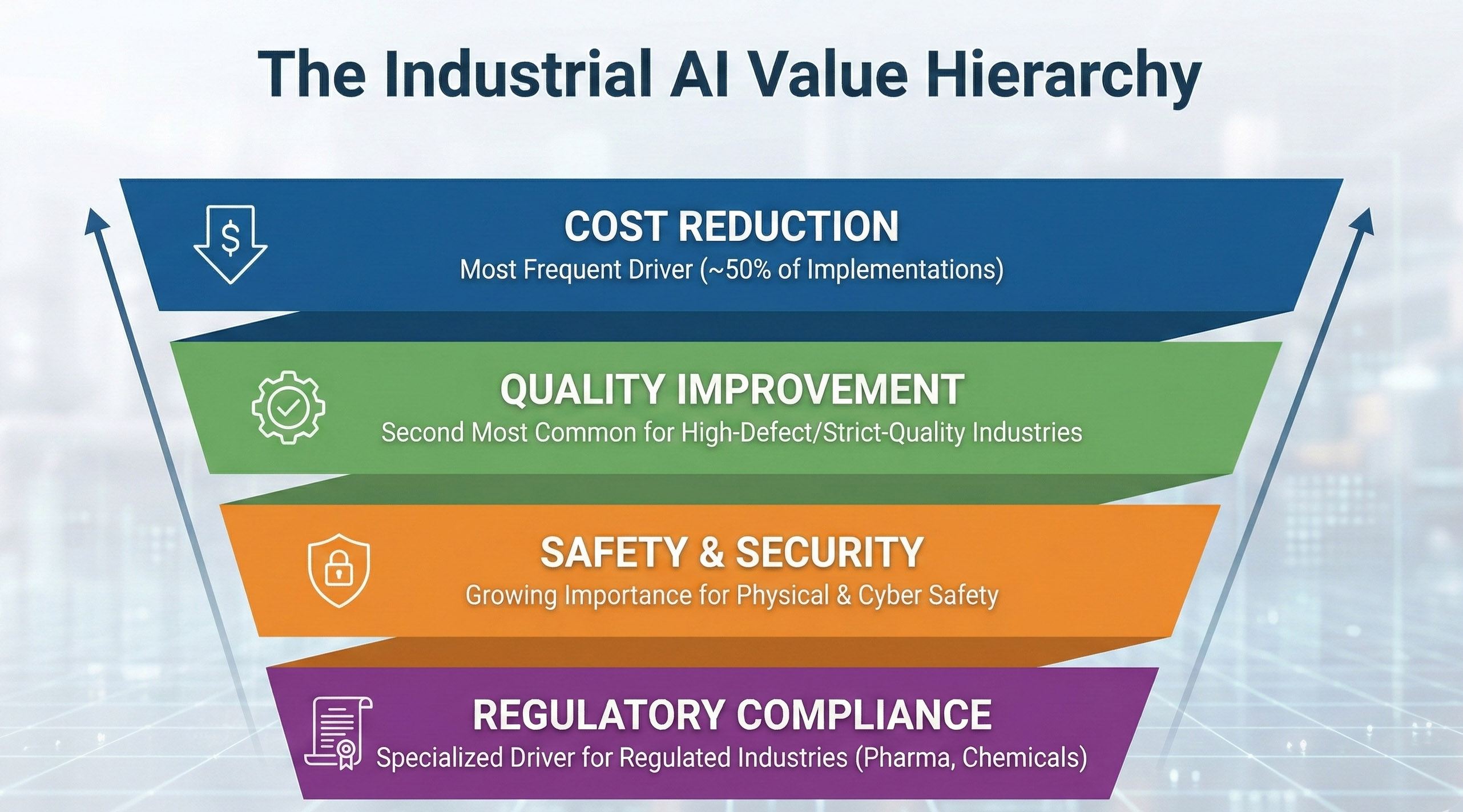
Not all AI benefits are created equal, at least not in terms of how frequently they drive implementation decisions. When you examine where manufacturers are actually investing in industrial AI, a clear hierarchy emerges:
Cost Reduction: The most frequently targeted benefit, driving roughly half of all industrial AI implementations
Quality Improvement: The second most common driver, particularly in industries with high defect costs or stringent quality requirements
Safety & Security: Increasingly important as both physical and cyber safety concerns grow in connected manufacturing environments
Regulatory Compliance: A specialized but growing driver, particularly in pharmaceuticals, chemicals, and other regulated industries
What's notable is that many successful implementations deliver multiple benefits simultaneously. A predictive maintenance system that prevents unplanned downtime delivers cost reduction, but it may also prevent safety incidents and support regulatory compliance through better documentation. The best industrial AI strategies recognize these overlapping value streams.
Cost Reduction: The Primary ROI Driver
Cost reduction remains the dominant value proposition for industrial AI, and for good reason: it's the easiest to quantify, the fastest to realize, and the most directly tied to bottom-line impact. The most successful cost-focused AI implementations target specific, measurable cost pools: unplanned downtime, energy consumption, labor inefficiency, and waste.
Predictive Maintenance: The Clearest ROI Case
Avoiding 24+ Hours of Unplanned Downtime
Predictive maintenance consistently delivers the most straightforward industrial AI ROI. The math is simple: unplanned downtime is expensive, often dramatically more expensive than planned maintenance. AI that predicts failures before they occur converts costly emergency repairs into scheduled maintenance events.
In continuous process industries, for example, a single prevented failure can justify an entire predictive maintenance investment. These implementations demonstrate why maintenance-focused AI has the highest deployment success rates across industrial AI categories.
From Reactive to Proactive Maintenance
Food and beverage manufacturers have faced chronic challenges with unplanned production line stops. By deploying AI-powered predictive maintenance platforms, they fundamentally shift maintenance strategy from reactive to proactive. Systems monitor vibration signatures across production equipment, providing advance warning of developing issues.
The ROI comes from three sources: reduced emergency repair costs, fewer production losses from unplanned stops, and better spare parts inventory management when maintenance can be planned in advance.
Energy Optimization: Reducing the Largest Variable Cost
For energy-intensive industries, chemicals, metals, industrial gases, cement, energy often represents the largest controllable cost. AI-driven process optimization can deliver significant savings by fine-tuning operations in ways human operators can't match.
Reinforcement Learning for Industrial Gas Plants
Industrial gas producers are deploying AI control systems based on reinforcement learning to optimize their plants. These systems continuously learn from process data and adjust control parameters to minimize energy consumption while maintaining production targets. In air separation and other energy-intensive gas production processes, even small percentage improvements in energy efficiency translate to substantial cost savings.
What makes these implementations notable is that the AI systems also reduce the tuning effort typically required to optimize complex control systems, a secondary cost benefit that multiplies across global plant networks.
Labor Efficiency: Automating High-Cost Manual Processes
AI-Optimized Technician Assignment
HVAC and field service companies face significant inefficiencies in technician assignments due to manual scheduling processes. AI-powered recommendation engines automate technician assignment using natural language processing to understand job requirements, GPS data for routing optimization, and learning-to-rank algorithms to match technicians to jobs based on skills and availability.
This results in more jobs completed per technician per day, and better customer satisfaction through appropriate skill matching. For field service organizations, this kind of AI-driven scheduling optimization often delivers ROI within months.
Document Processing: From Hours to Minutes
Global pharmaceutical companies need to regularly share documents with external parties while protecting confidential information. Manual redaction is time-consuming and error-prone. By implementing AI-powered document processing using OCR and natural language processing, manufacturers automate the redaction process, reducing what previously took hours of skilled labor to minutes of automated processing.
Quality Improvement & Scrap Reduction
Quality-focused AI implementations represent the second-largest category of industrial AI value creation. The ROI case differs from cost reduction: rather than preventing costs, quality AI prevents value destruction, catching defects before they reach customers, reducing scrap, and ensuring products meet specifications.
Automated Visual Inspection: Exceeding Human Accuracy
Computer vision for quality inspection has matured significantly. Modern AI-based inspection systems don't just match human inspection accuracy, they exceed it, while operating continuously without fatigue or attention lapses.
Deep Learning for Assembly Line Inspection
Traditional rule-based AOI systems suffered from high false positive rates, flagging acceptable products as defective, requiring manual review, and slowing production. Deep learning models dramatically reduced false positives while maintaining (or improving) defect detection rates.
The ROI comes from multiple sources: reduced manual re-inspection labor, faster production throughput, fewer good products rejected, and better actual defect detection protecting brand quality.
AI-Powered Product Sorting
Food processing facilities utilize AI-driven optical sorting systems that identify and remove defective products at high speed, something that would require enormous labor for manual sorting. The result is consistent product quality that commands premium pricing, with processing efficiency that makes the economics work for commodity products.
Process Optimization for Quality Consistency
Golden Batch Profiling
Petrochemical manufacturers deploy process optimization solutions to monitor batch operations. Systems track current batches against "Golden Batch Profiles", optimal process trajectories derived from historical best-performing batches. When current batches deviate from optimal profiles, operators receive alerts and guidance to correct course.
The quality ROI: more batches meeting specification on first pass, reduced rework and off-spec product, and better yield from raw materials. In specialty chemicals where product value is high, these quality improvements directly impact margins.
AI-Assisted Error Identification
Automotive manufacturers have integrated large language models into digital production ecosystems to improve quality management. Production engineers use natural language queries to diagnose issues, identify error patterns, and receive troubleshooting recommendations. These systems make specialized quality analysis capabilities accessible to frontline workers who previously would have needed data science support.
The quality ROI is harder to quantify but no less real: faster problem identification means fewer defective vehicles, and pattern recognition across production data helps identify systemic quality issues before they affect large production runs.
Safety & Security: Protecting People and Assets
Safety-focused AI implementations have grown significantly as manufacturers recognize that AI can monitor for hazards continuously in ways humans cannot. The ROI case for safety AI is different, it's often about avoiding catastrophic costs (injuries, environmental incidents, cyber breaches) rather than generating incremental savings.
Physical Safety Monitoring
AI Video Analytics for Refinery Safety
Petroleum refineries have implemented AI-powered video analytics. These systems apply multi-dimensional AI algorithms to existing CCTV feeds to automatically detect safety violations, unauthorized access, and potential hazards. Unlike human security monitoring, the AI system watches all cameras continuously and doesn't suffer from attention fatigue.
In refinery environments where a safety incident can have catastrophic consequences, the ROI calculation includes avoided injuries, prevented environmental releases, and reduced insurance and regulatory costs, benefits that can dwarf the implementation investment.
Continuous Leak Detection
Chemical manufacturers have deployed AI and IoT solutions for detecting potential containment leaks in production environments. Using video analytics and machine learning, these systems monitor for visual indicators of leaks in real-time. The implementations support zero safety-related incident goals, by detecting potential problems before they become incidents.
The safety ROI extends beyond incident prevention: continuous AI monitoring demonstrates due diligence for regulatory purposes and can reduce insurance premiums in high-hazard industries.
Cybersecurity: Protecting Connected Operations
As manufacturing becomes more connected through IIoT, the attack surface expands. AI-powered cybersecurity has become essential infrastructure, particularly for protecting operational technology networks where traditional IT security tools struggle.
Protecting IP Across Global Operations
Global specialty chemicals manufacturers have deployed AI-powered network detection across operations in 50+ countries. These systems use machine learning to monitor network metadata, logs, and cloud events for signs of intrusion or data exfiltration. For companies whose competitive advantage depends on proprietary formulations and processes, protecting that intellectual property is an existential concern.
Regulatory Compliance: AI as a Compliance Tool
Compliance-driven AI implementations are the smallest category but growing rapidly, particularly in pharmaceuticals, chemicals, food production, and other regulated industries. The ROI case is often about risk avoidance (regulatory penalties, warning letters, consent decrees) combined with efficiency gains in compliance processes.
Automated Documentation and Traceability
AI for Production and Financial Compliance
Tobacco manufacturers implement AI automation for production and financial processes, automating tasks including raw material tracking, recipe management, and material costing. Where regulatory traceability requirements are extensive, AI automation ensures consistent documentation while reducing the manual effort required for compliance.
Vision Analytics for Quality Documentation
Plastic manufacturers have deployed AI and vision analytics to optimize manufacturing processes. Beyond the operational benefits, these systems provide automated quality documentation, creating records that support regulatory compliance and customer quality requirements without manual data entry.
The Power of Multi-Benefit Implementations
The most compelling industrial AI ROI often comes from implementations that deliver multiple benefit categories simultaneously. When a single system reduces costs AND improves quality AND enhances safety, the combined ROI case becomes significantly stronger.
Conclusion
Industrial AI ROI isn't mysterious, it flows from the same value drivers that have always mattered in manufacturing: controlling costs, ensuring quality, protecting safety, and maintaining compliance. What AI brings is the ability to address these drivers with unprecedented speed, scale, and consistency.
The manufacturers getting real returns from AI aren't chasing technology for its own sake. They're identifying specific, measurable business problems, excessive downtime, defect rates, energy costs, safety incidents, and applying AI as a tool to solve them. The technology matters less than the problem definition: when the problem is clear and measurable, the ROI case builds itself.
Get the newsletter
Industrial data & AI architecture guides, implementation tutorials and use-case blueprints, delivered as they’re published.
More articles
All articles →

The leading IIoT & AI educational platform for digital manufacturing teams