December 18, 2025

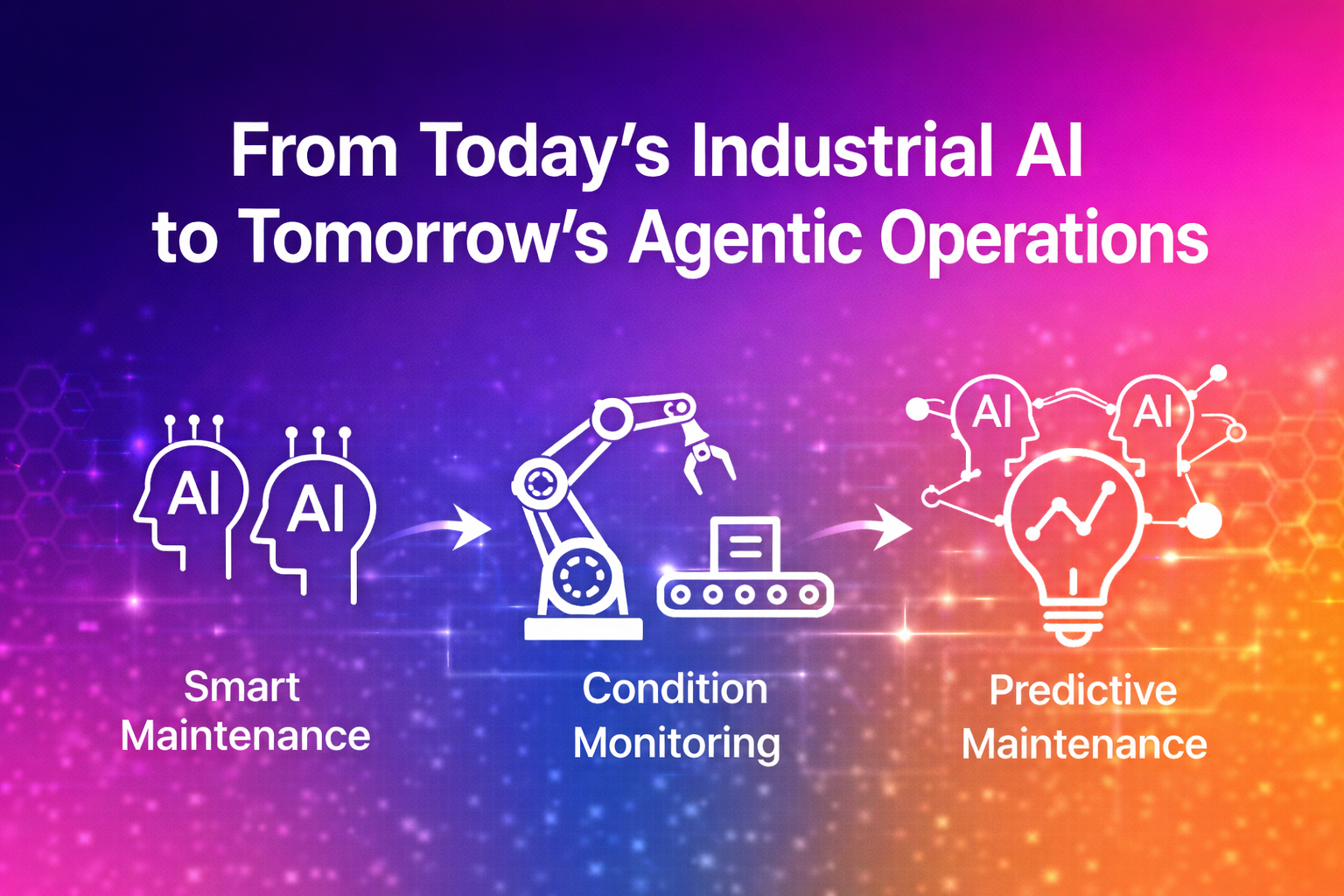
The industrial AI landscape today is populated by point solutions: a predictive maintenance system here, a quality inspection model there, an energy optimization algorithm somewhere else. Each solves a specific problem. Each operates in isolation. Each requires human orchestration to coordinate with other systems and decisions.
But look closer at these implementations and you'll see something else: the building blocks of a more autonomous future. The predictive maintenance system that alerts operators to impending failures is one step away from a Maintenance Scheduler Agent that automatically coordinates repairs, orders parts, and optimizes maintenance windows. The quality inspection system is a proto-Quality Guardian that could autonomously adjust upstream processes to prevent defects.
This article examines how today's industrial AI implementations map to tomorrow's agentic architecture, where specialized AI agents collaborate to optimize operations with minimal human intervention. We'll trace the evolutionary path from current point solutions to future autonomous systems, and identify the patterns that indicate where the first industrial agents will emerge.
Today's Point Solutions Are Tomorrow's Agents
Every deployed industrial AI system today can be understood as a proto-agent, a specialized capability that, with additional autonomy and coordination abilities, becomes an agent in a larger intelligent system. Let's trace three common implementation patterns to their agentic futures.
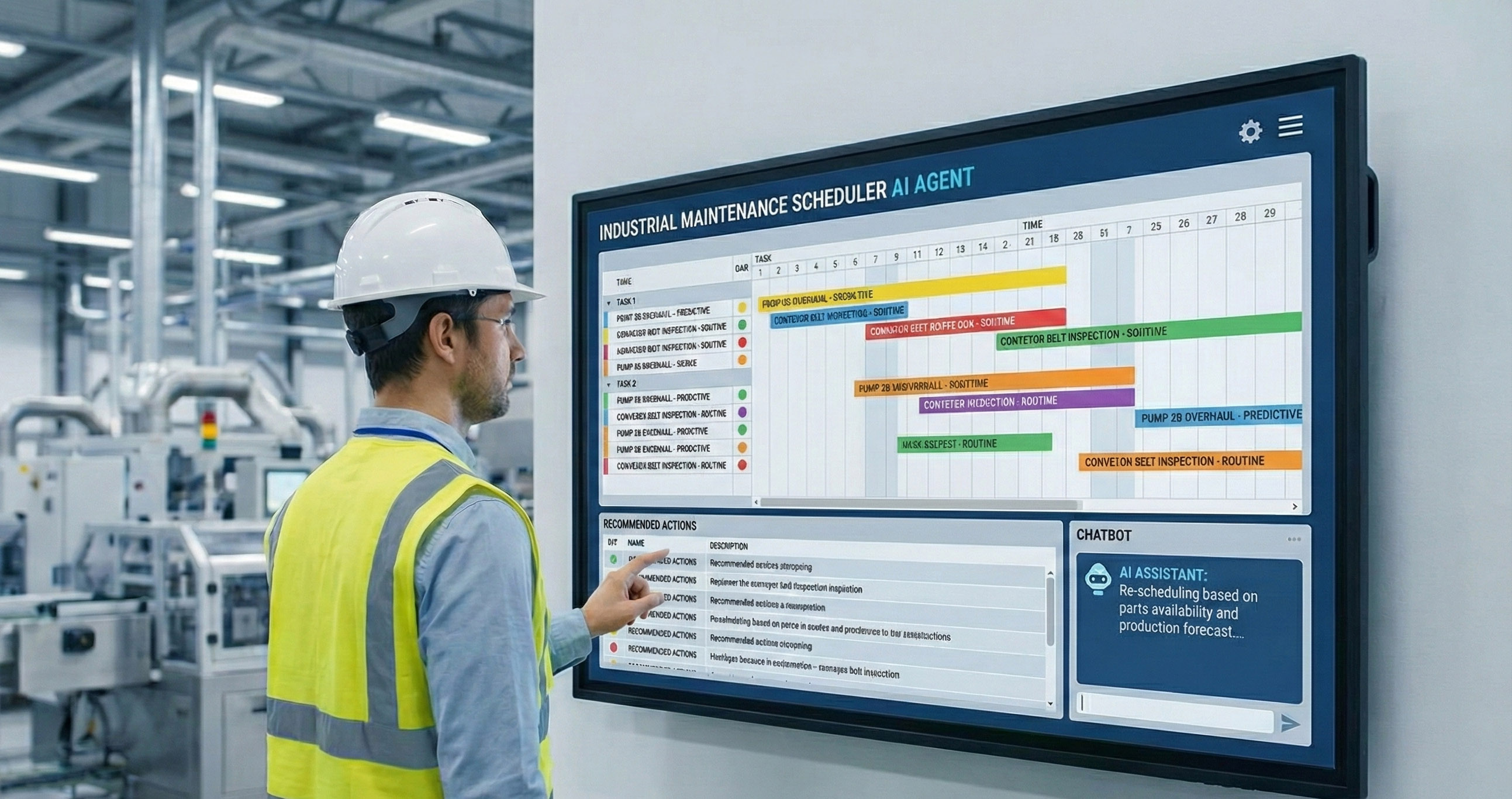
The Maintenance Scheduler Agent
Today's Reality: Predictive Maintenance Systems
Predictive maintenance (PdM) is one of the most mature industrial AI applications. Companies across industries have deployed systems that monitor equipment health, detect anomalies, and predict failures before they occur. These systems generate alerts that human maintenance planners then translate into work orders, spare parts requests, and scheduled downtime.
From Alert to Action
Manufacturers' PdM systems detect anomalies on production lines, avoiding hours of unplanned downtime. But consider the human steps that follow the alert: someone evaluates the alert severity, checks production schedules, coordinates with maintenance teams, verifies parts availability, and schedules the repair window. Each of these steps is a decision that could be automated.
Tomorrow's Agent: The Maintenance Scheduler
A Maintenance Scheduler Agent would receive the same anomaly detection signals, but then:
- Query the ERP system for spare parts availability and lead times
- Check production schedules for optimal maintenance windows
- Coordinate with a Production Planning Agent to minimize output impact
- Generate and dispatch work orders to maintenance teams
- Track repair completion and update asset health models
The core predictive capability already exists. What's missing is the authority, integration, and coordination logic to act autonomously.
The Quality Monitoring Agent
Today's Reality: Automated Inspection Systems
Automated optical inspection (AOI) has become mainstream in manufacturing. Electronics manufacturers, food processors, and aerospace companies use deep learning and computer vision to detect defects at production speeds no human inspector could match. But these systems operate as sophisticated sensors, they detect and classify, then pass the information to humans who decide what to do.
Detection Without Direction
GPU-powered AOI systems detect defects with accuracy exceeding traditional rule-based inspection. They use synthetic data generation to train models on defect patterns. But when a defect is detected, the system flags it for human review. When defect rates increase, humans must investigate root causes and adjust upstream processes.
Tomorrow's Agent: The Quality Monitor
A Quality Monitoring Agent would use the same detection capabilities, but then:
- Correlate defect patterns with upstream process parameters
- Identify root causes by querying Process Control Agents for recent parameter changes
- Recommend (or directly implement) process adjustments to reduce defects
- Negotiate with Production Agents about acceptable quality-throughput tradeoffs
- Escalate to human supervisors only for novel patterns outside its training
The perception capability is mature. The agency, the ability to act on what it perceives, is the next frontier.
The Energy Optimization Agent
Today's Reality: Process Control Optimization
A handful of advanced implementations have already crossed into autonomous territory. The reinforcement learning systems deployed by chemical manufacturers and industrial gas producers don't just recommend control actions, they execute them directly, optimizing processes in real-time without human intervention.
The Agent That Already Exists
Process control vendors and chemical manufacturers have deployed reinforcement learning systems that autonomously controlled chemical plants for entire years. These systems adjust process parameters in real-time, adapt to seasonal changes, and maintain operation through maintenance periods. This isn't a proto-agent, it's an actual autonomous agent operating in production.
Tomorrow's Evolution: The Coordinated Energy Agent
Current systems optimize within their process units. The next evolution is coordination:
- Negotiate with grid-level energy agents for optimal power purchasing
- Coordinate with upstream and downstream process agents to optimize plant-wide energy use
- Balance production targets against energy costs in real-time
- Integrate with carbon accounting systems to optimize emissions alongside efficiency
Autonomous control exists. The multi-agent coordination is the next step.
GenAI Assistants: The Agent-Orchestrators
While specialized AI systems become specialized agents, today's generative AI assistants are evolving toward a different role: orchestration. These systems already serve as natural language interfaces between humans and complex industrial data. With additional capabilities, they become the orchestration layer that coordinates specialized agents.
From Assistants to Orchestrators
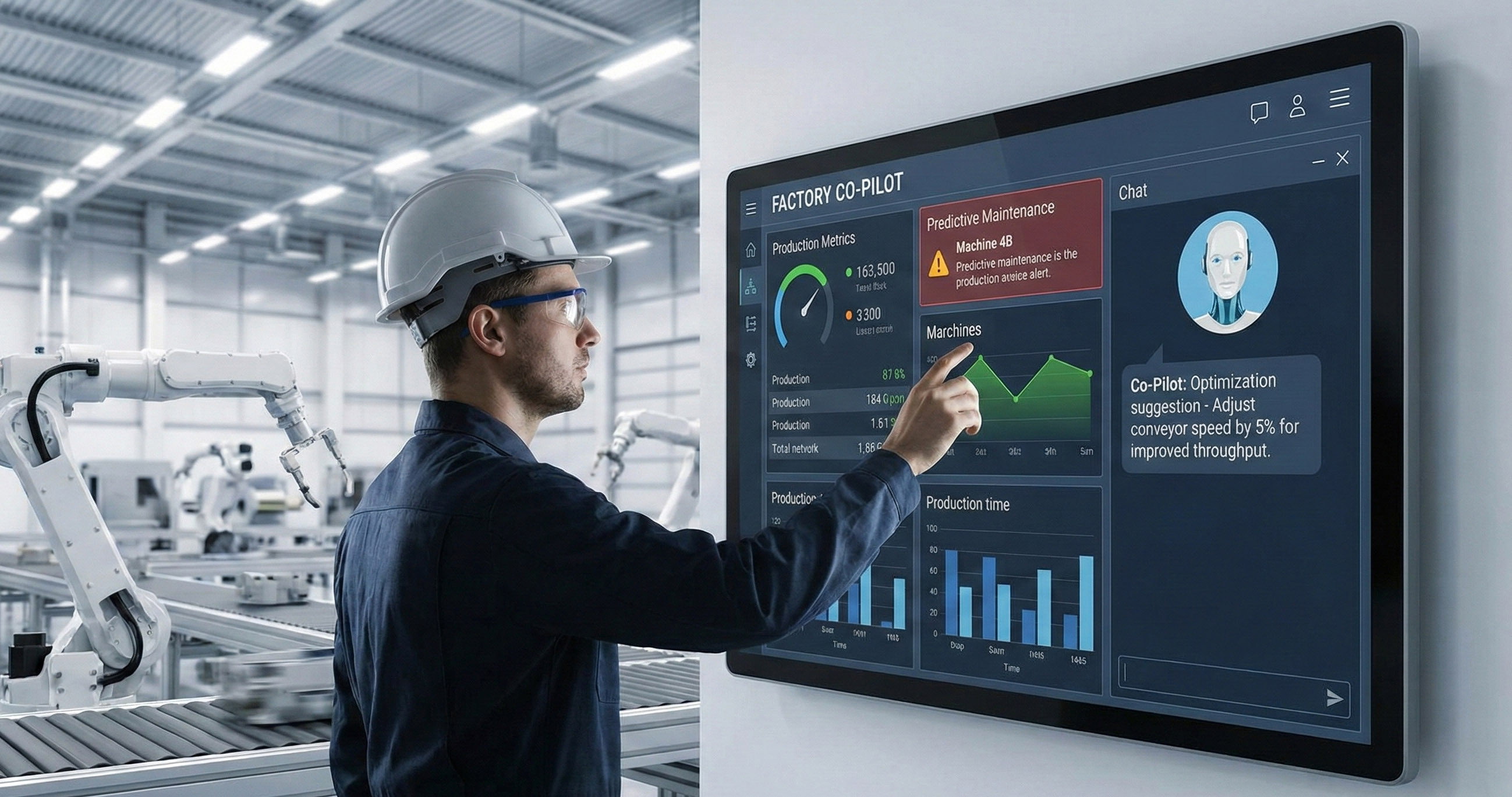
Factory CoPilot
Some manufacturers have deployed factory copilots, AI-driven natural language interfaces using LLMs that make plant data accessible from shop floor to executives. Today, engineers query the system for insights; the system retrieves, contextualizes, and presents information. It's an interface layer.
But consider what this system already does: it understands natural language intent, translates that into data queries, contextualizes results for different stakeholders, and presents actionable information. These are the core capabilities of an orchestration agent, one that understands high-level goals and coordinates resources to achieve them.
Industrial Copilot
Industrial copilots from automation vendors go further, they generate PLC code from natural language input. An engineer describes what they want to achieve; the system generates working automation logic. This is code generation, but it's also planning: the system must understand the goal, select appropriate control strategies, and generate implementation.
The path to orchestration is clear: instead of generating code for human review, the system could directly instruct specialized agents (process control, robotics, quality) to achieve the described outcome, monitoring results and adjusting as needed.
SOP-Interfacing Co-Pilot
Pharmaceutical packaging manufacturers' co-pilots are trained on 200+ standard operating procedures. Operators query them for guidance on procedures, troubleshooting, and quality requirements. The system knows how things should be done.
An orchestration agent built on this foundation wouldn't just explain procedures, it would verify that specialized agents are following them, detect deviations, and coordinate corrections. The SOP knowledge becomes the governance layer for autonomous operations.
Where Industrial AI Agents Will Emerge First
Not all industrial AI applications are equally close to becoming agents. Examining the patterns in current implementations reveals where the first true industrial agents are likely to emerge.
Pattern 1: Logistics and Scheduling
Logistics applications already exhibit agent-like characteristics. Systems for warehouse robotics, autonomous guided vehicles, and dynamic routing make real-time decisions about resource allocation without human intervention for each decision.
Warehouse robotics: Advanced systems already coordinate thousands of robots in warehouse operations, making millions of micro-decisions about routing and task assignment.
Autonomous guided vehicles: GPU-powered AGVs navigate dynamic factory environments, coordinating with each other and the production schedule.
Dynamic routing: Optimization systems make real-time decisions about delivery sequences based on traffic, weather, and package priorities.
Prediction: Logistics Coordinator Agents will be among the first to achieve full autonomy, coordinating warehouse operations, fleet movements, and inventory positioning across entire supply networks.
Pattern 2: Security and Threat Response
Cybersecurity is inherently an agent problem, threats emerge continuously, response time is critical, and the volume of potential incidents exceeds human processing capacity. Current implementations already automate detection AND response.
Cyber threat detection: Systems use unsupervised learning to detect threats and can autonomously contain them by isolating affected network segments, detection and response in a single system.
Physical security: AI video analytics monitors for physical security threats and safety violations, automatically alerting response teams when threats are detected.
Prediction: Security Sentinel Agents will emerge that coordinate cyber defense, physical security, and safety monitoring, recognizing that threats in connected manufacturing environments cross these traditional boundaries.
Pattern 3: High Use-Case Density Industries
Industries where manufacturers deploy multiple AI use cases simultaneously are natural environments for multi-agent coordination. When a single facility has predictive maintenance, quality inspection, energy optimization, and logistics AI, the coordination overhead becomes significant, and the opportunity for agent-to-agent coordination becomes compelling.
The industries with highest use-case diversity, machinery manufacturing, mining, electronics, and automotive, are where we should expect multi-agent industrial systems to emerge first. These environments have the complexity that demands coordination and the AI investment that provides the building blocks.
Conclusion
For manufacturing leaders, the strategic implication is clear: the AI investments you make today should be designed with agency in mind. Systems should be built to not just generate insights but to take actions. Integration architectures should enable AI-to-AI communication, not just AI-to-human reporting. Governance frameworks should be embedded in system design, not bolted on later.

Kudzai Manditereza is an Industry4.0 technology evangelist and creator of Industry40.tv, an independent media and education platform focused on industrial data and AI for smart manufacturing. He specializes in Industrial AI, IIoT, Unified Namespace, Digital Twins, and Industrial DataOps, helping digital manufacturing leaders implement and scale AI initiatives.
Kudzai hosts the AI in Manufacturing podcast and writes the Smart Factory Playbook newsletter, where he shares practical guidance on building the data backbone that makes industrial AI work in real-world manufacturing environments. He currently serves as Senior Industry Solutions Advocate at HiveMQ.
Stay up to date on the latest industry4.0 trends
Connect Online
.svg)
.svg)

